

3.3 Solutions
221
= [(1 − 0)(1 + 0 + 1)]
1/2
|1 >=
√
2|1 >
J +
3 >= [[1 − (−1)](1 − 1 + 1)]
1
2
2 >=
√
2 |2 >
J − |1 >= [( j + m)( j − m + 1)]
1/2
|2 >
= [(1 + 1)(1 − 1 + 1)]
1/2
|2 >=
√
2 |2 >
J − |2 >=
√
2 |3 >
J − |3 >= 0
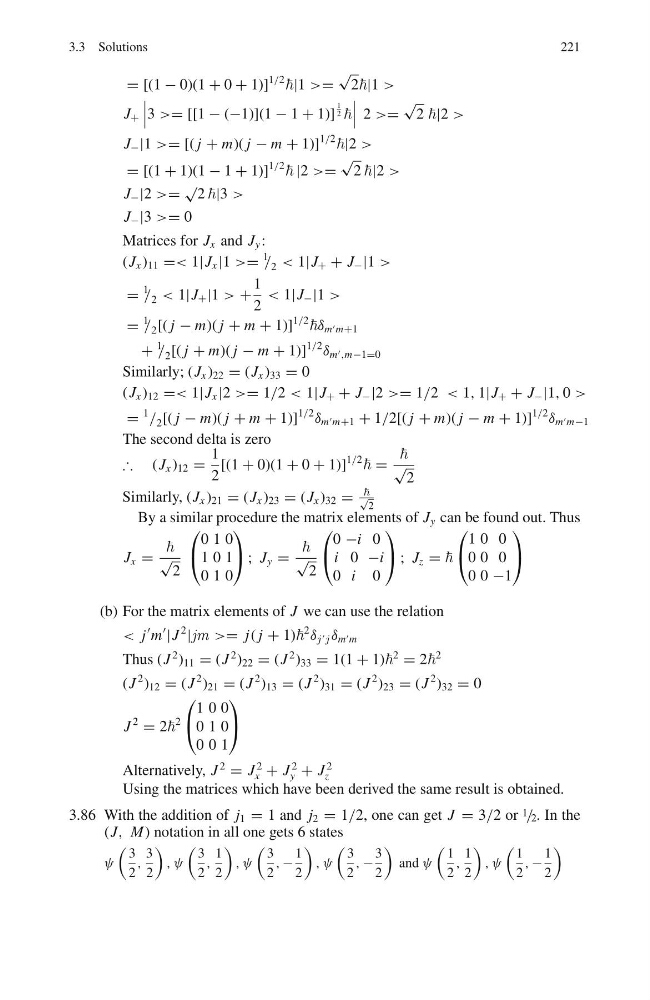
Matrices for J x and J y :
(J x ) 11 =< 1|J x |1 >=
1
/ 2 < 1|J + + J − |1 >
=
1
/ 2 < 1|J + |1 > +
1
2
< 1|J − |1 >
=
1
/ 2 [( j − m)( j + m + 1)]
1/2
δ m m+1
+
1
/ 2 [( j + m)( j − m + 1)]
1/2
δ m ,m−1=0
Similarly; (J x ) 22 = (J x ) 33 = 0
(J x ) 12 =< 1|J x |2 >= 1/2 < 1|J + + J − |2 >= 1/2 < 1, 1|J + + J − |1, 0 >
=
1
/ 2 [( j − m)( j + m + 1)]
1/2
δ m m+1 + 1/2[( j + m)( j − m + 1)]
1/2
δ m m−1
The second delta is zero
∴ (J x ) 12 =
1
2
[(1 + 0)(1 + 0 + 1)]
1/2
=
√
2
Similarly, (J x ) 21 = (J x ) 23 = (J x ) 32 =
√
2
By a similar procedure the matrix elements of J y can be found out. Thus
J x =
√
2
⎛
⎝
0 1 0
1 0 1
0 1 0
⎞
⎠ ; J y =
√
2
⎛
⎝
0 −i 0
i 0 −i
0 i 0
⎞
⎠ ; J z =
⎛
⎝
1 0 0
0 0 0
0 0 −1
⎞
⎠
(b) For the matrix elements of J we can use the relation
< j
m
|J
2
|jm >= j( j + 1)
2
δ j j δ m m
Thus (J
2 ) 11 = (J
2 ) 22 = (J
2 ) 33 = 1(1 + 1)
2
= 2
2
(J
2 ) 12 = (J
2 ) 21 = (J
2 ) 13 = (J
2 ) 31 = (J
2 ) 23 = (J
2 ) 32 = 0
J
2
= 2
2
⎛
⎝
1 0 0
0 1 0
0 0 1
⎞
⎠
Alternatively, J
2
= J
2
x + J
2
y + J
2
z
Using the matrices which have been derived the same result is obtained.
3.86 With the addition of j 1 = 1 and j 2 = 1/2, one can get J = 3/2 or 1 / 2 . In the
(J, M) notation in all one gets 6 states
ψ
3
2
,
3
2
, ψ
3
2
,
1
2
, ψ
3
2
, −
1
2
, ψ
3
2
, −
3
2
and ψ
1
2
,
1
2
, ψ
1
2
, −
1
2
221
= [(1 − 0)(1 + 0 + 1)]
1/2
|1 >=
√
2|1 >
J +
3 >= [[1 − (−1)](1 − 1 + 1)]
1
2
2 >=
√
2 |2 >
J − |1 >= [( j + m)( j − m + 1)]
1/2
|2 >
= [(1 + 1)(1 − 1 + 1)]
1/2
|2 >=
√
2 |2 >
J − |2 >=
√
2 |3 >
J − |3 >= 0
Matrices for J x and J y :
(J x ) 11 =< 1|J x |1 >=
1
/ 2 < 1|J + + J − |1 >
=
1
/ 2 < 1|J + |1 > +
1
2
< 1|J − |1 >
=
1
/ 2 [( j − m)( j + m + 1)]
1/2
δ m m+1
+
1
/ 2 [( j + m)( j − m + 1)]
1/2
δ m ,m−1=0
Similarly; (J x ) 22 = (J x ) 33 = 0
(J x ) 12 =< 1|J x |2 >= 1/2 < 1|J + + J − |2 >= 1/2 < 1, 1|J + + J − |1, 0 >
=
1
/ 2 [( j − m)( j + m + 1)]
1/2
δ m m+1 + 1/2[( j + m)( j − m + 1)]
1/2
δ m m−1
The second delta is zero
∴ (J x ) 12 =
1
2
[(1 + 0)(1 + 0 + 1)]
1/2
=
√
2
Similarly, (J x ) 21 = (J x ) 23 = (J x ) 32 =
√
2
By a similar procedure the matrix elements of J y can be found out. Thus
J x =
√
2
⎛
⎝
0 1 0
1 0 1
0 1 0
⎞
⎠ ; J y =
√
2
⎛
⎝
0 −i 0
i 0 −i
0 i 0
⎞
⎠ ; J z =
⎛
⎝
1 0 0
0 0 0
0 0 −1
⎞
⎠
(b) For the matrix elements of J we can use the relation
< j
m
|J
2
|jm >= j( j + 1)
2
δ j j δ m m
Thus (J
2 ) 11 = (J
2 ) 22 = (J
2 ) 33 = 1(1 + 1)
2
= 2
2
(J
2 ) 12 = (J
2 ) 21 = (J
2 ) 13 = (J
2 ) 31 = (J
2 ) 23 = (J
2 ) 32 = 0
J
2
= 2
2
⎛
⎝
1 0 0
0 1 0
0 0 1
⎞
⎠
Alternatively, J
2
= J
2
x + J
2
y + J
2
z
Using the matrices which have been derived the same result is obtained.
3.86 With the addition of j 1 = 1 and j 2 = 1/2, one can get J = 3/2 or 1 / 2 . In the
(J, M) notation in all one gets 6 states
ψ
3
2
,
3
2
, ψ
3
2
,
1
2
, ψ
3
2
, −
1
2
, ψ
3
2
, −
3
2
and ψ
1
2
,
1
2
, ψ
1
2
, −
1
2