

218
3 Quantum Mechanics – II
Now L z g(ϕ) = −i
∂g
∂ϕ
= mg(ϕ)
Thus the z-component of angular momentum is quantized with eigen
value .
3.81 One can do similar calculations for L x and L y as in Problem 3.80 and obtain
L x
i
= sin ϕ
∂
∂θ
+ cot θ cos ϕ
∂
∂ϕ
L y
i
= − cos ϕ
∂
∂θ
+ cot θ sin ϕ
∂
∂ϕ
3.82 Using L
2
= L
2
x + L
2
y + L
2
z , the commutator with total angular momentum
squared can be evaluated
[L
2
, L z ] =
L
2
x + L
2
y + L
2
z , L z
=
L
2
x + L
2
y , L z
= L x [L x , L z ] + [L x , L z ] L x + L y
L y , L z
+
L y , L z
L y
(1)
= −iL x L y − iL y L x + iL y L x + iL x L y = 0
Similarly
L
2
, L x
= [L
2
, L y ] = [L
2
, L] = 0
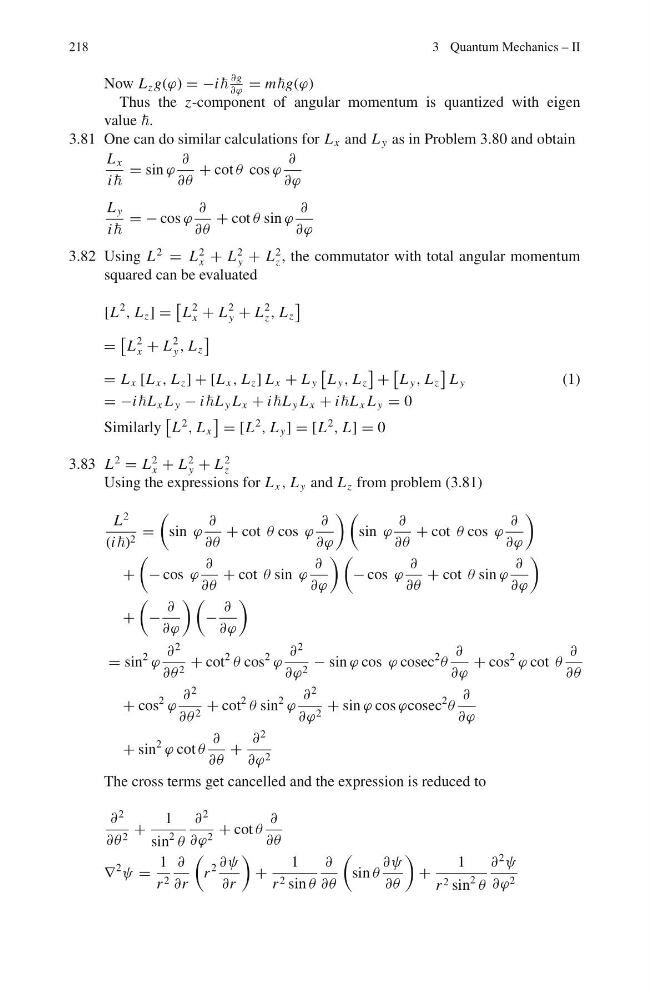
3.83 L
2
= L
2
x + L
2
y + L
2
z
Using the expressions for L x , L y and L z from problem (3.81)
L
2
(i) 2 =
sin ϕ
∂
∂θ
+ cot θ cos ϕ
∂
∂ϕ
sin ϕ
∂
∂θ
+ cot θ cos ϕ
∂
∂ϕ
+
− cos ϕ
∂
∂θ
+ cot θ sin ϕ
∂
∂ϕ
− cos ϕ
∂
∂θ
+ cot θ sin ϕ
∂
∂ϕ
+
−
∂
∂ϕ
−
∂
∂ϕ
= sin
2
ϕ
∂
2
∂θ 2 + cot
2
θ cos
2
ϕ
∂
2
∂ϕ 2 − sin ϕ cos ϕ cosec
2
θ
∂
∂ϕ
+ cos
2
ϕ cot θ
∂
∂θ
+ cos
2
ϕ
∂
2
∂θ 2 + cot
2
θ sin
2
ϕ
∂
2
∂ϕ 2 + sin ϕ cos ϕcosec
2
θ
∂
∂ϕ
+ sin
2
ϕ cot θ
∂
∂θ
+
∂
2
∂ϕ 2
The cross terms get cancelled and the expression is reduced to
∂
2
∂θ 2 +
1
sin
2
θ
∂
2
∂ϕ 2 + cot θ
∂
∂θ
∇
2
ψ =
1
r 2
∂
∂r
r
2 ∂ψ
∂r
+
1
r 2 sin θ
∂
∂θ
sin θ
∂ψ
∂θ
+
1
r 2 sin
2
θ
∂
2
ψ
∂ϕ 2
3 Quantum Mechanics – II
Now L z g(ϕ) = −i
∂g
∂ϕ
= mg(ϕ)
Thus the z-component of angular momentum is quantized with eigen
value .
3.81 One can do similar calculations for L x and L y as in Problem 3.80 and obtain
L x
i
= sin ϕ
∂
∂θ
+ cot θ cos ϕ
∂
∂ϕ
L y
i
= − cos ϕ
∂
∂θ
+ cot θ sin ϕ
∂
∂ϕ
3.82 Using L
2
= L
2
x + L
2
y + L
2
z , the commutator with total angular momentum
squared can be evaluated
[L
2
, L z ] =
L
2
x + L
2
y + L
2
z , L z
=
L
2
x + L
2
y , L z
= L x [L x , L z ] + [L x , L z ] L x + L y
L y , L z
+
L y , L z
L y
(1)
= −iL x L y − iL y L x + iL y L x + iL x L y = 0
Similarly
L
2
, L x
= [L
2
, L y ] = [L
2
, L] = 0
3.83 L
2
= L
2
x + L
2
y + L
2
z
Using the expressions for L x , L y and L z from problem (3.81)
L
2
(i) 2 =
sin ϕ
∂
∂θ
+ cot θ cos ϕ
∂
∂ϕ
sin ϕ
∂
∂θ
+ cot θ cos ϕ
∂
∂ϕ
+
− cos ϕ
∂
∂θ
+ cot θ sin ϕ
∂
∂ϕ
− cos ϕ
∂
∂θ
+ cot θ sin ϕ
∂
∂ϕ
+
−
∂
∂ϕ
−
∂
∂ϕ
= sin
2
ϕ
∂
2
∂θ 2 + cot
2
θ cos
2
ϕ
∂
2
∂ϕ 2 − sin ϕ cos ϕ cosec
2
θ
∂
∂ϕ
+ cos
2
ϕ cot θ
∂
∂θ
+ cos
2
ϕ
∂
2
∂θ 2 + cot
2
θ sin
2
ϕ
∂
2
∂ϕ 2 + sin ϕ cos ϕcosec
2
θ
∂
∂ϕ
+ sin
2
ϕ cot θ
∂
∂θ
+
∂
2
∂ϕ 2
The cross terms get cancelled and the expression is reduced to
∂
2
∂θ 2 +
1
sin
2
θ
∂
2
∂ϕ 2 + cot θ
∂
∂θ
∇
2
ψ =
1
r 2
∂
∂r
r
2 ∂ψ
∂r
+
1
r 2 sin θ
∂
∂θ
sin θ
∂ψ
∂θ
+
1
r 2 sin
2
θ
∂
2
ψ
∂ϕ 2