

3.3 Solutions
217
x = r sin θ cos ϕ
y = r sin θ sin ϕ
(2)
z = r cos θ
r
2
= x
2
+ y
2
+ z
2
(3)
tan
2
θ =
x
2
+ y
2
z 2
(4)
tan ϕ =
y
x
(5)
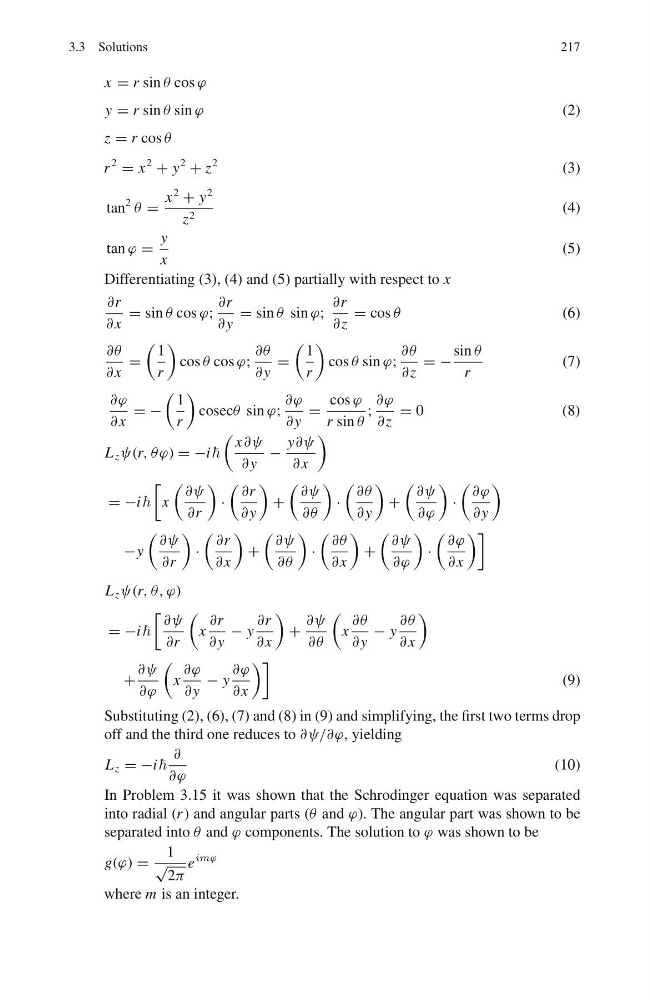
Differentiating (3), (4) and (5) partially with respect to x
∂r
∂ x
= sin θ cos ϕ;
∂r
∂ y
= sin θ sin ϕ;
∂r
∂z
= cos θ
(6)
∂θ
∂ x
=
1
r
cos θ cos ϕ;
∂θ
∂ y
=
1
r
cos θ sin ϕ;
∂θ
∂z
= −
sin θ
r
(7)
∂ϕ
∂ x
= −
1
r
cosecθ sin ϕ;
∂ϕ
∂ y
=
cos ϕ
r sin θ
;
∂ϕ
∂z
= 0
( 8 )
L z ψ(r, θϕ) = −i
x∂ψ
∂ y
−
y∂ψ
∂ x
= −i
x
∂ψ
∂r
·
∂r
∂ y
+
∂ψ
∂θ
·
∂θ
∂ y
+
∂ψ
∂ϕ
·
∂ϕ
∂ y
−y
∂ψ
∂r
·
∂r
∂ x
+
∂ψ
∂θ
·
∂θ
∂ x
+
∂ψ
∂ϕ
·
∂ϕ
∂ x
L z ψ(r, θ, ϕ)
= −i
∂ψ
∂r
x
∂r
∂ y
− y
∂r
∂ x
+
∂ψ
∂θ
x
∂θ
∂ y
− y
∂θ
∂ x
+
∂ψ
∂ϕ
x
∂ϕ
∂ y
− y
∂ϕ
∂ x
(9)
Substituting (2), (6), (7) and (8) in (9) and simplifying, the first two terms drop
off and the third one reduces to ∂ψ/∂ϕ, yielding
L z = −i
∂
∂ϕ
(10)
In Problem 3.15 it was shown that the Schrodinger equation was separated
into radial (r ) and angular parts (θ and ϕ). The angular part was shown to be
separated into θ and ϕ components. The solution to ϕ was shown to be
g(ϕ) =
1
√
2π
e
imϕ
where m is an integer.
217
x = r sin θ cos ϕ
y = r sin θ sin ϕ
(2)
z = r cos θ
r
2
= x
2
+ y
2
+ z
2
(3)
tan
2
θ =
x
2
+ y
2
z 2
(4)
tan ϕ =
y
x
(5)
Differentiating (3), (4) and (5) partially with respect to x
∂r
∂ x
= sin θ cos ϕ;
∂r
∂ y
= sin θ sin ϕ;
∂r
∂z
= cos θ
(6)
∂θ
∂ x
=
1
r
cos θ cos ϕ;
∂θ
∂ y
=
1
r
cos θ sin ϕ;
∂θ
∂z
= −
sin θ
r
(7)
∂ϕ
∂ x
= −
1
r
cosecθ sin ϕ;
∂ϕ
∂ y
=
cos ϕ
r sin θ
;
∂ϕ
∂z
= 0
( 8 )
L z ψ(r, θϕ) = −i
x∂ψ
∂ y
−
y∂ψ
∂ x
= −i
x
∂ψ
∂r
·
∂r
∂ y
+
∂ψ
∂θ
·
∂θ
∂ y
+
∂ψ
∂ϕ
·
∂ϕ
∂ y
−y
∂ψ
∂r
·
∂r
∂ x
+
∂ψ
∂θ
·
∂θ
∂ x
+
∂ψ
∂ϕ
·
∂ϕ
∂ x
L z ψ(r, θ, ϕ)
= −i
∂ψ
∂r
x
∂r
∂ y
− y
∂r
∂ x
+
∂ψ
∂θ
x
∂θ
∂ y
− y
∂θ
∂ x
+
∂ψ
∂ϕ
x
∂ϕ
∂ y
− y
∂ϕ
∂ x
(9)
Substituting (2), (6), (7) and (8) in (9) and simplifying, the first two terms drop
off and the third one reduces to ∂ψ/∂ϕ, yielding
L z = −i
∂
∂ϕ
(10)
In Problem 3.15 it was shown that the Schrodinger equation was separated
into radial (r ) and angular parts (θ and ϕ). The angular part was shown to be
separated into θ and ϕ components. The solution to ϕ was shown to be
g(ϕ) =
1
√
2π
e
imϕ
where m is an integer.