

190
3 Quantum Mechanics – II
ψ 2 = C exp(ik 2 x)
( 5 )
where
k
2
2 =
2m(E − U 0 )
2
(6)
It represents the transmitted wave to the right with reduced amplitude.
Note that the second term is absent in (5) as there is no reflected wave in
the region x > 0.
Case (ii), U 0 > E
Region x < 0
ψ 3 = A exp(ik 1 x) + B exp(−ik 1 x)
( 7 )
Region x > 0
d
2
ψ
dx 2 −
2mψ(U 0 − E)
2
= 0
d
2
ψ
dx 2 − α
2
ψ = 0
ψ 4 = Ce
−αx
+ De
αx
where α
2
=
2m(U 0 −E)
2
ψ must be finite everywhere including at x = −∞. We therefore set
D = 0. The physically accepted solution is then
ψ 4 = Ce
−αx
(8)
(b) The continuity condition on the function and its derivative at x = 0 leads
to Eqs. (9) and (10).
ψ 3 (0) = ψ 4 (0)
A + B = C
(9)
dψ 3
dx
x=0
=
dψ 4
dx
x=0
ik 1 ( A − B) = −Cα
(10)
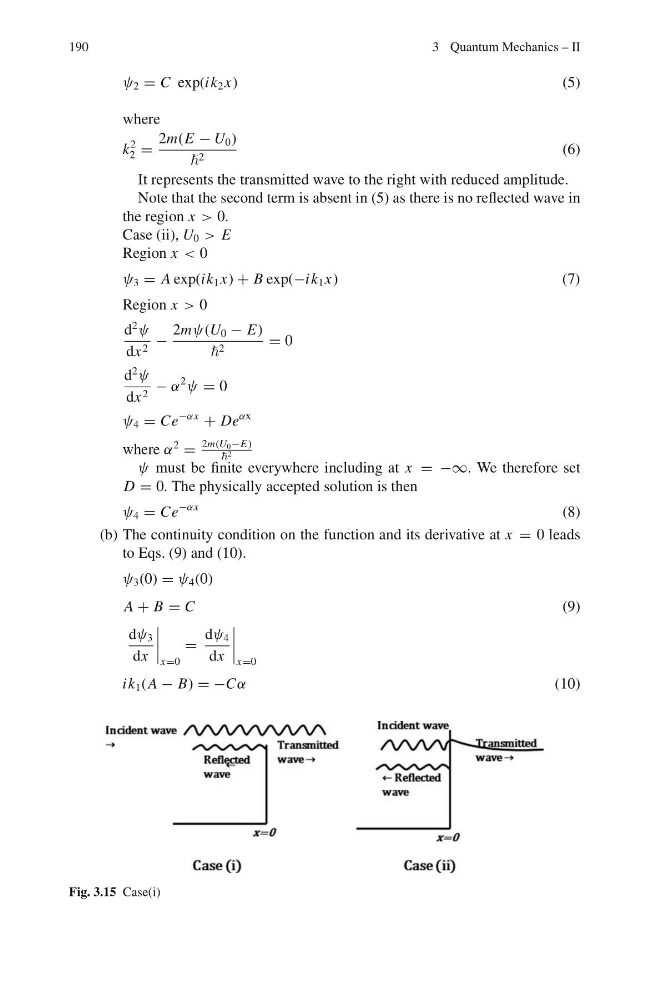
Fig. 3.15 Case(i)
3 Quantum Mechanics – II
ψ 2 = C exp(ik 2 x)
( 5 )
where
k
2
2 =
2m(E − U 0 )
2
(6)
It represents the transmitted wave to the right with reduced amplitude.
Note that the second term is absent in (5) as there is no reflected wave in
the region x > 0.
Case (ii), U 0 > E
Region x < 0
ψ 3 = A exp(ik 1 x) + B exp(−ik 1 x)
( 7 )
Region x > 0
d
2
ψ
dx 2 −
2mψ(U 0 − E)
2
= 0
d
2
ψ
dx 2 − α
2
ψ = 0
ψ 4 = Ce
−αx
+ De
αx
where α
2
=
2m(U 0 −E)
2
ψ must be finite everywhere including at x = −∞. We therefore set
D = 0. The physically accepted solution is then
ψ 4 = Ce
−αx
(8)
(b) The continuity condition on the function and its derivative at x = 0 leads
to Eqs. (9) and (10).
ψ 3 (0) = ψ 4 (0)
A + B = C
(9)
dψ 3
dx
x=0
=
dψ 4
dx
x=0
ik 1 ( A − B) = −Cα
(10)
Fig. 3.15 Case(i)