

3.3 Solutions
189
None of the numbers n x , n y , or n z can be zero, otherwise ψ(x, y, z) itself
will vanish.
For an infinitely deep potential well E n =
h
2
8ma 2
n
2
x + n
2
y + n
2
z
. The combination n x = n y = n z = 0 is ruled out because the wave function will be
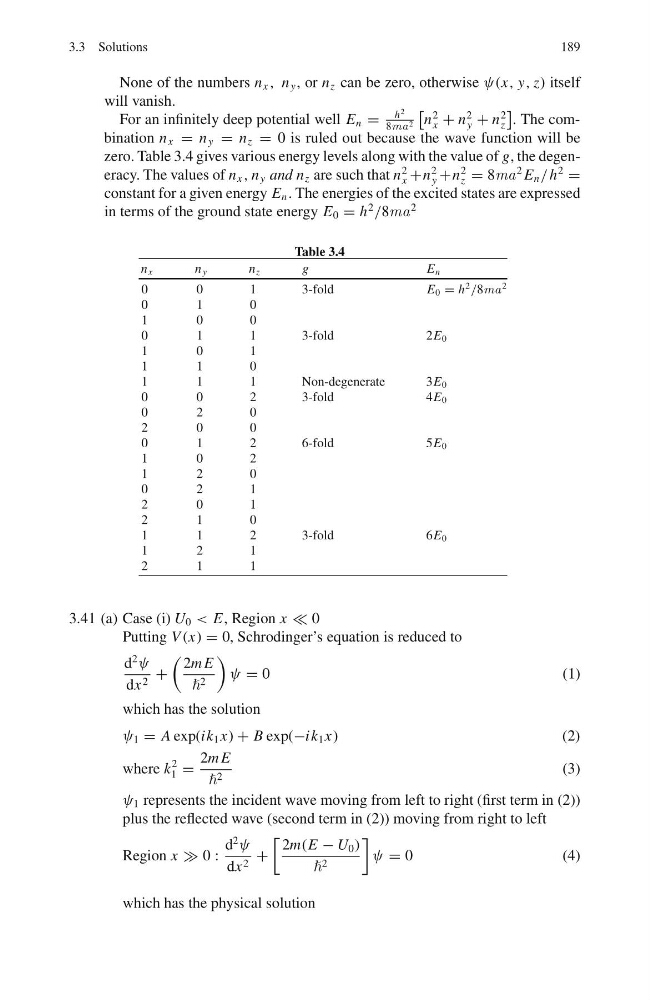
zero. Table 3.4 gives various energy levels along with the value of g, the degeneracy. The values of n x , n y and n z are such that n
2
x +n
2
y +n
2
z = 8ma
2 E n / h
2
=
constant for a given energy E n . The energies of the excited states are expressed
in terms of the ground state energy E 0 = h
2
/8ma
2
Table 3.4
n x
n y
n z
g
E n
0
0
1
3-fold
E 0 = h
2
/8ma
2
0
1
0
1
0
0
0
1
1
3-fold
2E 0
1
0
1
1
1
0
1
1
1
Non-degenerate
3E 0
0
0
2
3-fold
4E 0
0
2
0
2
0
0
0
1
2
6-fold
5E 0
1
0
2
1
2
0
0
2
1
2
0
1
2
1
0
1
1
2
3-fold
6E 0
1
2
1
2
1
1
3.41 (a) Case (i) U 0 < E, Region x 0
Putting V (x) = 0, Schrodinger’s equation is reduced to
d
2
ψ
dx 2 +
2m E
2
ψ = 0
( 1 )
which has the solution
ψ 1 = A exp(ik 1 x) + B exp(−ik 1 x)
( 2 )
where k
2
1 =
2m E
2
(3)
ψ 1 represents the incident wave moving from left to right (first term in (2))
plus the reflected wave (second term in (2)) moving from right to left
Region x 0 :
d
2
ψ
dx 2 +
2m(E − U 0 )
2
ψ = 0
( 4 )
which has the physical solution
189
None of the numbers n x , n y , or n z can be zero, otherwise ψ(x, y, z) itself
will vanish.
For an infinitely deep potential well E n =
h
2
8ma 2
n
2
x + n
2
y + n
2
z
. The combination n x = n y = n z = 0 is ruled out because the wave function will be
zero. Table 3.4 gives various energy levels along with the value of g, the degeneracy. The values of n x , n y and n z are such that n
2
x +n
2
y +n
2
z = 8ma
2 E n / h
2
=
constant for a given energy E n . The energies of the excited states are expressed
in terms of the ground state energy E 0 = h
2
/8ma
2
Table 3.4
n x
n y
n z
g
E n
0
0
1
3-fold
E 0 = h
2
/8ma
2
0
1
0
1
0
0
0
1
1
3-fold
2E 0
1
0
1
1
1
0
1
1
1
Non-degenerate
3E 0
0
0
2
3-fold
4E 0
0
2
0
2
0
0
0
1
2
6-fold
5E 0
1
0
2
1
2
0
0
2
1
2
0
1
2
1
0
1
1
2
3-fold
6E 0
1
2
1
2
1
1
3.41 (a) Case (i) U 0 < E, Region x 0
Putting V (x) = 0, Schrodinger’s equation is reduced to
d
2
ψ
dx 2 +
2m E
2
ψ = 0
( 1 )
which has the solution
ψ 1 = A exp(ik 1 x) + B exp(−ik 1 x)
( 2 )
where k
2
1 =
2m E
2
(3)
ψ 1 represents the incident wave moving from left to right (first term in (2))
plus the reflected wave (second term in (2)) moving from right to left
Region x 0 :
d
2
ψ
dx 2 +
2m(E − U 0 )
2
ψ = 0
( 4 )
which has the physical solution