

3.3 Solutions
163
From the recurrence relation (6)
a 1 = −
a 0
2
Therefore, y(r ) = a 0 r
1 −
r
2
F(r ) = a 0 e
−
r
2 r
1 −
r
2
The normalization constant is given to be 1/
√
2.
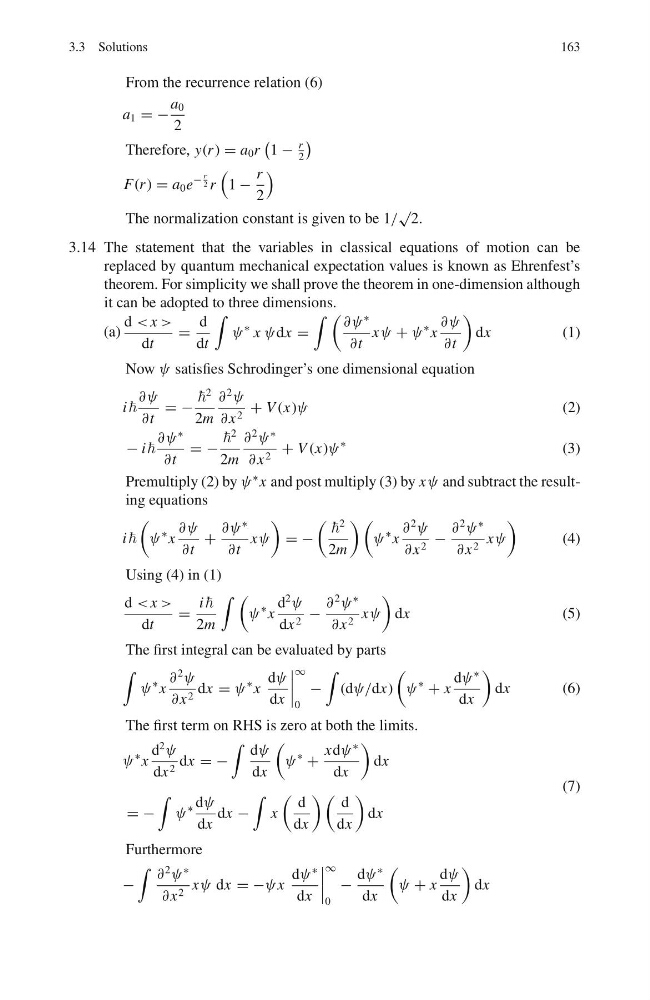
3.14 The statement that the variables in classical equations of motion can be
replaced by quantum mechanical expectation values is known as Ehrenfest’s
theorem. For simplicity we shall prove the theorem in one-dimension although
it can be adopted to three dimensions.
(a)
d < x >
dt
=
d
dt
ψ
∗ x ψdx =
∂ψ
∗
∂t
xψ + ψ
∗ x
∂ψ
∂t
dx
(1)
Now ψ satisfies Schrodinger’s one dimensional equation
i
∂ψ
∂t
= −
2
2m
∂
2
ψ
∂ x 2 + V (x)ψ
(2)
− i
∂ψ
∗
∂t
= −
2
2m
∂
2
ψ
∗
∂ x 2 + V (x)ψ
∗
(3)
Premultiply (2) by ψ
∗ x and post multiply (3) by xψ and subtract the resulting equations
i
ψ
∗ x
∂ψ
∂t
+
∂ψ
∗
∂t
xψ
= −
2
2m
ψ
∗ x
∂
2
ψ
∂ x 2 −
∂
2
ψ
∗
∂ x 2 xψ
(4)
Using (4) in (1)
d < x >
dt
=
i
2m
ψ
∗ x
d
2
ψ
dx 2 −
∂
2
ψ
∗
∂ x 2 xψ
dx
(5)
The first integral can be evaluated by parts
ψ
∗ x
∂
2
ψ
∂ x 2 dx = ψ
∗ x
dψ
dx
∞
0
−
(dψ/dx)
ψ
∗
+ x
dψ
∗
dx
dx
(6)
The first term on RHS is zero at both the limits.
ψ
∗ x
d
2
ψ
dx 2 dx = −
dψ
dx
ψ
∗
+
xdψ
∗
dx
dx
= −
ψ
∗ dψ
dx
dx −
x
d
dx
d
dx
dx
(7)
Furthermore
−
∂
2
ψ
∗
∂ x 2 xψ dx = −ψ x
dψ
∗
dx
∞
0
−
dψ
∗
dx
ψ + x
dψ
dx
dx
163
From the recurrence relation (6)
a 1 = −
a 0
2
Therefore, y(r ) = a 0 r
1 −
r
2
F(r ) = a 0 e
−
r
2 r
1 −
r
2
The normalization constant is given to be 1/
√
2.
3.14 The statement that the variables in classical equations of motion can be
replaced by quantum mechanical expectation values is known as Ehrenfest’s
theorem. For simplicity we shall prove the theorem in one-dimension although
it can be adopted to three dimensions.
(a)
d < x >
dt
=
d
dt
ψ
∗ x ψdx =
∂ψ
∗
∂t
xψ + ψ
∗ x
∂ψ
∂t
dx
(1)
Now ψ satisfies Schrodinger’s one dimensional equation
i
∂ψ
∂t
= −
2
2m
∂
2
ψ
∂ x 2 + V (x)ψ
(2)
− i
∂ψ
∗
∂t
= −
2
2m
∂
2
ψ
∗
∂ x 2 + V (x)ψ
∗
(3)
Premultiply (2) by ψ
∗ x and post multiply (3) by xψ and subtract the resulting equations
i
ψ
∗ x
∂ψ
∂t
+
∂ψ
∗
∂t
xψ
= −
2
2m
ψ
∗ x
∂
2
ψ
∂ x 2 −
∂
2
ψ
∗
∂ x 2 xψ
(4)
Using (4) in (1)
d < x >
dt
=
i
2m
ψ
∗ x
d
2
ψ
dx 2 −
∂
2
ψ
∗
∂ x 2 xψ
dx
(5)
The first integral can be evaluated by parts
ψ
∗ x
∂
2
ψ
∂ x 2 dx = ψ
∗ x
dψ
dx
∞
0
−
(dψ/dx)
ψ
∗
+ x
dψ
∗
dx
dx
(6)
The first term on RHS is zero at both the limits.
ψ
∗ x
d
2
ψ
dx 2 dx = −
dψ
dx
ψ
∗
+
xdψ
∗
dx
dx
= −
ψ
∗ dψ
dx
dx −
x
d
dx
d
dx
dx
(7)
Furthermore
−
∂
2
ψ
∗
∂ x 2 xψ dx = −ψ x
dψ
∗
dx
∞
0
−
dψ
∗
dx
ψ + x
dψ
dx
dx