

3.2 Problems
145
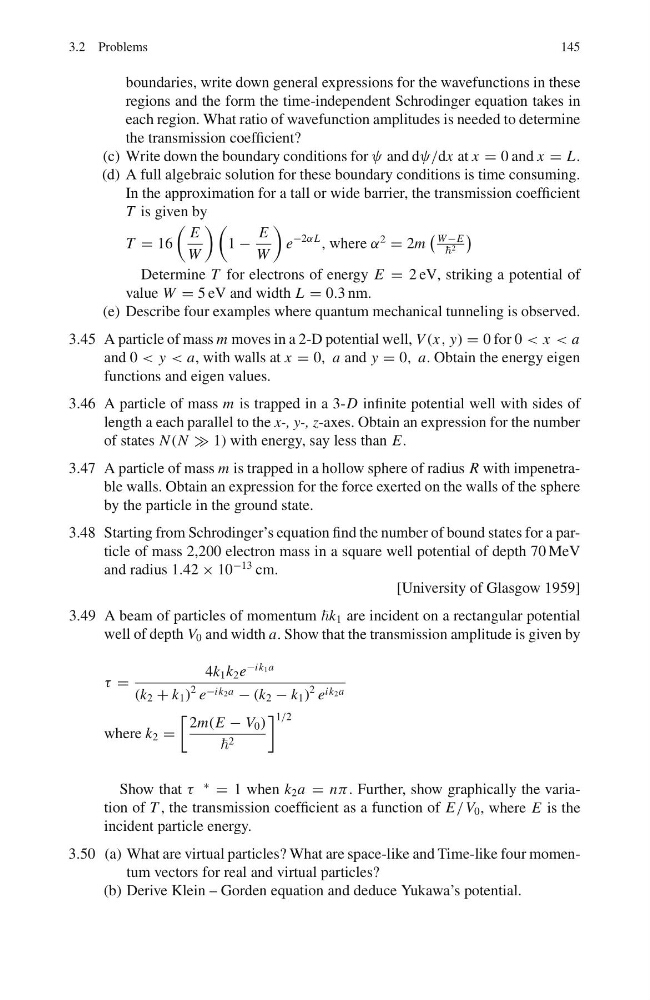
boundaries, write down general expressions for the wavefunctions in these
regions and the form the time-independent Schrodinger equation takes in
each region. What ratio of wavefunction amplitudes is needed to determine
the transmission coefficient?
(c) Write down the boundary conditions for ψ and dψ/dx at x = 0 and x = L.
(d) A full algebraic solution for these boundary conditions is time consuming.
In the approximation for a tall or wide barrier, the transmission coefficient
T is given by
T = 16
E
W
1 −
E
W
e
−2αL , where α
2
= 2m
W −E
2
Determine T for electrons of energy E = 2 eV, striking a potential of
value W = 5 eV and width L = 0.3 nm.
(e) Describe four examples where quantum mechanical tunneling is observed.
3.45 A particle of mass m moves in a 2-D potential well, V (x, y) = 0 for 0 < x < a
and 0 < y < a, with walls at x = 0, a and y = 0, a. Obtain the energy eigen
functions and eigen values.
3.46 A particle of mass m is trapped in a 3-D infinite potential well with sides of
length a each parallel to the x-, y-, z-axes. Obtain an expression for the number
of states N (N 1) with energy, say less than E.
3.47 A particle of mass m is trapped in a hollow sphere of radius R with impenetrable walls. Obtain an expression for the force exerted on the walls of the sphere
by the particle in the ground state.
3.48 Starting from Schrodinger’s equation find the number of bound states for a particle of mass 2,200 electron mass in a square well potential of depth 70 MeV
and radius 1.42 × 10
−13 cm.
[University of Glasgow 1959]
3.49 A beam of particles of momentum k 1 are incident on a rectangular potential
well of depth V 0 and width a. Show that the transmission amplitude is given by
τ =
4k 1 k 2 e
−ik1a
(k 2 + k 1 )
2 e −ik2a − (k 2 − k 1 )
2 e ik2a
where k 2 =
2m(E − V 0 )
2
1/2
Show that τ
∗
= 1 when k 2 a = nπ. Further, show graphically the variation of T , the transmission coefficient as a function of E/V 0 , where E is the
incident particle energy.
3.50 (a) What are virtual particles? What are space-like and Time-like four momentum vectors for real and virtual particles?
(b) Derive Klein – Gorden equation and deduce Yukawa’s potential.
145
boundaries, write down general expressions for the wavefunctions in these
regions and the form the time-independent Schrodinger equation takes in
each region. What ratio of wavefunction amplitudes is needed to determine
the transmission coefficient?
(c) Write down the boundary conditions for ψ and dψ/dx at x = 0 and x = L.
(d) A full algebraic solution for these boundary conditions is time consuming.
In the approximation for a tall or wide barrier, the transmission coefficient
T is given by
T = 16
E
W
1 −
E
W
e
−2αL , where α
2
= 2m
W −E
2
Determine T for electrons of energy E = 2 eV, striking a potential of
value W = 5 eV and width L = 0.3 nm.
(e) Describe four examples where quantum mechanical tunneling is observed.
3.45 A particle of mass m moves in a 2-D potential well, V (x, y) = 0 for 0 < x < a
and 0 < y < a, with walls at x = 0, a and y = 0, a. Obtain the energy eigen
functions and eigen values.
3.46 A particle of mass m is trapped in a 3-D infinite potential well with sides of
length a each parallel to the x-, y-, z-axes. Obtain an expression for the number
of states N (N 1) with energy, say less than E.
3.47 A particle of mass m is trapped in a hollow sphere of radius R with impenetrable walls. Obtain an expression for the force exerted on the walls of the sphere
by the particle in the ground state.
3.48 Starting from Schrodinger’s equation find the number of bound states for a particle of mass 2,200 electron mass in a square well potential of depth 70 MeV
and radius 1.42 × 10
−13 cm.
[University of Glasgow 1959]
3.49 A beam of particles of momentum k 1 are incident on a rectangular potential
well of depth V 0 and width a. Show that the transmission amplitude is given by
τ =
4k 1 k 2 e
−ik1a
(k 2 + k 1 )
2 e −ik2a − (k 2 − k 1 )
2 e ik2a
where k 2 =
2m(E − V 0 )
2
1/2
Show that τ
∗
= 1 when k 2 a = nπ. Further, show graphically the variation of T , the transmission coefficient as a function of E/V 0 , where E is the
incident particle energy.
3.50 (a) What are virtual particles? What are space-like and Time-like four momentum vectors for real and virtual particles?
(b) Derive Klein – Gorden equation and deduce Yukawa’s potential.