

144
3 Quantum Mechanics – II
conditions to sketch the form of ψ(x) in the region around x = 0 for
the cases (i) and (ii).
3.42 A steady stream of particles with energy E(> V 0 ) is incident on a potential
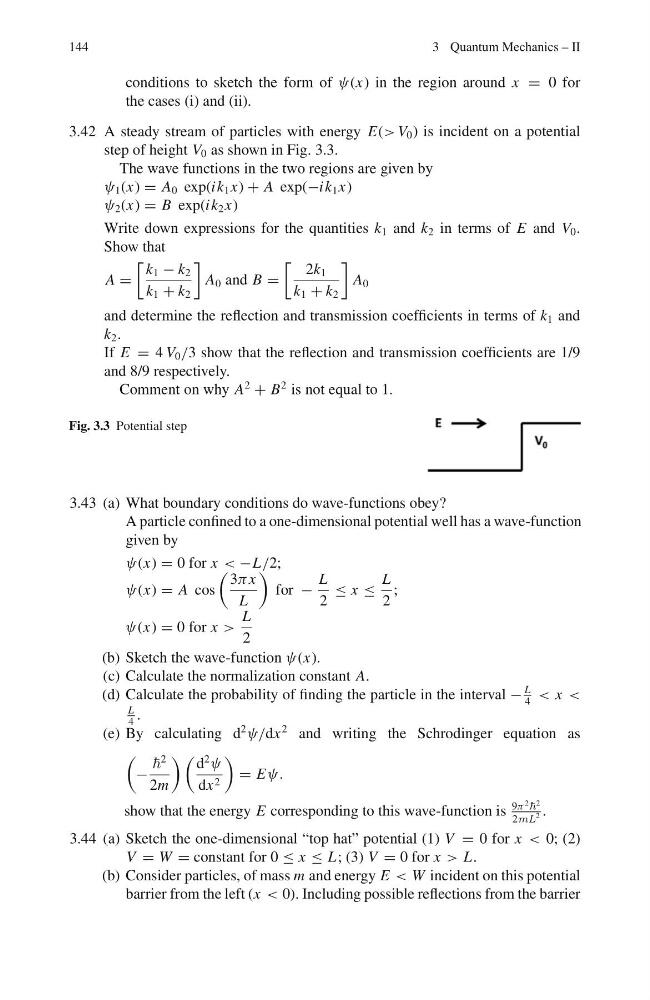
step of height V 0 as shown in Fig. 3.3.
The wave functions in the two regions are given by
ψ 1 (x) = A 0 exp(ik 1 x) + A exp(−ik 1 x)
ψ 2 (x) = B exp(ik 2 x)
Write down expressions for the quantities k 1 and k 2 in terms of E and V 0 .
Show that
A =
k 1 − k 2
k 1 + k 2
A 0 and B =
2k 1
k 1 + k 2
A 0
and determine the reflection and transmission coefficients in terms of k 1 and
k 2 .
If E = 4 V 0 /3 show that the reflection and transmission coefficients are 1/9
and 8/9 respectively.
Comment on why A
2
+ B
2 is not equal to 1.
Fig. 3.3 Potential step
3.43 (a) What boundary conditions do wave-functions obey?
A particle confined to a one-dimensional potential well has a wave-function
given by
ψ(x) = 0 for x < −L/2;
ψ(x) = A cos
3π x
L
for −
L
2
≤ x ≤
L
2
;
ψ(x) = 0 for x >
L
2
(b) Sketch the wave-function ψ(x).
(c) Calculate the normalization constant A.
(d) Calculate the probability of finding the particle in the interval −
L
4
< x <
L
4
.
(e) By calculating d
2
ψ/dx
2 and writing the Schrodinger equation as
−
2
2m
d
2
ψ
dx 2
= Eψ.
show that the energy E corresponding to this wave-function is
9π
2
2
2mL
2 .
3.44 (a) Sketch the one-dimensional “top hat” potential (1) V = 0 for x < 0; (2)
V = W = constant for 0 ≤ x ≤ L; (3) V = 0 for x > L.
(b) Consider particles, of mass m and energy E < W incident on this potential
barrier from the left (x < 0). Including possible reflections from the barrier
3 Quantum Mechanics – II
conditions to sketch the form of ψ(x) in the region around x = 0 for
the cases (i) and (ii).
3.42 A steady stream of particles with energy E(> V 0 ) is incident on a potential
step of height V 0 as shown in Fig. 3.3.
The wave functions in the two regions are given by
ψ 1 (x) = A 0 exp(ik 1 x) + A exp(−ik 1 x)
ψ 2 (x) = B exp(ik 2 x)
Write down expressions for the quantities k 1 and k 2 in terms of E and V 0 .
Show that
A =
k 1 − k 2
k 1 + k 2
A 0 and B =
2k 1
k 1 + k 2
A 0
and determine the reflection and transmission coefficients in terms of k 1 and
k 2 .
If E = 4 V 0 /3 show that the reflection and transmission coefficients are 1/9
and 8/9 respectively.
Comment on why A
2
+ B
2 is not equal to 1.
Fig. 3.3 Potential step
3.43 (a) What boundary conditions do wave-functions obey?
A particle confined to a one-dimensional potential well has a wave-function
given by
ψ(x) = 0 for x < −L/2;
ψ(x) = A cos
3π x
L
for −
L
2
≤ x ≤
L
2
;
ψ(x) = 0 for x >
L
2
(b) Sketch the wave-function ψ(x).
(c) Calculate the normalization constant A.
(d) Calculate the probability of finding the particle in the interval −
L
4
< x <
L
4
.
(e) By calculating d
2
ψ/dx
2 and writing the Schrodinger equation as
−
2
2m
d
2
ψ
dx 2
= Eψ.
show that the energy E corresponding to this wave-function is
9π
2
2
2mL
2 .
3.44 (a) Sketch the one-dimensional “top hat” potential (1) V = 0 for x < 0; (2)
V = W = constant for 0 ≤ x ≤ L; (3) V = 0 for x > L.
(b) Consider particles, of mass m and energy E < W incident on this potential
barrier from the left (x < 0). Including possible reflections from the barrier