

2.3 Solutions
119
2.52 ΔE = μ B BΔm = μ B B (because Δm = ±1)
= (9.27 × 10
−24 )(1.0) = 9.27 × 10
−24 J = 5.79 × 10
−5 eV.
The splitting of levels by equal amount in the presence of magnetic field is
called normal Zeeman effect.
f = ΔE/ h = 5.79 × 10
−5
× 1.6 × 10
−19
/6.625 × 10
−34
= 1.398 × 10
10 c/s
2.53 For the term
2 P 1/2 , l = 1, j =
1
2
, s =
1
2
and g =
2
3
. For the term
2 S 1/2 , l = 0,
j =
1
2
, s =
1
2
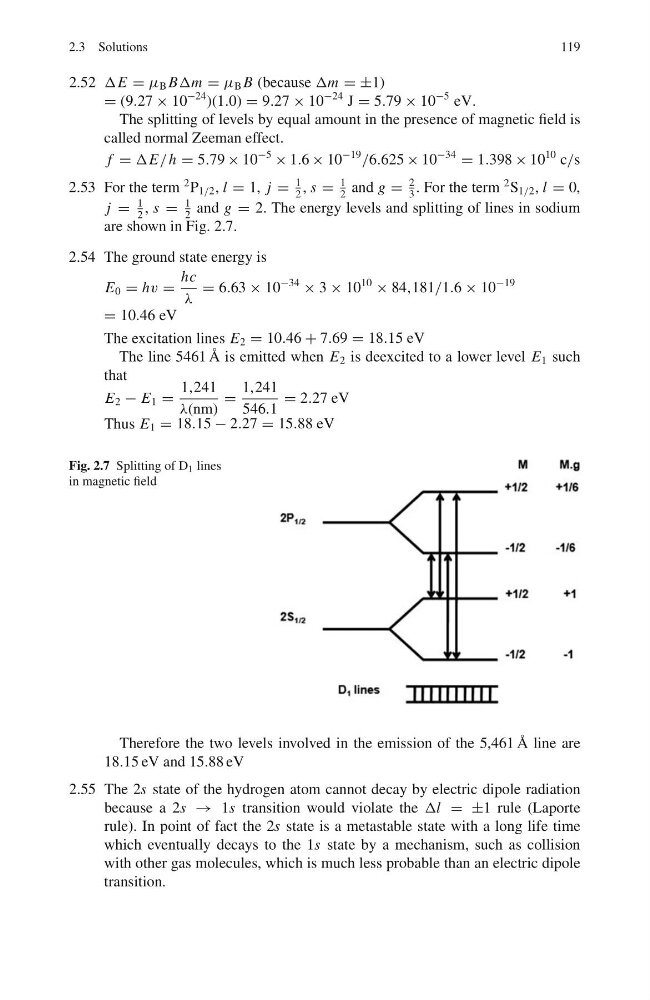
and g = 2. The energy levels and splitting of lines in sodium
are shown in Fig. 2.7.
2.54 The ground state energy is
E 0 = hv =
hc
λ
= 6.63 × 10
−34
× 3 × 10
10
× 84,181/1.6 × 10
−19
= 10.46 eV
The excitation lines E 2 = 10.46 + 7.69 = 18.15 eV
The line 5461 ˚
A is emitted when E 2 is deexcited to a lower level E 1 such
that
E 2 − E 1 =
1,241
λ(nm)
=
1,241
546.1
= 2.27 eV
Thus E 1 = 18.15 − 2.27 = 15.88 eV
Fig. 2.7 Splitting of D 1 lines
in magnetic field
Therefore the two levels involved in the emission of the 5,461 ˚
A line are
18.15 eV and 15.88 eV
2.55 The 2s state of the hydrogen atom cannot decay by electric dipole radiation
because a 2s → 1s transition would violate the Δl = ±1 rule (Laporte
rule). In point of fact the 2s state is a metastable state with a long life time
which eventually decays to the 1s state by a mechanism, such as collision
with other gas molecules, which is much less probable than an electric dipole
transition.
119
2.52 ΔE = μ B BΔm = μ B B (because Δm = ±1)
= (9.27 × 10
−24 )(1.0) = 9.27 × 10
−24 J = 5.79 × 10
−5 eV.
The splitting of levels by equal amount in the presence of magnetic field is
called normal Zeeman effect.
f = ΔE/ h = 5.79 × 10
−5
× 1.6 × 10
−19
/6.625 × 10
−34
= 1.398 × 10
10 c/s
2.53 For the term
2 P 1/2 , l = 1, j =
1
2
, s =
1
2
and g =
2
3
. For the term
2 S 1/2 , l = 0,
j =
1
2
, s =
1
2
and g = 2. The energy levels and splitting of lines in sodium
are shown in Fig. 2.7.
2.54 The ground state energy is
E 0 = hv =
hc
λ
= 6.63 × 10
−34
× 3 × 10
10
× 84,181/1.6 × 10
−19
= 10.46 eV
The excitation lines E 2 = 10.46 + 7.69 = 18.15 eV
The line 5461 ˚
A is emitted when E 2 is deexcited to a lower level E 1 such
that
E 2 − E 1 =
1,241
λ(nm)
=
1,241
546.1
= 2.27 eV
Thus E 1 = 18.15 − 2.27 = 15.88 eV
Fig. 2.7 Splitting of D 1 lines
in magnetic field
Therefore the two levels involved in the emission of the 5,461 ˚
A line are
18.15 eV and 15.88 eV
2.55 The 2s state of the hydrogen atom cannot decay by electric dipole radiation
because a 2s → 1s transition would violate the Δl = ±1 rule (Laporte
rule). In point of fact the 2s state is a metastable state with a long life time
which eventually decays to the 1s state by a mechanism, such as collision
with other gas molecules, which is much less probable than an electric dipole
transition.