

118
2 Quantum Mechanics – I
The splitting of levels as in sodium is shown in Fig. 2.5. Transitions take place
with the selection rule
ΔM = 0, ±1.
2.50 Under the assumption of Russel–Saunders coupling, the ratios of the intervals
in a multiplet can be easily calculated as follows. The magnetic field produced
by L is proportional to [L(L + 1)]
1/2 , and the component of S in the direction
of this field is [S(S + 1)]
1/2 cos(L , S). The energy in the magnetic field is
W = W 0 − Bμ B
(1)
where μ B is the component of the magnetic moment in the field direction and
W 0 is the energy in the field-free case. From (1) the interaction energy is
μ B B = A[L(L + 1)]
1/2 [S(S + 1)]
1/2 cos(L , S)
( 2 )
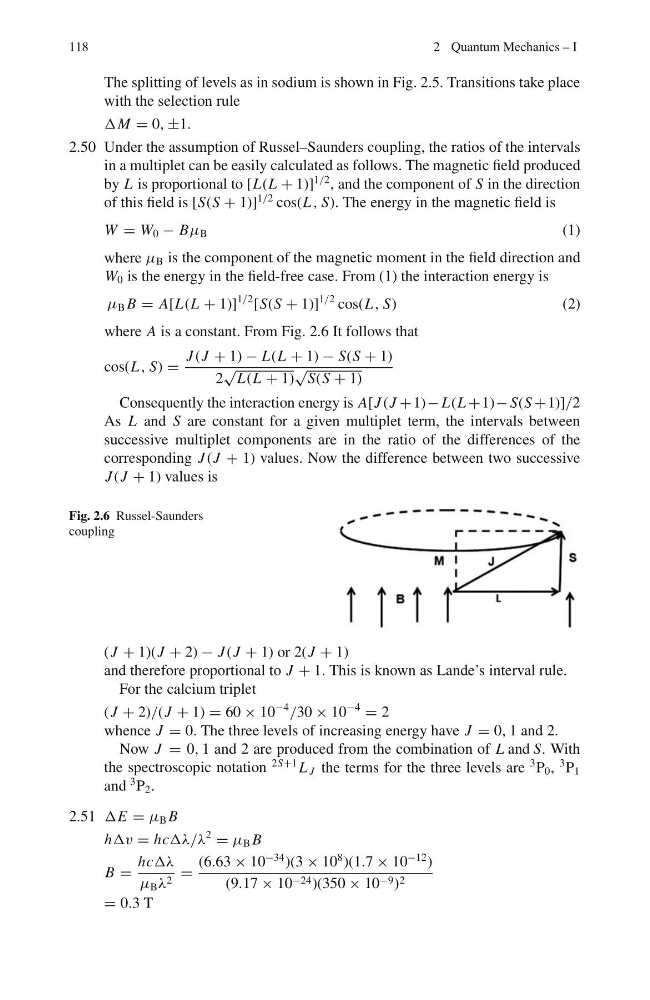
where A is a constant. From Fig. 2.6 It follows that
cos(L , S) =
J (J + 1) − L(L + 1) − S(S + 1)
2
√
L(L + 1)
√
S(S + 1)
Consequently the interaction energy is A[J (J +1)− L(L +1)− S(S +1)]/2
As L and S are constant for a given multiplet term, the intervals between
successive multiplet components are in the ratio of the differences of the
corresponding J (J + 1) values. Now the difference between two successive
J (J + 1) values is
Fig. 2.6 Russel-Saunders
coupling
(J + 1)(J + 2) − J (J + 1) or 2(J + 1)
and therefore proportional to J + 1. This is known as Lande’s interval rule.
For the calcium triplet
(J + 2)/(J + 1) = 60 × 10
−4
/30 × 10
−4
= 2
whence J = 0. The three levels of increasing energy have J = 0, 1 and 2.
Now J = 0, 1 and 2 are produced from the combination of L and S. With
the spectroscopic notation
2S+1 L J the terms for the three levels are
3 P 0 ,
3 P 1
and
3 P 2 .
2.51 ΔE = μ B B
hΔv = hcΔλ/λ
2
= μ B B
B =
hcΔλ
μ B λ 2 =
(6.63 × 10
−34 )(3 × 10
8 )(1.7 × 10
−12 )
(9.17 × 10 −24 )(350 × 10 −9 ) 2
= 0.3 T
2 Quantum Mechanics – I
The splitting of levels as in sodium is shown in Fig. 2.5. Transitions take place
with the selection rule
ΔM = 0, ±1.
2.50 Under the assumption of Russel–Saunders coupling, the ratios of the intervals
in a multiplet can be easily calculated as follows. The magnetic field produced
by L is proportional to [L(L + 1)]
1/2 , and the component of S in the direction
of this field is [S(S + 1)]
1/2 cos(L , S). The energy in the magnetic field is
W = W 0 − Bμ B
(1)
where μ B is the component of the magnetic moment in the field direction and
W 0 is the energy in the field-free case. From (1) the interaction energy is
μ B B = A[L(L + 1)]
1/2 [S(S + 1)]
1/2 cos(L , S)
( 2 )
where A is a constant. From Fig. 2.6 It follows that
cos(L , S) =
J (J + 1) − L(L + 1) − S(S + 1)
2
√
L(L + 1)
√
S(S + 1)
Consequently the interaction energy is A[J (J +1)− L(L +1)− S(S +1)]/2
As L and S are constant for a given multiplet term, the intervals between
successive multiplet components are in the ratio of the differences of the
corresponding J (J + 1) values. Now the difference between two successive
J (J + 1) values is
Fig. 2.6 Russel-Saunders
coupling
(J + 1)(J + 2) − J (J + 1) or 2(J + 1)
and therefore proportional to J + 1. This is known as Lande’s interval rule.
For the calcium triplet
(J + 2)/(J + 1) = 60 × 10
−4
/30 × 10
−4
= 2
whence J = 0. The three levels of increasing energy have J = 0, 1 and 2.
Now J = 0, 1 and 2 are produced from the combination of L and S. With
the spectroscopic notation
2S+1 L J the terms for the three levels are
3 P 0 ,
3 P 1
and
3 P 2 .
2.51 ΔE = μ B B
hΔv = hcΔλ/λ
2
= μ B B
B =
hcΔλ
μ B λ 2 =
(6.63 × 10
−34 )(3 × 10
8 )(1.7 × 10
−12 )
(9.17 × 10 −24 )(350 × 10 −9 ) 2
= 0.3 T