

2.3 Solutions
115
The magnetic moment μ 0 produced is equal to this current multiplied by
the area enclosed.
μ B = i A = ωe.
πr
2
2π
(2)
Using (1) in (2)
μ B =
e
2m e
(3)
μ B is known as Bohr magneton.
Electron with total angular momentum [ j( j + 1)]
1/2
has a magnetic
moment μ = [ j( j + 1)]
1/2
μ B
The z-component of the magnetic moment is μ J = m J μ B
where m J is the z-component of the angular momentum.
2.3.5 Spectroscopy
2.45 The principle quantum number n denotes the number of stationary states in
Bohr’s atom model. n = 1, 2, 3 . . .
l is called azimuthal or orbital angular quantum number. For a given value of
n, l takes the values 0, 1, 2 . . . n − 1
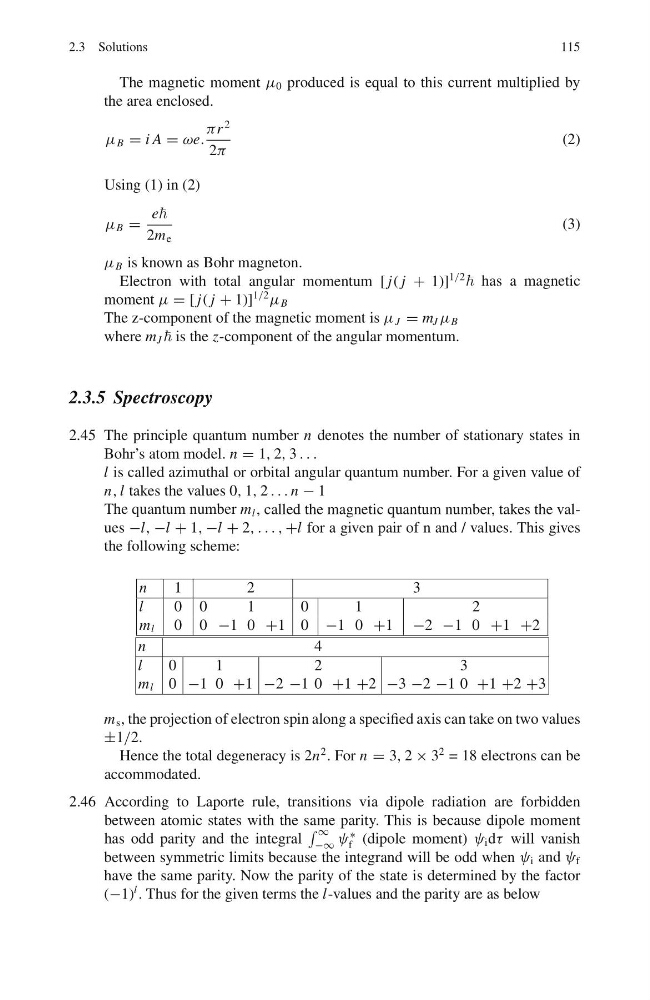
The quantum number m l , called the magnetic quantum number, takes the values −l, −l + 1, −l + 2, . . . , +l for a given pair of n and / values. This gives
the following scheme:
n
1
2
3
l
0 0
1
0
1
2
m l 0 0 −1 0 +1 0 −1 0 +1 −2 −1 0 +1 +2
n
4
l
0
1
2
3
m l 0 −1 0 +1 −2 −1 0 +1 +2 −3 −2 −1 0 +1 +2 +3
m s , the projection of electron spin along a specified axis can take on two values
±1/2.
Hence the total degeneracy is 2n
2 . For n = 3, 2 × 3
2 = 18 electrons can be
accommodated.
2.46 According to Laporte rule, transitions via dipole radiation are forbidden
between atomic states with the same parity. This is because dipole moment
has odd parity and the integral
∞
−∞ ψ
∗
f (dipole moment) ψ i dτ will vanish
between symmetric limits because the integrand will be odd when ψ i and ψ f
have the same parity. Now the parity of the state is determined by the factor
(−1)
l . Thus for the given terms the l-values and the parity are as below
115
The magnetic moment μ 0 produced is equal to this current multiplied by
the area enclosed.
μ B = i A = ωe.
πr
2
2π
(2)
Using (1) in (2)
μ B =
e
2m e
(3)
μ B is known as Bohr magneton.
Electron with total angular momentum [ j( j + 1)]
1/2
has a magnetic
moment μ = [ j( j + 1)]
1/2
μ B
The z-component of the magnetic moment is μ J = m J μ B
where m J is the z-component of the angular momentum.
2.3.5 Spectroscopy
2.45 The principle quantum number n denotes the number of stationary states in
Bohr’s atom model. n = 1, 2, 3 . . .
l is called azimuthal or orbital angular quantum number. For a given value of
n, l takes the values 0, 1, 2 . . . n − 1
The quantum number m l , called the magnetic quantum number, takes the values −l, −l + 1, −l + 2, . . . , +l for a given pair of n and / values. This gives
the following scheme:
n
1
2
3
l
0 0
1
0
1
2
m l 0 0 −1 0 +1 0 −1 0 +1 −2 −1 0 +1 +2
n
4
l
0
1
2
3
m l 0 −1 0 +1 −2 −1 0 +1 +2 −3 −2 −1 0 +1 +2 +3
m s , the projection of electron spin along a specified axis can take on two values
±1/2.
Hence the total degeneracy is 2n
2 . For n = 3, 2 × 3
2 = 18 electrons can be
accommodated.
2.46 According to Laporte rule, transitions via dipole radiation are forbidden
between atomic states with the same parity. This is because dipole moment
has odd parity and the integral
∞
−∞ ψ
∗
f (dipole moment) ψ i dτ will vanish
between symmetric limits because the integrand will be odd when ψ i and ψ f
have the same parity. Now the parity of the state is determined by the factor
(−1)
l . Thus for the given terms the l-values and the parity are as below