

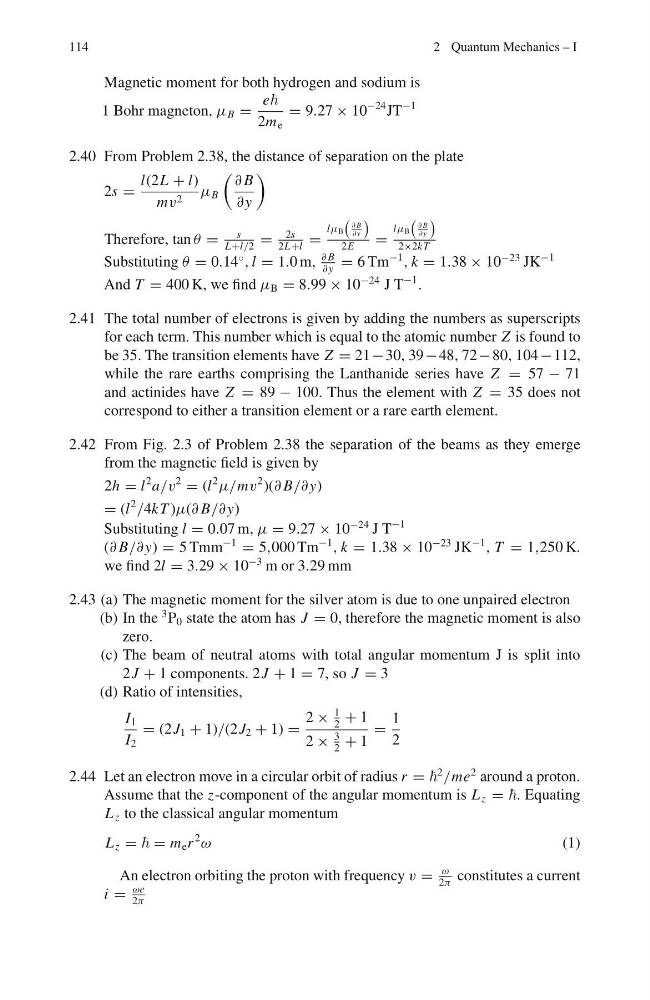
114
2 Quantum Mechanics – I
Magnetic moment for both hydrogen and sodium is
1 Bohr magneton, μ B =
e
2m e
= 9.27 × 10
−24 JT
−1
2.40 From Problem 2.38, the distance of separation on the plate
2s =
l(2L + l)
mv 2 μ B
∂ B
∂ y
Therefore, tan θ =
s
L+l/2
=
2s
2L+l
=
lμ B
∂ B
∂ y
2E
=
lμ B
∂ B
∂ y
2×2kT
Substituting θ = 0.14
◦
, l = 1.0 m,
∂ B
∂ y
= 6 Tm
−1
, k = 1.38 × 10
−23 JK
−1
And T = 400 K, we find μ B = 8.99 × 10
−24 J T
−1 .
2.41 The total number of electrons is given by adding the numbers as superscripts
for each term. This number which is equal to the atomic number Z is found to
be 35. The transition elements have Z = 21 − 30, 39 − 48, 72 − 80, 104 − 112,
while the rare earths comprising the Lanthanide series have Z = 57 − 71
and actinides have Z = 89 − 100. Thus the element with Z = 35 does not
correspond to either a transition element or a rare earth element.
2.42 From Fig. 2.3 of Problem 2.38 the separation of the beams as they emerge
from the magnetic field is given by
2h = l
2 a/v
2
= (l
2
μ/mv
2 )(∂ B/∂ y)
= (l
2
/4kT )μ(∂ B/∂ y)
Substituting l = 0.07 m, μ = 9.27 × 10
−24 J T
−1
(∂ B/∂ y) = 5 Tmm
−1
= 5,000 Tm
−1
, k = 1.38 × 10
−23 JK
−1 , T = 1,250 K.
we find 2l = 3.29 × 10
−3 m or 3.29 mm
2.43 (a) The magnetic moment for the silver atom is due to one unpaired electron
(b) In the
3 P 0 state the atom has J = 0, therefore the magnetic moment is also
zero.
(c) The beam of neutral atoms with total angular momentum J is split into
2J + 1 components. 2J + 1 = 7, so J = 3
(d) Ratio of intensities,
I 1
I 2
= (2J 1 + 1)/(2J 2 + 1) =
2 ×
1
2
+ 1
2 ×
3
2
+ 1
=
1
2
2.44 Let an electron move in a circular orbit of radius r =
2
/me
2 around a proton.
Assume that the z-component of the angular momentum is L z = . Equating
L z to the classical angular momentum
L z = = m e r
2
ω
(1)
An electron orbiting the proton with frequency v =
ω
2π
constitutes a current
i =
ωe
2π
2 Quantum Mechanics – I
Magnetic moment for both hydrogen and sodium is
1 Bohr magneton, μ B =
e
2m e
= 9.27 × 10
−24 JT
−1
2.40 From Problem 2.38, the distance of separation on the plate
2s =
l(2L + l)
mv 2 μ B
∂ B
∂ y
Therefore, tan θ =
s
L+l/2
=
2s
2L+l
=
lμ B
∂ B
∂ y
2E
=
lμ B
∂ B
∂ y
2×2kT
Substituting θ = 0.14
◦
, l = 1.0 m,
∂ B
∂ y
= 6 Tm
−1
, k = 1.38 × 10
−23 JK
−1
And T = 400 K, we find μ B = 8.99 × 10
−24 J T
−1 .
2.41 The total number of electrons is given by adding the numbers as superscripts
for each term. This number which is equal to the atomic number Z is found to
be 35. The transition elements have Z = 21 − 30, 39 − 48, 72 − 80, 104 − 112,
while the rare earths comprising the Lanthanide series have Z = 57 − 71
and actinides have Z = 89 − 100. Thus the element with Z = 35 does not
correspond to either a transition element or a rare earth element.
2.42 From Fig. 2.3 of Problem 2.38 the separation of the beams as they emerge
from the magnetic field is given by
2h = l
2 a/v
2
= (l
2
μ/mv
2 )(∂ B/∂ y)
= (l
2
/4kT )μ(∂ B/∂ y)
Substituting l = 0.07 m, μ = 9.27 × 10
−24 J T
−1
(∂ B/∂ y) = 5 Tmm
−1
= 5,000 Tm
−1
, k = 1.38 × 10
−23 JK
−1 , T = 1,250 K.
we find 2l = 3.29 × 10
−3 m or 3.29 mm
2.43 (a) The magnetic moment for the silver atom is due to one unpaired electron
(b) In the
3 P 0 state the atom has J = 0, therefore the magnetic moment is also
zero.
(c) The beam of neutral atoms with total angular momentum J is split into
2J + 1 components. 2J + 1 = 7, so J = 3
(d) Ratio of intensities,
I 1
I 2
= (2J 1 + 1)/(2J 2 + 1) =
2 ×
1
2
+ 1
2 ×
3
2
+ 1
=
1
2
2.44 Let an electron move in a circular orbit of radius r =
2
/me
2 around a proton.
Assume that the z-component of the angular momentum is L z = . Equating
L z to the classical angular momentum
L z = = m e r
2
ω
(1)
An electron orbiting the proton with frequency v =
ω
2π
constitutes a current
i =
ωe
2π