

112
2 Quantum Mechanics – I
2.37 (a) By definition the magnetic moment of electron is given by the product of
the charge and the area A contained by the circular orbit.
μ = i A = −
eπr
2
T
= −
ωeπr
2
2π
=
−em e ωr
2
2m e
= −
eL
2m e
(b) μ l = −
e
2mc
(L(L + 1))
1/2
μ s = −(2e/2mc) (S(S + 1))
1/2
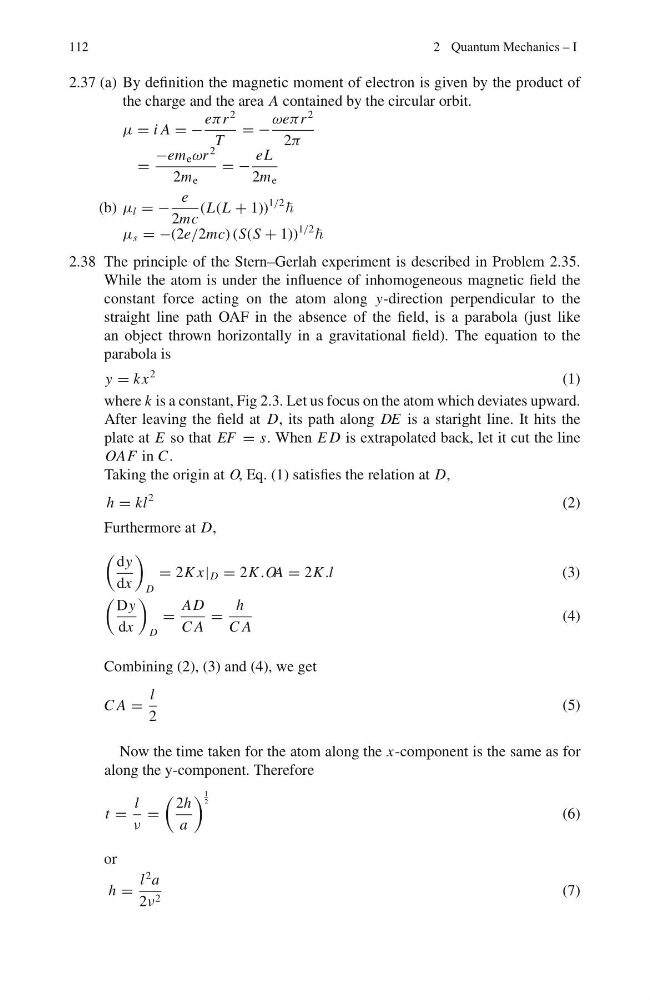
2.38 The principle of the Stern–Gerlah experiment is described in Problem 2.35.
While the atom is under the influence of inhomogeneous magnetic field the
constant force acting on the atom along y-direction perpendicular to the
straight line path OAF in the absence of the field, is a parabola (just like
an object thrown horizontally in a gravitational field). The equation to the
parabola is
y = kx
2
(1)
where k is a constant, Fig 2.3. Let us focus on the atom which deviates upward.
After leaving the field at D, its path along DE is a staright line. It hits the
plate at E so that EF = s. When E D is extrapolated back, let it cut the line
OAF in C.
Taking the origin at O, Eq. (1) satisfies the relation at D,
h = kl
2
(2)
Furthermore at D,
dy
dx
D
= 2K x| D = 2K .OA = 2K .l
(3)
Dy
dx
D
=
AD
C A
=
h
C A
(4)
Combining (2), (3) and (4), we get
C A =
l
2
(5)
Now the time taken for the atom along the x-component is the same as for
along the y-component. Therefore
t =
l
ν
=
2h
a
1
2
(6)
or
h =
l
2 a
2ν 2
(7)
2 Quantum Mechanics – I
2.37 (a) By definition the magnetic moment of electron is given by the product of
the charge and the area A contained by the circular orbit.
μ = i A = −
eπr
2
T
= −
ωeπr
2
2π
=
−em e ωr
2
2m e
= −
eL
2m e
(b) μ l = −
e
2mc
(L(L + 1))
1/2
μ s = −(2e/2mc) (S(S + 1))
1/2
2.38 The principle of the Stern–Gerlah experiment is described in Problem 2.35.
While the atom is under the influence of inhomogeneous magnetic field the
constant force acting on the atom along y-direction perpendicular to the
straight line path OAF in the absence of the field, is a parabola (just like
an object thrown horizontally in a gravitational field). The equation to the
parabola is
y = kx
2
(1)
where k is a constant, Fig 2.3. Let us focus on the atom which deviates upward.
After leaving the field at D, its path along DE is a staright line. It hits the
plate at E so that EF = s. When E D is extrapolated back, let it cut the line
OAF in C.
Taking the origin at O, Eq. (1) satisfies the relation at D,
h = kl
2
(2)
Furthermore at D,
dy
dx
D
= 2K x| D = 2K .OA = 2K .l
(3)
Dy
dx
D
=
AD
C A
=
h
C A
(4)
Combining (2), (3) and (4), we get
C A =
l
2
(5)
Now the time taken for the atom along the x-component is the same as for
along the y-component. Therefore
t =
l
ν
=
2h
a
1
2
(6)
or
h =
l
2 a
2ν 2
(7)