

2.3 Solutions
111
2.34 By Moseley’s law
1
λ
= A(Z 1 − 1)
2
= A(19 − 1)
2
(1)
1
λ/4
= A(Z − 1)
2
(2)
Dividing (2) by (1) and solving for Z , we get Z = 37
2.3.4 Spin and μ and Quantum Numbers – Stern–Gerlah’s
Experiment
2.35 The existence of electron spin and its value was provided by the Stern–Gerlah
experiment in which a beam of atoms is sent through an inhomogeneous magnetic field.
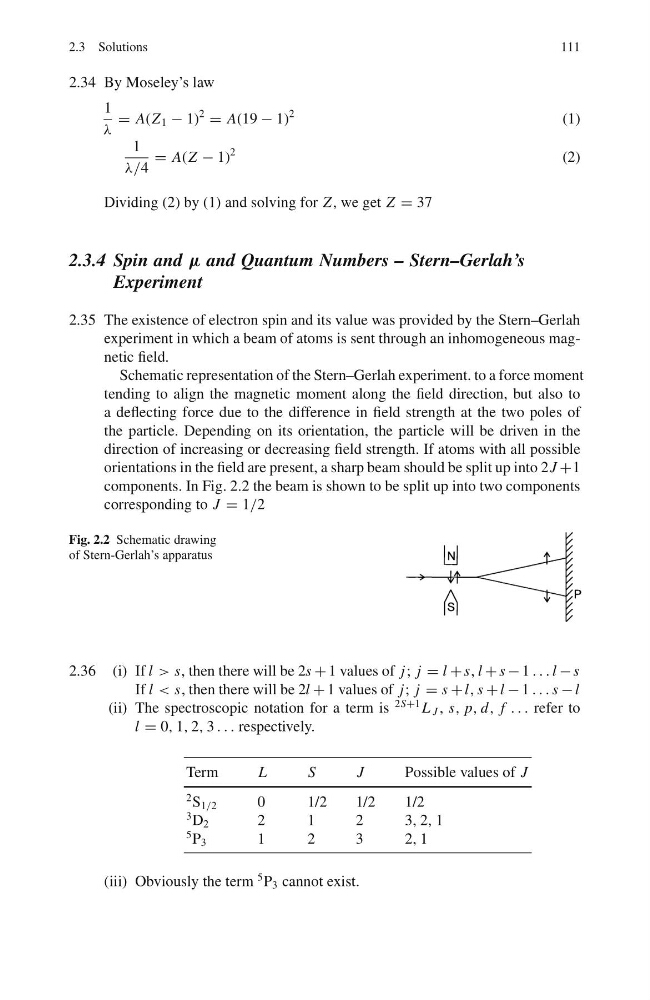
Schematic representation of the Stern–Gerlah experiment. to a force moment
tending to align the magnetic moment along the field direction, but also to
a deflecting force due to the difference in field strength at the two poles of
the particle. Depending on its orientation, the particle will be driven in the
direction of increasing or decreasing field strength. If atoms with all possible
orientations in the field are present, a sharp beam should be split up into 2J +1
components. In Fig. 2.2 the beam is shown to be split up into two components
corresponding to J = 1/2
Fig. 2.2 Schematic drawing
of Stern-Gerlah’s apparatus
2.36 (i) If l > s, then there will be 2s + 1 values of j; j = l + s, l + s − 1 . . . l − s
If l < s, then there will be 2l + 1 values of j; j = s + l, s + l − 1 . . . s − l
(ii) The spectroscopic notation for a term is
2S+1 L J , s, p, d, f . . . refer to
l = 0, 1, 2, 3 . . . respectively.
Term
L
S
J
Possible values of J
2 S 1/2
0
1/2
1/2
1/2
3 D 2
2
1
2
3,2,1
5 P 3
1
2
3
2,1
(iii) Obviously the term
5 P 3 cannot exist.
111
2.34 By Moseley’s law
1
λ
= A(Z 1 − 1)
2
= A(19 − 1)
2
(1)
1
λ/4
= A(Z − 1)
2
(2)
Dividing (2) by (1) and solving for Z , we get Z = 37
2.3.4 Spin and μ and Quantum Numbers – Stern–Gerlah’s
Experiment
2.35 The existence of electron spin and its value was provided by the Stern–Gerlah
experiment in which a beam of atoms is sent through an inhomogeneous magnetic field.
Schematic representation of the Stern–Gerlah experiment. to a force moment
tending to align the magnetic moment along the field direction, but also to
a deflecting force due to the difference in field strength at the two poles of
the particle. Depending on its orientation, the particle will be driven in the
direction of increasing or decreasing field strength. If atoms with all possible
orientations in the field are present, a sharp beam should be split up into 2J +1
components. In Fig. 2.2 the beam is shown to be split up into two components
corresponding to J = 1/2
Fig. 2.2 Schematic drawing
of Stern-Gerlah’s apparatus
2.36 (i) If l > s, then there will be 2s + 1 values of j; j = l + s, l + s − 1 . . . l − s
If l < s, then there will be 2l + 1 values of j; j = s + l, s + l − 1 . . . s − l
(ii) The spectroscopic notation for a term is
2S+1 L J , s, p, d, f . . . refer to
l = 0, 1, 2, 3 . . . respectively.
Term
L
S
J
Possible values of J
2 S 1/2
0
1/2
1/2
1/2
3 D 2
2
1
2
3,2,1
5 P 3
1
2
3
2,1
(iii) Obviously the term
5 P 3 cannot exist.