

164
R. N. Mohapatra
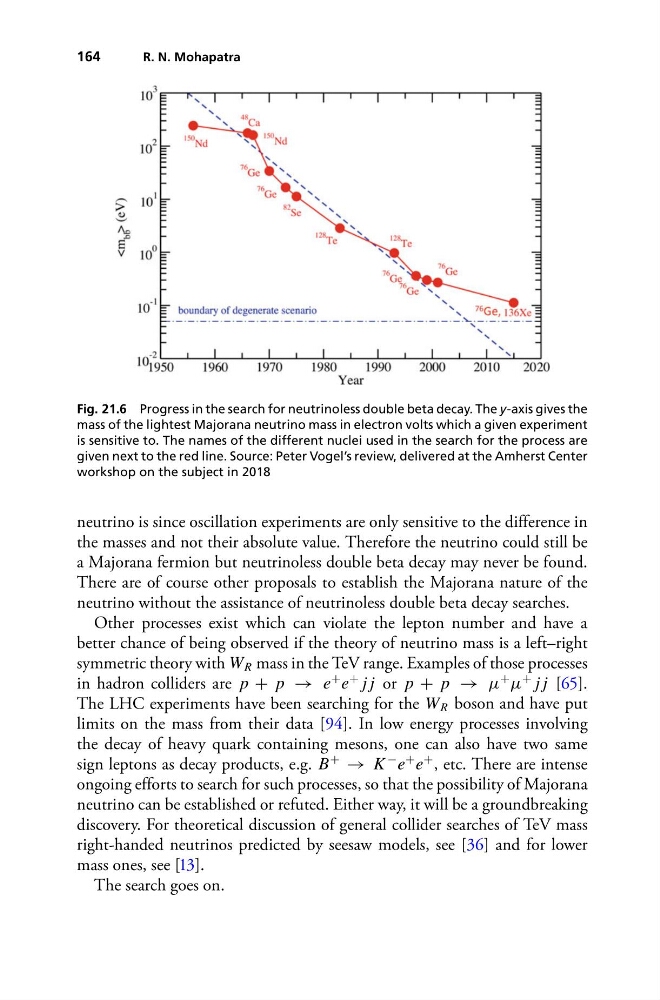
Fig. 21.6 Progress in the search for neutrinoless double beta decay. The y-axis gives the
mass of the lightest Majorana neutrino mass in electron volts which a given experiment
is sensitive to. The names of the different nuclei used in the search for the process are
given next to the red line. Source: Peter Vogel’s review, delivered at the Amherst Center
workshop on the subject in 2018
neutrino is since oscillation experiments are only sensitive to the difference in
the masses and not their absolute value. Therefore the neutrino could still be
a Majorana fermion but neutrinoless double beta decay may never be found.
There are of course other proposals to establish the Majorana nature of the
neutrino without the assistance of neutrinoless double beta decay searches.
Other processes exist which can violate the lepton number and have a
better chance of being observed if the theory of neutrino mass is a left–right
symmetric theory with W R mass in the TeV range. Examples of those processes
in hadron colliders are p + p → e
+ e
+ jj or p + p → μ
+ μ
+ jj [65].
The LHC experiments have been searching for the W R boson and have put
limits on the mass from their data [94]. In low energy processes involving
the decay of heavy quark containing mesons, one can also have two same
sign leptons as decay products, e.g. B
+
→ K
− e
+ e
+ , etc. There are intense
ongoing efforts to search for such processes, so that the possibility of Majorana
neutrino can be established or refuted. Either way, it will be a groundbreaking
discovery. For theoretical discussion of general collider searches of TeV mass
right-handed neutrinos predicted by seesaw models, see [36] and for lower
mass ones, see [13].
The search goes on.
R. N. Mohapatra
Fig. 21.6 Progress in the search for neutrinoless double beta decay. The y-axis gives the
mass of the lightest Majorana neutrino mass in electron volts which a given experiment
is sensitive to. The names of the different nuclei used in the search for the process are
given next to the red line. Source: Peter Vogel’s review, delivered at the Amherst Center
workshop on the subject in 2018
neutrino is since oscillation experiments are only sensitive to the difference in
the masses and not their absolute value. Therefore the neutrino could still be
a Majorana fermion but neutrinoless double beta decay may never be found.
There are of course other proposals to establish the Majorana nature of the
neutrino without the assistance of neutrinoless double beta decay searches.
Other processes exist which can violate the lepton number and have a
better chance of being observed if the theory of neutrino mass is a left–right
symmetric theory with W R mass in the TeV range. Examples of those processes
in hadron colliders are p + p → e
+ e
+ jj or p + p → μ
+ μ
+ jj [65].
The LHC experiments have been searching for the W R boson and have put
limits on the mass from their data [94]. In low energy processes involving
the decay of heavy quark containing mesons, one can also have two same
sign leptons as decay products, e.g. B
+
→ K
− e
+ e
+ , etc. There are intense
ongoing efforts to search for such processes, so that the possibility of Majorana
neutrino can be established or refuted. Either way, it will be a groundbreaking
discovery. For theoretical discussion of general collider searches of TeV mass
right-handed neutrinos predicted by seesaw models, see [36] and for lower
mass ones, see [13].
The search goes on.