

21 Mirror Symmetric Weak Force and Neutrino Mass
163
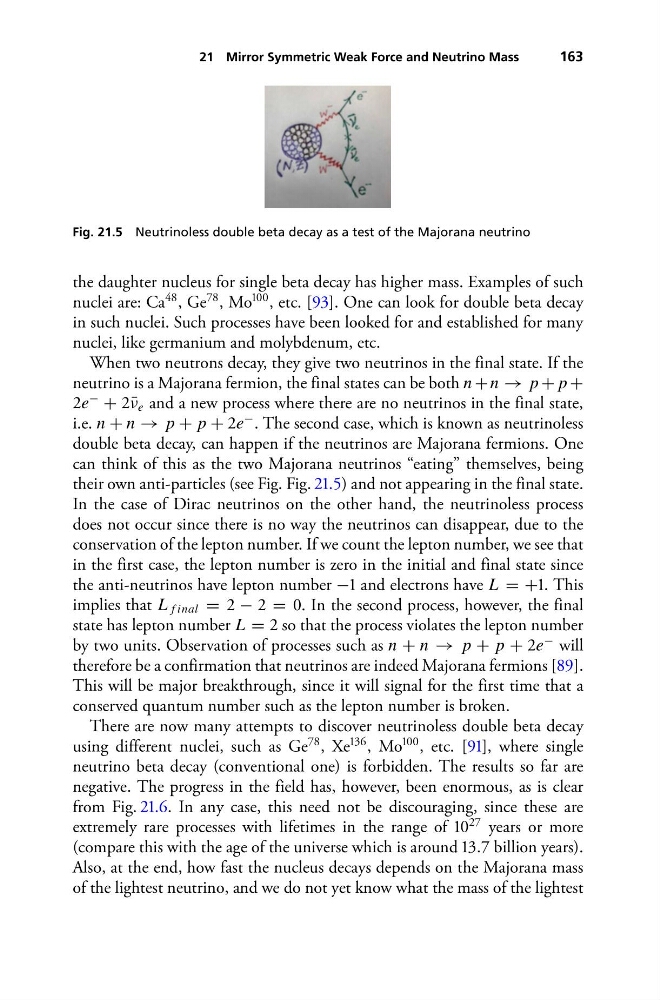
Fig. 21.5 Neutrinoless double beta decay as a test of the Majorana neutrino
the daughter nucleus for single beta decay has higher mass. Examples of such
nuclei are: Ca
48 , Ge
78 , Mo
100 , etc. [93]. One can look for double beta decay
in such nuclei. Such processes have been looked for and established for many
nuclei, like germanium and molybdenum, etc.
When two neutrons decay, they give two neutrinos in the final state. If the
neutrino is a Majorana fermion, the final states can be both n + n → p + p +
2e
−
+ 2 ¯
ν e and a new process where there are no neutrinos in the final state,
i.e. n + n → p + p + 2e
− . The second case, which is known as neutrinoless
double beta decay, can happen if the neutrinos are Majorana fermions. One
can think of this as the two Majorana neutrinos “eating” themselves, being
their own anti-particles (see Fig. Fig. 21.5) and not appearing in the final state.
In the case of Dirac neutrinos on the other hand, the neutrinoless process
does not occur since there is no way the neutrinos can disappear, due to the
conservation of the lepton number. If we count the lepton number, we see that
in the first case, the lepton number is zero in the initial and final state since
the anti-neutrinos have lepton number −1 and electrons have L = +1. This
implies that L f inal = 2 − 2 = 0. In the second process, however, the final
state has lepton number L = 2 so that the process violates the lepton number
by two units. Observation of processes such as n + n → p + p + 2e
− will
therefore be a confirmation that neutrinos are indeed Majorana fermions [89].
This will be major breakthrough, since it will signal for the first time that a
conserved quantum number such as the lepton number is broken.
There are now many attempts to discover neutrinoless double beta decay
using different nuclei, such as Ge
78 , Xe
136 , Mo
100 , etc. [91], where single
neutrino beta decay (conventional one) is forbidden. The results so far are
negative. The progress in the field has, however, been enormous, as is clear
from Fig. 21.6. In any case, this need not be discouraging, since these are
extremely rare processes with lifetimes in the range of 10
27 years or more
(compare this with the age of the universe which is around 13.7 billion years).
Also, at the end, how fast the nucleus decays depends on the Majorana mass
of the lightest neutrino, and we do not yet know what the mass of the lightest
163
Fig. 21.5 Neutrinoless double beta decay as a test of the Majorana neutrino
the daughter nucleus for single beta decay has higher mass. Examples of such
nuclei are: Ca
48 , Ge
78 , Mo
100 , etc. [93]. One can look for double beta decay
in such nuclei. Such processes have been looked for and established for many
nuclei, like germanium and molybdenum, etc.
When two neutrons decay, they give two neutrinos in the final state. If the
neutrino is a Majorana fermion, the final states can be both n + n → p + p +
2e
−
+ 2 ¯
ν e and a new process where there are no neutrinos in the final state,
i.e. n + n → p + p + 2e
− . The second case, which is known as neutrinoless
double beta decay, can happen if the neutrinos are Majorana fermions. One
can think of this as the two Majorana neutrinos “eating” themselves, being
their own anti-particles (see Fig. Fig. 21.5) and not appearing in the final state.
In the case of Dirac neutrinos on the other hand, the neutrinoless process
does not occur since there is no way the neutrinos can disappear, due to the
conservation of the lepton number. If we count the lepton number, we see that
in the first case, the lepton number is zero in the initial and final state since
the anti-neutrinos have lepton number −1 and electrons have L = +1. This
implies that L f inal = 2 − 2 = 0. In the second process, however, the final
state has lepton number L = 2 so that the process violates the lepton number
by two units. Observation of processes such as n + n → p + p + 2e
− will
therefore be a confirmation that neutrinos are indeed Majorana fermions [89].
This will be major breakthrough, since it will signal for the first time that a
conserved quantum number such as the lepton number is broken.
There are now many attempts to discover neutrinoless double beta decay
using different nuclei, such as Ge
78 , Xe
136 , Mo
100 , etc. [91], where single
neutrino beta decay (conventional one) is forbidden. The results so far are
negative. The progress in the field has, however, been enormous, as is clear
from Fig. 21.6. In any case, this need not be discouraging, since these are
extremely rare processes with lifetimes in the range of 10
27 years or more
(compare this with the age of the universe which is around 13.7 billion years).
Also, at the end, how fast the nucleus decays depends on the Majorana mass
of the lightest neutrino, and we do not yet know what the mass of the lightest