

21 Mirror Symmetric Weak Force and Neutrino Mass
159
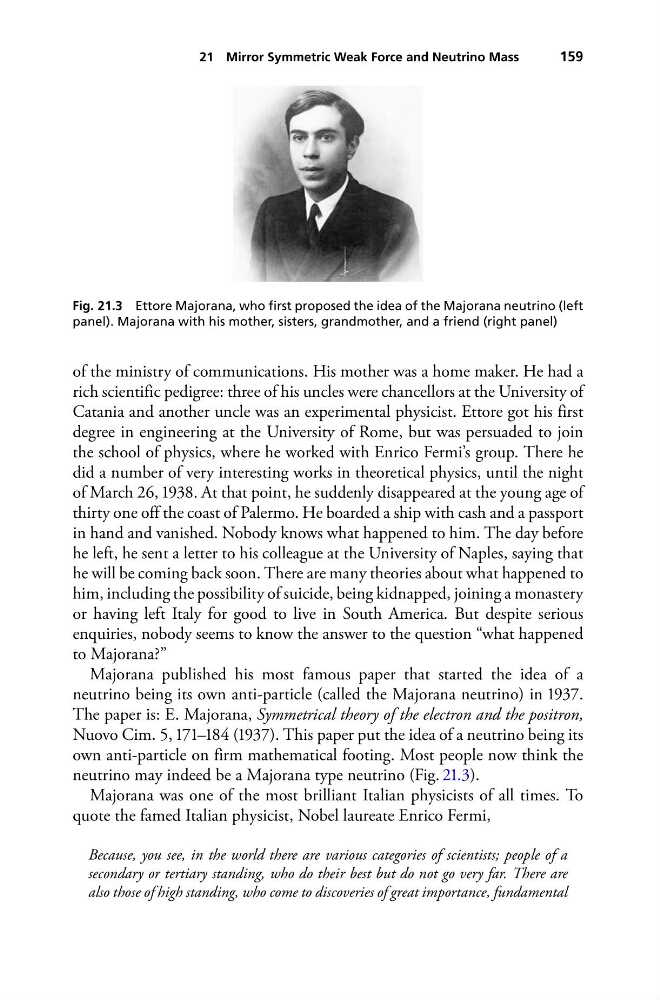
Fig. 21.3 Ettore Majorana, who first proposed the idea of the Majorana neutrino (left
panel). Majorana with his mother, sisters, grandmother, and a friend (right panel)
of the ministry of communications. His mother was a home maker. He had a
rich scientific pedigree: three of his uncles were chancellors at the University of
Catania and another uncle was an experimental physicist. Ettore got his first
degree in engineering at the University of Rome, but was persuaded to join
the school of physics, where he worked with Enrico Fermi’s group. There he
did a number of very interesting works in theoretical physics, until the night
of March 26, 1938. At that point, he suddenly disappeared at the young age of
thirty one off the coast of Palermo. He boarded a ship with cash and a passport
in hand and vanished. Nobody knows what happened to him. The day before
he left, he sent a letter to his colleague at the University of Naples, saying that
he will be coming back soon. There are many theories about what happened to
him, including the possibility of suicide, being kidnapped, joining a monastery
or having left Italy for good to live in South America. But despite serious
enquiries, nobody seems to know the answer to the question “what happened
to Majorana?”
Majorana published his most famous paper that started the idea of a
neutrino being its own anti-particle (called the Majorana neutrino) in 1937.
The paper is: E. Majorana, Symmetrical theory of the electron and the positron,
Nuovo Cim. 5, 171–184 (1937). This paper put the idea of a neutrino being its
own anti-particle on firm mathematical footing. Most people now think the
neutrino may indeed be a Majorana type neutrino (Fig. 21.3).
Majorana was one of the most brilliant Italian physicists of all times. To
quote the famed Italian physicist, Nobel laureate Enrico Fermi,
Because, you see, in the world there are various categories of scientists; people of a
secondary or tertiary standing, who do their best but do not go very far. There are
also those of high standing, who come to discoveries of great importance, fundamental
159
Fig. 21.3 Ettore Majorana, who first proposed the idea of the Majorana neutrino (left
panel). Majorana with his mother, sisters, grandmother, and a friend (right panel)
of the ministry of communications. His mother was a home maker. He had a
rich scientific pedigree: three of his uncles were chancellors at the University of
Catania and another uncle was an experimental physicist. Ettore got his first
degree in engineering at the University of Rome, but was persuaded to join
the school of physics, where he worked with Enrico Fermi’s group. There he
did a number of very interesting works in theoretical physics, until the night
of March 26, 1938. At that point, he suddenly disappeared at the young age of
thirty one off the coast of Palermo. He boarded a ship with cash and a passport
in hand and vanished. Nobody knows what happened to him. The day before
he left, he sent a letter to his colleague at the University of Naples, saying that
he will be coming back soon. There are many theories about what happened to
him, including the possibility of suicide, being kidnapped, joining a monastery
or having left Italy for good to live in South America. But despite serious
enquiries, nobody seems to know the answer to the question “what happened
to Majorana?”
Majorana published his most famous paper that started the idea of a
neutrino being its own anti-particle (called the Majorana neutrino) in 1937.
The paper is: E. Majorana, Symmetrical theory of the electron and the positron,
Nuovo Cim. 5, 171–184 (1937). This paper put the idea of a neutrino being its
own anti-particle on firm mathematical footing. Most people now think the
neutrino may indeed be a Majorana type neutrino (Fig. 21.3).
Majorana was one of the most brilliant Italian physicists of all times. To
quote the famed Italian physicist, Nobel laureate Enrico Fermi,
Because, you see, in the world there are various categories of scientists; people of a
secondary or tertiary standing, who do their best but do not go very far. There are
also those of high standing, who come to discoveries of great importance, fundamental