

14 What Have We Learned about Neutrinos...
109
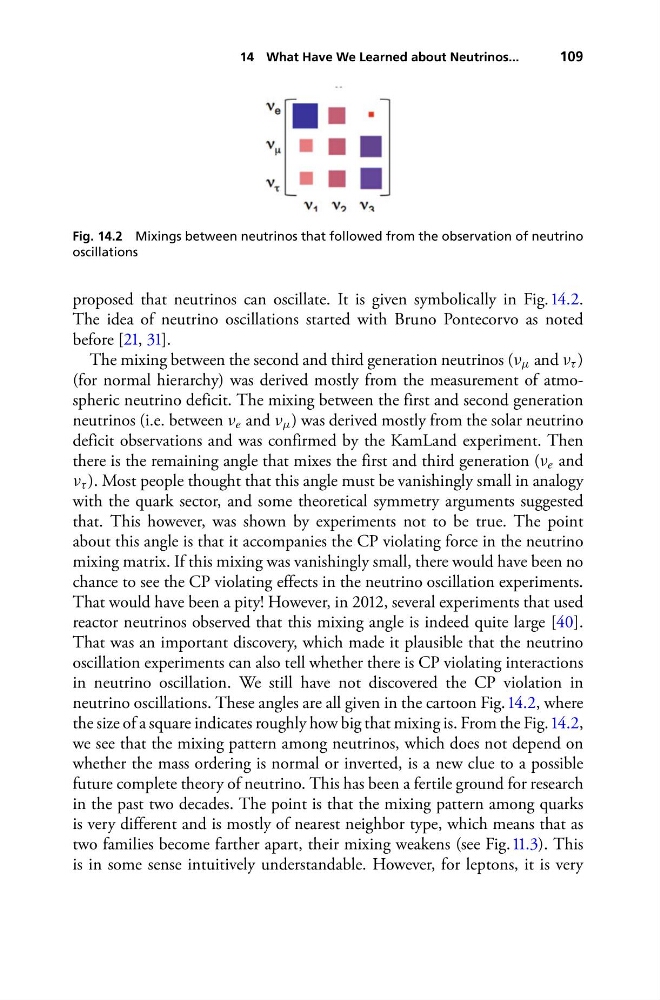
Fig. 14.2 Mixings between neutrinos that followed from the observation of neutrino
oscillations
proposed that neutrinos can oscillate. It is given symbolically in Fig. 14.2.
The idea of neutrino oscillations started with Bruno Pontecorvo as noted
before [21, 31].
The mixing between the second and third generation neutrinos (ν μ and ν τ )
(for normal hierarchy) was derived mostly from the measurement of atmospheric neutrino deficit. The mixing between the first and second generation
neutrinos (i.e. between ν e and ν μ ) was derived mostly from the solar neutrino
deficit observations and was confirmed by the KamLand experiment. Then
there is the remaining angle that mixes the first and third generation (ν e and
ν τ ). Most people thought that this angle must be vanishingly small in analogy
with the quark sector, and some theoretical symmetry arguments suggested
that. This however, was shown by experiments not to be true. The point
about this angle is that it accompanies the CP violating force in the neutrino
mixing matrix. If this mixing was vanishingly small, there would have been no
chance to see the CP violating effects in the neutrino oscillation experiments.
That would have been a pity! However, in 2012, several experiments that used
reactor neutrinos observed that this mixing angle is indeed quite large [40].
That was an important discovery, which made it plausible that the neutrino
oscillation experiments can also tell whether there is CP violating interactions
in neutrino oscillation. We still have not discovered the CP violation in
neutrino oscillations. These angles are all given in the cartoon Fig. 14.2, where
the size of a square indicates roughly how big that mixing is. From the Fig. 14.2,
we see that the mixing pattern among neutrinos, which does not depend on
whether the mass ordering is normal or inverted, is a new clue to a possible
future complete theory of neutrino. This has been a fertile ground for research
in the past two decades. The point is that the mixing pattern among quarks
is very different and is mostly of nearest neighbor type, which means that as
two families become farther apart, their mixing weakens (see Fig. 11.3). This
is in some sense intuitively understandable. However, for leptons, it is very
109
Fig. 14.2 Mixings between neutrinos that followed from the observation of neutrino
oscillations
proposed that neutrinos can oscillate. It is given symbolically in Fig. 14.2.
The idea of neutrino oscillations started with Bruno Pontecorvo as noted
before [21, 31].
The mixing between the second and third generation neutrinos (ν μ and ν τ )
(for normal hierarchy) was derived mostly from the measurement of atmospheric neutrino deficit. The mixing between the first and second generation
neutrinos (i.e. between ν e and ν μ ) was derived mostly from the solar neutrino
deficit observations and was confirmed by the KamLand experiment. Then
there is the remaining angle that mixes the first and third generation (ν e and
ν τ ). Most people thought that this angle must be vanishingly small in analogy
with the quark sector, and some theoretical symmetry arguments suggested
that. This however, was shown by experiments not to be true. The point
about this angle is that it accompanies the CP violating force in the neutrino
mixing matrix. If this mixing was vanishingly small, there would have been no
chance to see the CP violating effects in the neutrino oscillation experiments.
That would have been a pity! However, in 2012, several experiments that used
reactor neutrinos observed that this mixing angle is indeed quite large [40].
That was an important discovery, which made it plausible that the neutrino
oscillation experiments can also tell whether there is CP violating interactions
in neutrino oscillation. We still have not discovered the CP violation in
neutrino oscillations. These angles are all given in the cartoon Fig. 14.2, where
the size of a square indicates roughly how big that mixing is. From the Fig. 14.2,
we see that the mixing pattern among neutrinos, which does not depend on
whether the mass ordering is normal or inverted, is a new clue to a possible
future complete theory of neutrino. This has been a fertile ground for research
in the past two decades. The point is that the mixing pattern among quarks
is very different and is mostly of nearest neighbor type, which means that as
two families become farther apart, their mixing weakens (see Fig. 11.3). This
is in some sense intuitively understandable. However, for leptons, it is very