

98
R. N. Mohapatra
13.5 Super-Kamiokande Experiment
The Davis experiment was followed by a major experiment in Japan, the
Super-Kamiokande experiment, located in Mozumi mine below Japanese Alps,
owned by the Kamioka Mining Company. The experiment used purified water
instead of dry-cleaning fluid. The 50 kilotons of water in the detector were
surrounded by more than 11,000 photo-multiplier tubes that were used to
detect light emitted in a neutrino reaction. The idea was that if a solar or
atmospheric (cosmic ray) neutrino meets a neutron in the water molecule,
it would undergo weak force reaction and produce an electron or muon
together with a proton. The electron or muon will be traveling at a high
enough speed in water to be relativistic. Inside water, the speed of light is
less than in empty space. When that happens, the light produced by the fast
moving electron will travel in a cone, called a Cherenkov cone, named after
the Russian physicist Pavel Cherenkov, who won the 1958 Nobel Prize for
his discovery. An analogous phenomenon happens in a water tank when a
duck swims faster than the speed of sound in water. There is a cone, which is
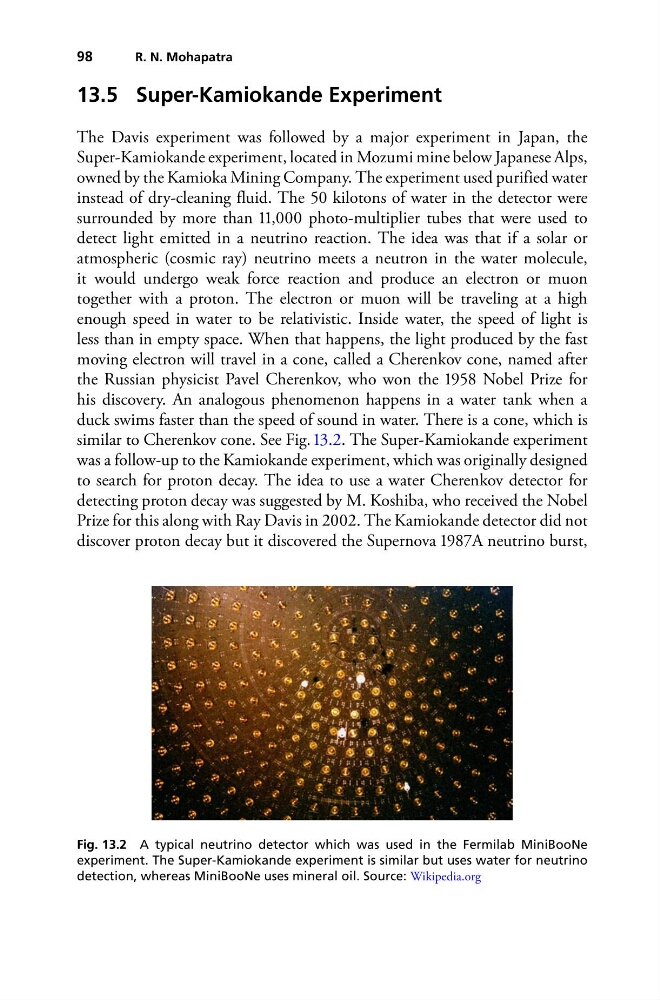
similar to Cherenkov cone. See Fig. 13.2. The Super-Kamiokande experiment
was a follow-up to the Kamiokande experiment, which was originally designed
to search for proton decay. The idea to use a water Cherenkov detector for
detecting proton decay was suggested by M. Koshiba, who received the Nobel
Prize for this along with Ray Davis in 2002. The Kamiokande detector did not
discover proton decay but it discovered the Supernova 1987A neutrino burst,
Fig. 13.2 A typical neutrino detector which was used in the Fermilab MiniBooNe
experiment. The Super-Kamiokande experiment is similar but uses water for neutrino
detection, whereas MiniBooNe uses mineral oil. Source: Wikipedia.org
R. N. Mohapatra
13.5 Super-Kamiokande Experiment
The Davis experiment was followed by a major experiment in Japan, the
Super-Kamiokande experiment, located in Mozumi mine below Japanese Alps,
owned by the Kamioka Mining Company. The experiment used purified water
instead of dry-cleaning fluid. The 50 kilotons of water in the detector were
surrounded by more than 11,000 photo-multiplier tubes that were used to
detect light emitted in a neutrino reaction. The idea was that if a solar or
atmospheric (cosmic ray) neutrino meets a neutron in the water molecule,
it would undergo weak force reaction and produce an electron or muon
together with a proton. The electron or muon will be traveling at a high
enough speed in water to be relativistic. Inside water, the speed of light is
less than in empty space. When that happens, the light produced by the fast
moving electron will travel in a cone, called a Cherenkov cone, named after
the Russian physicist Pavel Cherenkov, who won the 1958 Nobel Prize for
his discovery. An analogous phenomenon happens in a water tank when a
duck swims faster than the speed of sound in water. There is a cone, which is
similar to Cherenkov cone. See Fig. 13.2. The Super-Kamiokande experiment
was a follow-up to the Kamiokande experiment, which was originally designed
to search for proton decay. The idea to use a water Cherenkov detector for
detecting proton decay was suggested by M. Koshiba, who received the Nobel
Prize for this along with Ray Davis in 2002. The Kamiokande detector did not
discover proton decay but it discovered the Supernova 1987A neutrino burst,
Fig. 13.2 A typical neutrino detector which was used in the Fermilab MiniBooNe
experiment. The Super-Kamiokande experiment is similar but uses water for neutrino
detection, whereas MiniBooNe uses mineral oil. Source: Wikipedia.org