

© Dunod – La photocopie non autorisée est un délit
SOLUTIONS
Solutions
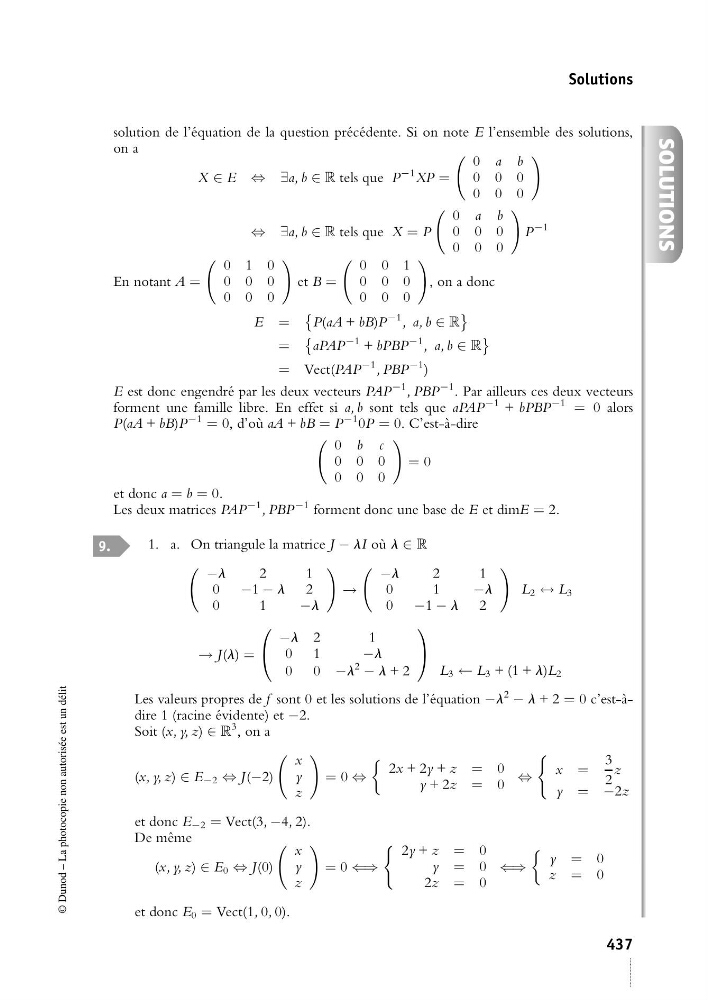
solution de l’équation de la question précédente. Si on note E l’ensemble des solutions,
on a
X ∈ E ⇔ ∃a, b ∈ R tels que P
−1 XP =
0 a b
0 0 0
0 0 0
⇔ ∃a, b ∈ R tels que X = P
0 a b
0 0 0
0 0 0
P
−1
En notant A =
0 1 0
0 0 0
0 0 0
et B =
0 0 1
0 0 0
0 0 0
, on a donc
E =
P(aA + bB)P
−1 , a, b ∈ R
=
aPAP
−1 + bPBP
−1 , a, b ∈ R
= Vect(PAP
−1 , PBP
−1 )
E est donc engendré par les deux vecteurs PAP
−1 , PBP
−1 . Par ailleurs ces deux vecteurs
forment une famille libre. En effet si a, b sont tels que aPAP
−1 + bPBP
−1 = 0 alors
P(aA + bB)P
−1 = 0, d’où aA + bB = P
−1 0P = 0. C’est-à-dire
0 b c
0 0 0
0 0 0
= 0
et donc a = b = 0.
Les deux matrices PAP
−1 , PBP
−1 forment donc une base de E et dimE = 2.
9.
1. a. On triangule la matrice J − lI où l ∈ R
−l
2
1
0 −1 − l 2
0
1
−l
→
−l
2
1
0
1
−l
0 −1 − l 2
L 2 ↔ L 3
→ J(l) =
⎛
⎝
−l 2
1
0 1
−l
0 0 −l
2
− l + 2
⎞
⎠
L 3 ← L 3 + (1 + l)L 2
Les valeurs propres de f sont 0 et les solutions de l’équation −l
2
− l + 2 = 0 c’est-àdire 1 (racine évidente) et −2.
Soit (x, y, z) ∈ R
3 , on a
(x, y, z) ∈ E −2 ⇔ J(−2)
x
y
z
= 0 ⇔
2x + 2y + z = 0
y + 2z = 0
⇔
x =
3
2
z
y = −2z
et donc E −2 = Vect(3, −4, 2).
De même
(x, y, z) ∈ E 0 ⇔ J(0)
x
y
z
= 0 ⇐⇒
2y + z = 0
y = 0
2z = 0
⇐⇒
y = 0
z = 0
et donc E 0 = Vect(1, 0, 0).
437
SOLUTIONS
Solutions
solution de l’équation de la question précédente. Si on note E l’ensemble des solutions,
on a
X ∈ E ⇔ ∃a, b ∈ R tels que P
−1 XP =
0 a b
0 0 0
0 0 0
⇔ ∃a, b ∈ R tels que X = P
0 a b
0 0 0
0 0 0
P
−1
En notant A =
0 1 0
0 0 0
0 0 0
et B =
0 0 1
0 0 0
0 0 0
, on a donc
E =
P(aA + bB)P
−1 , a, b ∈ R
=
aPAP
−1 + bPBP
−1 , a, b ∈ R
= Vect(PAP
−1 , PBP
−1 )
E est donc engendré par les deux vecteurs PAP
−1 , PBP
−1 . Par ailleurs ces deux vecteurs
forment une famille libre. En effet si a, b sont tels que aPAP
−1 + bPBP
−1 = 0 alors
P(aA + bB)P
−1 = 0, d’où aA + bB = P
−1 0P = 0. C’est-à-dire
0 b c
0 0 0
0 0 0
= 0
et donc a = b = 0.
Les deux matrices PAP
−1 , PBP
−1 forment donc une base de E et dimE = 2.
9.
1. a. On triangule la matrice J − lI où l ∈ R
−l
2
1
0 −1 − l 2
0
1
−l
→
−l
2
1
0
1
−l
0 −1 − l 2
L 2 ↔ L 3
→ J(l) =
⎛
⎝
−l 2
1
0 1
−l
0 0 −l
2
− l + 2
⎞
⎠
L 3 ← L 3 + (1 + l)L 2
Les valeurs propres de f sont 0 et les solutions de l’équation −l
2
− l + 2 = 0 c’est-àdire 1 (racine évidente) et −2.
Soit (x, y, z) ∈ R
3 , on a
(x, y, z) ∈ E −2 ⇔ J(−2)
x
y
z
= 0 ⇔
2x + 2y + z = 0
y + 2z = 0
⇔
x =
3
2
z
y = −2z
et donc E −2 = Vect(3, −4, 2).
De même
(x, y, z) ∈ E 0 ⇔ J(0)
x
y
z
= 0 ⇐⇒
2y + z = 0
y = 0
2z = 0
⇐⇒
y = 0
z = 0
et donc E 0 = Vect(1, 0, 0).
437