

WORKED PROBLEMS
663
Problem 16.20 (level 2; chapters 6, 7, 8 and 10)
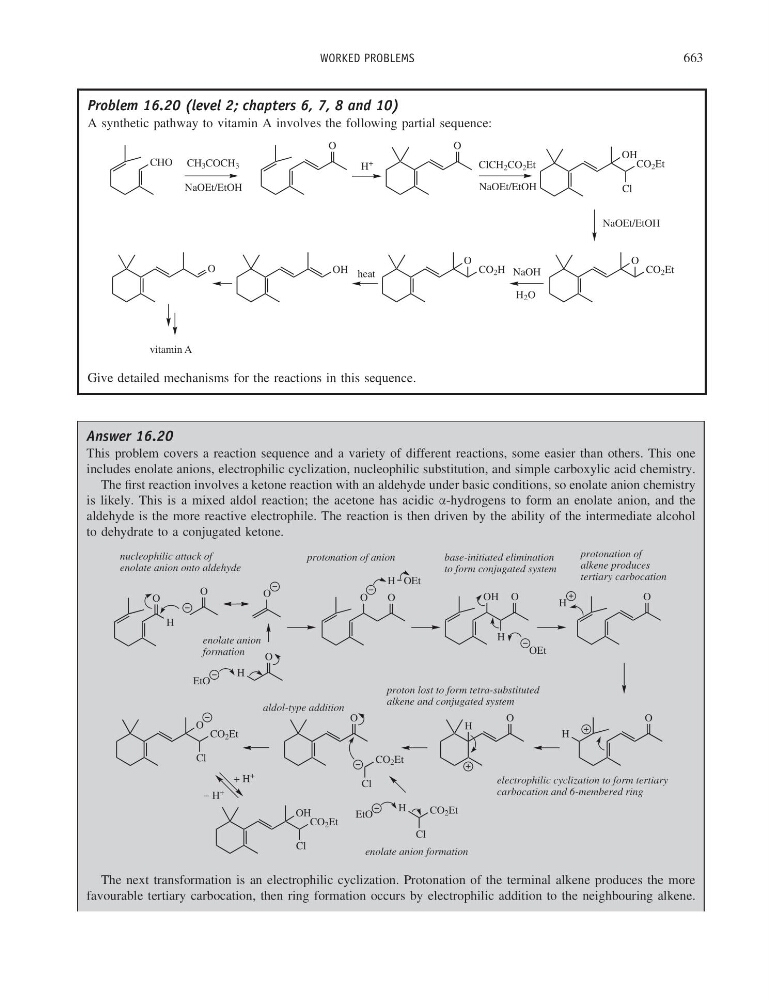
A synthetic pathway to vitamin A involves the following partial sequence:
O
O
CHO
H
+
CH 3 COCH 3
NaOEt/EtOH
ClCH 2 CO 2 Et
NaOEt/EtOH
CO 2 Et
Cl
OH
CO 2 Et
O
NaOEt/EtOH
CO 2 H
O
heat
O
OH
vitamin A
H 2 O
NaOH
Give detailed mechanisms for the reactions in this sequence.
Answer 16.20
This problem covers a reaction sequence and a variety of different reactions, some easier than others. This one
includes enolate anions, electrophilic cyclization, nucleophilic substitution, and simple carboxylic acid chemistry.
The first reaction involves a ketone reaction with an aldehyde under basic conditions, so enolate anion chemistry
is likely. This is a mixed aldol reaction; the acetone has acidic α-hydrogens to form an enolate anion, and the
aldehyde is the more reactive electrophile. The reaction is then driven by the ability of the intermediate alcohol
to dehydrate to a conjugated ketone.
O
H
O
H
EtO
O
O
O
O
H OEt
O
OH
H
OEt
O
H
O
H
O
H
O
enolate anion
formation
nucleophilic attack of
enolate anion onto aldehyde
protonation of anion
base-initiated elimination
to form conjugated system
protonation of
alkene produces
tertiary carbocation
electrophilic cyclization to form tertiary
carbocation and 6-membered ring
proton lost to form tetra-substituted
alkene and conjugated system
Cl
H
CO 2 Et
EtO
Cl
CO 2 Et
CO 2 Et
Cl
O
CO 2 Et
Cl
OH
+ H
+
− H
+
enolate anion formation
aldol-type addition
The next transformation is an electrophilic cyclization. Protonation of the terminal alkene produces the more
favourable tertiary carbocation, then ring formation occurs by electrophilic addition to the neighbouring alkene.