

662
HOW TO APPROACH EXAMINATION QUESTIONS: SELECTED PROBLEMS AND ANSWERS
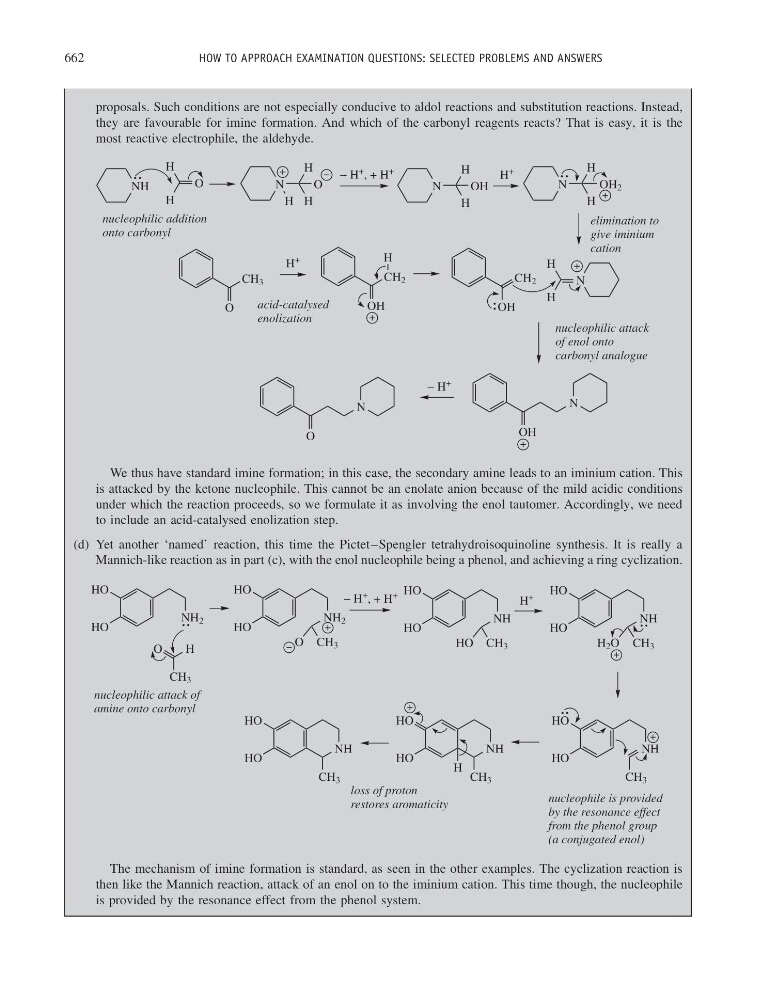
proposals. Such conditions are not especially conducive to aldol reactions and substitution reactions. Instead,
they are favourable for imine formation. And which of the carbonyl reagents reacts? That is easy, it is the
most reactive electrophile, the aldehyde.
NH
O
H
H
N
H
H
O
H
N
H
H
OH
N
H
H
OH 2
N
H
H
CH 2
OH
H
CH 3
O
CH 2
OH
OH
N
O
N
− H + , + H +
nucleophilic addition
onto carbonyl
H
+
elimination to
give iminium
cation
acid-catalysed
enolization
H
+
nucleophilic attack
of enol onto
carbonyl analogue
− H +
We thus have standard imine formation; in this case, the secondary amine leads to an iminium cation. This
is attacked by the ketone nucleophile. This cannot be an enolate anion because of the mild acidic conditions
under which the reaction proceeds, so we formulate it as involving the enol tautomer. Accordingly, we need
to include an acid-catalysed enolization step.
(d) Yet another ‘named’ reaction, this time the Pictet–Spengler tetrahydroisoquinoline synthesis. It is really a
Mannich-like reaction as in part (c), with the enol nucleophile being a phenol, and achieving a ring cyclization.
NH
HO
NH
HO
CH 3
CH 3
HO
NH 2
H
NH
HO
CH 3
nucleophile is provided
by the resonance effect
from the phenol group
(a conjugated enol)
loss of proton
restores aromaticity
HO
HO
HO
HO
CH 3
O
H
NH 2
HO
CH 3
HO
O
NH
HO
CH 3
HO
HO
NH
HO
CH 3
HO
H 2 O
nucleophilic attack of
amine onto carbonyl
− H + , + H
+
H +
The mechanism of imine formation is standard, as seen in the other examples. The cyclization reaction is
then like the Mannich reaction, attack of an enol on to the iminium cation. This time though, the nucleophile
is provided by the resonance effect from the phenol system.