

52
ATOMIC STRUCTURE AND BONDING
Table 2.3 Typical bond lengths
a
Bond type
Bond
Length ( ˚
A)
Bond
Length ( ˚
A)
Bond
Length ( ˚
A)
Single H–X
H–C
1.06–1.10
H–N
1.01
H–O
0.96
Single C–X
C–C
1.54
C–N
1.47
C–O
1.43
Double
C=C
1 . 3 4
C =N
1 . 3 0
C =O
1 . 2 3
Triple
C≡C
1 . 2 0
C ≡N
1 . 1 6
Aromatic
C–C aromatic
1.40
a 1 ˚
A (Angstrom unit) = 10
−10 m.
With these five typical bond lengths, and the typical
bond angles for tetrahedral, trigonal, and linear arrays, it
becomes possible to construct molecular models to predict a molecule’s size and shape. This may be achieved
via a molecular model kit, or by computer graphics.
Many different molecular model kits have been
produced over the years, each varying in their approach
to atoms and bonds, and also in their cost. However,
there are three main types, which can provide us
with three main types of information. These are the
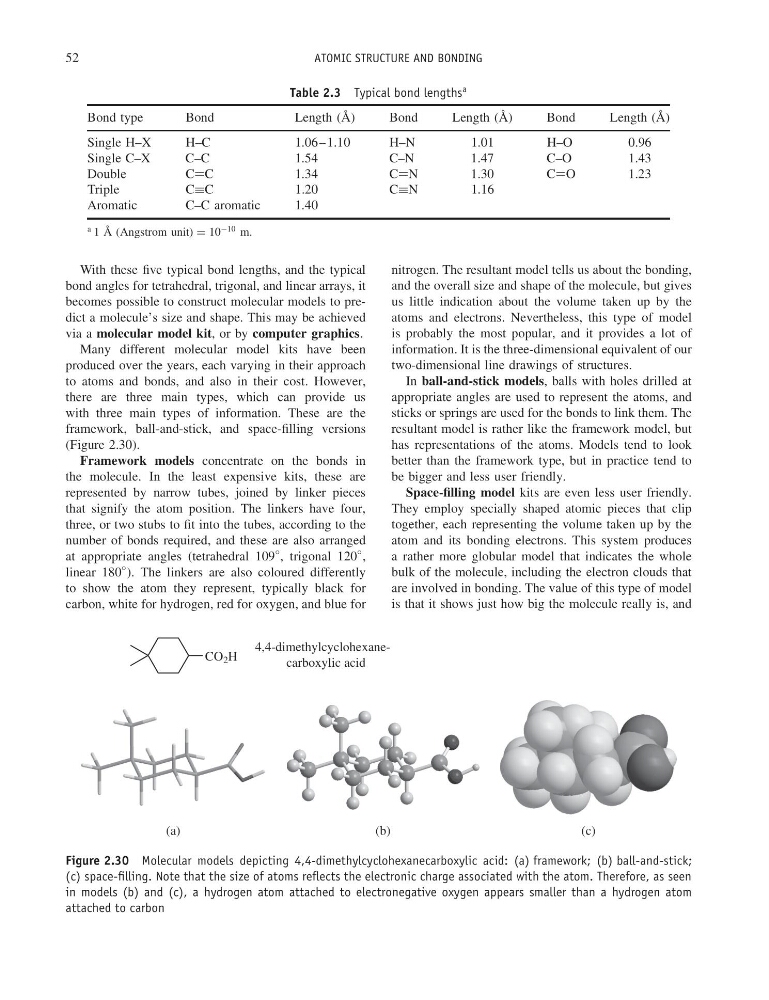
framework, ball-and-stick, and space-filling versions
(Figure 2.30).
Framework models concentrate on the bonds in
the molecule. In the least expensive kits, these are
represented by narrow tubes, joined by linker pieces
that signify the atom position. The linkers have four,
three, or two stubs to fit into the tubes, according to the
number of bonds required, and these are also arranged
at appropriate angles (tetrahedral 109
◦ , trigonal 120
◦ ,
linear 180
◦ ). The linkers are also coloured differently
to show the atom they represent, typically black for
carbon, white for hydrogen, red for oxygen, and blue for
nitrogen. The resultant model tells us about the bonding,
and the overall size and shape of the molecule, but gives
us little indication about the volume taken up by the
atoms and electrons. Nevertheless, this type of model
is probably the most popular, and it provides a lot of
information. It is the three-dimensional equivalent of our
two-dimensional line drawings of structures.
In ball-and-stick models, balls with holes drilled at
appropriate angles are used to represent the atoms, and
sticks or springs are used for the bonds to link them. The
resultant model is rather like the framework model, but
has representations of the atoms. Models tend to look
better than the framework type, but in practice tend to
be bigger and less user friendly.
Space-filling model kits are even less user friendly.
They employ specially shaped atomic pieces that clip
together, each representing the volume taken up by the
atom and its bonding electrons. This system produces
a rather more globular model that indicates the whole
bulk of the molecule, including the electron clouds that
are involved in bonding. The value of this type of model
is that it shows just how big the molecule really is, and
CO 2 H
4,4-dimethylcyclohexanecarboxylic acid
(a)
(b)
(c)
Figure 2.30 Molecular models depicting 4,4-dimethylcyclohexanecarboxylic acid: (a) framework; (b) ball-and-stick;
(c) space-filling. Note that the size of atoms reflects the electronic charge associated with the atom. Therefore, as seen
in models (b) and (c), a hydrogen atom attached to electronegative oxygen appears smaller than a hydrogen atom
attached to carbon
ATOMIC STRUCTURE AND BONDING
Table 2.3 Typical bond lengths
a
Bond type
Bond
Length ( ˚
A)
Bond
Length ( ˚
A)
Bond
Length ( ˚
A)
Single H–X
H–C
1.06–1.10
H–N
1.01
H–O
0.96
Single C–X
C–C
1.54
C–N
1.47
C–O
1.43
Double
C=C
1 . 3 4
C =N
1 . 3 0
C =O
1 . 2 3
Triple
C≡C
1 . 2 0
C ≡N
1 . 1 6
Aromatic
C–C aromatic
1.40
a 1 ˚
A (Angstrom unit) = 10
−10 m.
With these five typical bond lengths, and the typical
bond angles for tetrahedral, trigonal, and linear arrays, it
becomes possible to construct molecular models to predict a molecule’s size and shape. This may be achieved
via a molecular model kit, or by computer graphics.
Many different molecular model kits have been
produced over the years, each varying in their approach
to atoms and bonds, and also in their cost. However,
there are three main types, which can provide us
with three main types of information. These are the
framework, ball-and-stick, and space-filling versions
(Figure 2.30).
Framework models concentrate on the bonds in
the molecule. In the least expensive kits, these are
represented by narrow tubes, joined by linker pieces
that signify the atom position. The linkers have four,
three, or two stubs to fit into the tubes, according to the
number of bonds required, and these are also arranged
at appropriate angles (tetrahedral 109
◦ , trigonal 120
◦ ,
linear 180
◦ ). The linkers are also coloured differently
to show the atom they represent, typically black for
carbon, white for hydrogen, red for oxygen, and blue for
nitrogen. The resultant model tells us about the bonding,
and the overall size and shape of the molecule, but gives
us little indication about the volume taken up by the
atoms and electrons. Nevertheless, this type of model
is probably the most popular, and it provides a lot of
information. It is the three-dimensional equivalent of our
two-dimensional line drawings of structures.
In ball-and-stick models, balls with holes drilled at
appropriate angles are used to represent the atoms, and
sticks or springs are used for the bonds to link them. The
resultant model is rather like the framework model, but
has representations of the atoms. Models tend to look
better than the framework type, but in practice tend to
be bigger and less user friendly.
Space-filling model kits are even less user friendly.
They employ specially shaped atomic pieces that clip
together, each representing the volume taken up by the
atom and its bonding electrons. This system produces
a rather more globular model that indicates the whole
bulk of the molecule, including the electron clouds that
are involved in bonding. The value of this type of model
is that it shows just how big the molecule really is, and
CO 2 H
4,4-dimethylcyclohexanecarboxylic acid
(a)
(b)
(c)
Figure 2.30 Molecular models depicting 4,4-dimethylcyclohexanecarboxylic acid: (a) framework; (b) ball-and-stick;
(c) space-filling. Note that the size of atoms reflects the electronic charge associated with the atom. Therefore, as seen
in models (b) and (c), a hydrogen atom attached to electronegative oxygen appears smaller than a hydrogen atom
attached to carbon