

MOLECULAR MODELS
51
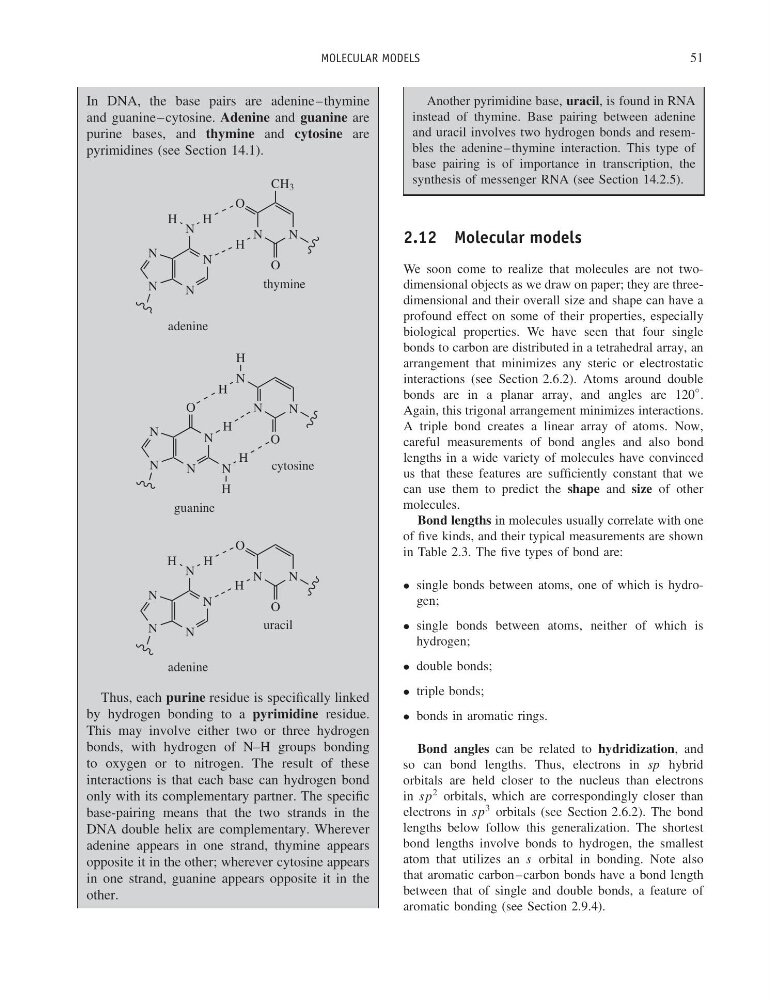
In DNA, the base pairs are adenine–thymine
and guanine–cytosine. Adenine and guanine are
purine bases, and thymine and cytosine are
pyrimidines (see Section 14.1).
N
N
N
O
N
N
N
N
N
N
N
N
N
O
N
N
N
O
O
CH 3
adenine
thymine
guanine
cytosine
H
H
H
H
H
H
H
H
N
N
N
N
N
N
N
O
O
adenine
uracil
H
H
H
Thus, each purine residue is specifically linked
by hydrogen bonding to a pyrimidine residue.
This may involve either two or three hydrogen
bonds, with hydrogen of N–H groups bonding
to oxygen or to nitrogen. The result of these
interactions is that each base can hydrogen bond
only with its complementary partner. The specific
base-pairing means that the two strands in the
DNA double helix are complementary. Wherever
adenine appears in one strand, thymine appears
opposite it in the other; wherever cytosine appears
in one strand, guanine appears opposite it in the
other.
Another pyrimidine base, uracil, is found in RNA
instead of thymine. Base pairing between adenine
and uracil involves two hydrogen bonds and resembles the adenine–thymine interaction. This type of
base pairing is of importance in transcription, the
synthesis of messenger RNA (see Section 14.2.5).
2.12 Molecular models
We soon come to realize that molecules are not twodimensional objects as we draw on paper; they are threedimensional and their overall size and shape can have a
profound effect on some of their properties, especially
biological properties. We have seen that four single
bonds to carbon are distributed in a tetrahedral array, an
arrangement that minimizes any steric or electrostatic
interactions (see Section 2.6.2). Atoms around double
bonds are in a planar array, and angles are 120
◦ .
Again, this trigonal arrangement minimizes interactions.
A triple bond creates a linear array of atoms. Now,
careful measurements of bond angles and also bond
lengths in a wide variety of molecules have convinced
us that these features are sufficiently constant that we
can use them to predict the shape and size of other
molecules.
Bond lengths in molecules usually correlate with one
of five kinds, and their typical measurements are shown
in Table 2.3. The five types of bond are:
• single bonds between atoms, one of which is hydrogen;
• single bonds between atoms, neither of which is
hydrogen;
• double bonds;
• triple bonds;
• bonds in aromatic rings.
Bond angles can be related to hydridization, and
so can bond lengths. Thus, electrons in sp hybrid
orbitals are held closer to the nucleus than electrons
in sp
2 orbitals, which are correspondingly closer than
electrons in sp
3 orbitals (see Section 2.6.2). The bond
lengths below follow this generalization. The shortest
bond lengths involve bonds to hydrogen, the smallest
atom that utilizes an s orbital in bonding. Note also
that aromatic carbon–carbon bonds have a bond length
between that of single and double bonds, a feature of
aromatic bonding (see Section 2.9.4).
51
In DNA, the base pairs are adenine–thymine
and guanine–cytosine. Adenine and guanine are
purine bases, and thymine and cytosine are
pyrimidines (see Section 14.1).
N
N
N
O
N
N
N
N
N
N
N
N
N
O
N
N
N
O
O
CH 3
adenine
thymine
guanine
cytosine
H
H
H
H
H
H
H
H
N
N
N
N
N
N
N
O
O
adenine
uracil
H
H
H
Thus, each purine residue is specifically linked
by hydrogen bonding to a pyrimidine residue.
This may involve either two or three hydrogen
bonds, with hydrogen of N–H groups bonding
to oxygen or to nitrogen. The result of these
interactions is that each base can hydrogen bond
only with its complementary partner. The specific
base-pairing means that the two strands in the
DNA double helix are complementary. Wherever
adenine appears in one strand, thymine appears
opposite it in the other; wherever cytosine appears
in one strand, guanine appears opposite it in the
other.
Another pyrimidine base, uracil, is found in RNA
instead of thymine. Base pairing between adenine
and uracil involves two hydrogen bonds and resembles the adenine–thymine interaction. This type of
base pairing is of importance in transcription, the
synthesis of messenger RNA (see Section 14.2.5).
2.12 Molecular models
We soon come to realize that molecules are not twodimensional objects as we draw on paper; they are threedimensional and their overall size and shape can have a
profound effect on some of their properties, especially
biological properties. We have seen that four single
bonds to carbon are distributed in a tetrahedral array, an
arrangement that minimizes any steric or electrostatic
interactions (see Section 2.6.2). Atoms around double
bonds are in a planar array, and angles are 120
◦ .
Again, this trigonal arrangement minimizes interactions.
A triple bond creates a linear array of atoms. Now,
careful measurements of bond angles and also bond
lengths in a wide variety of molecules have convinced
us that these features are sufficiently constant that we
can use them to predict the shape and size of other
molecules.
Bond lengths in molecules usually correlate with one
of five kinds, and their typical measurements are shown
in Table 2.3. The five types of bond are:
• single bonds between atoms, one of which is hydrogen;
• single bonds between atoms, neither of which is
hydrogen;
• double bonds;
• triple bonds;
• bonds in aromatic rings.
Bond angles can be related to hydridization, and
so can bond lengths. Thus, electrons in sp hybrid
orbitals are held closer to the nucleus than electrons
in sp
2 orbitals, which are correspondingly closer than
electrons in sp
3 orbitals (see Section 2.6.2). The bond
lengths below follow this generalization. The shortest
bond lengths involve bonds to hydrogen, the smallest
atom that utilizes an s orbital in bonding. Note also
that aromatic carbon–carbon bonds have a bond length
between that of single and double bonds, a feature of
aromatic bonding (see Section 2.9.4).