

WORKED PROBLEMS
653
H
H
O
OH
base removes a proton
from α to carbonyl,
generating an enolate
anion
H
O
H
O
resonance
stabilization
H
O
H
O
H
O
enolate anion as nucleophile
adds to carbonyl
H OH
anion abstracts
proton from
solvent
H
O
H
OH
aldol addition
product
H
HO
H
O
H
under basic
conditions, this
dehydrates
product is favoured
by conjugation
α,β-unsaturated aldehyde
− H 2 O
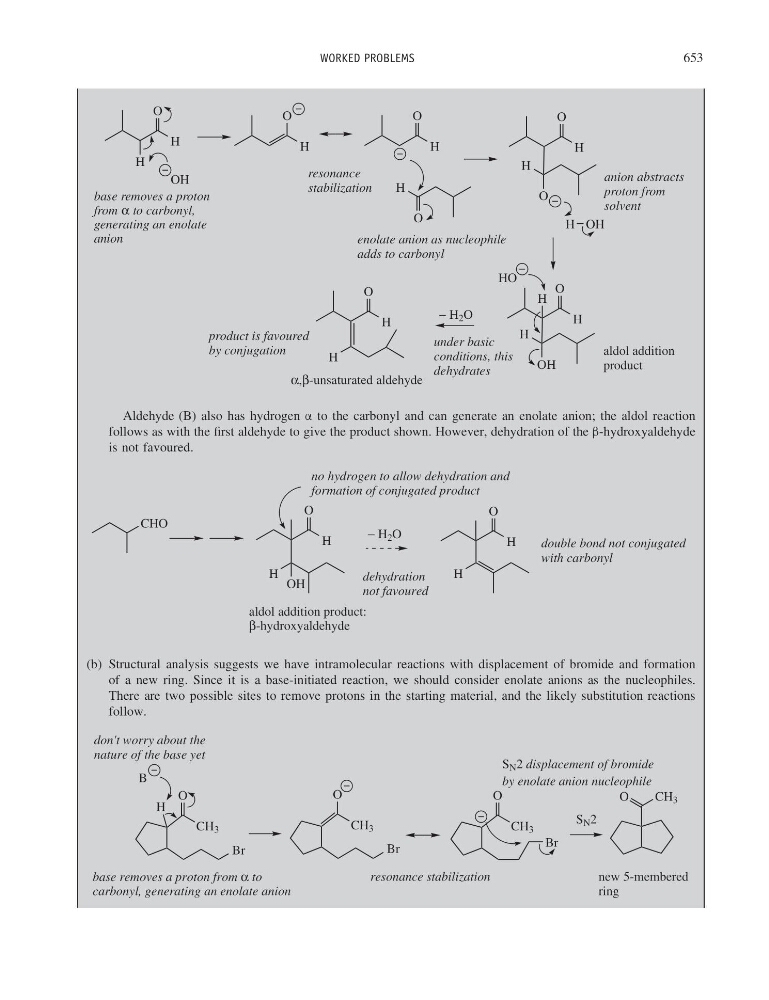
Aldehyde (B) also has hydrogen α to the carbonyl and can generate an enolate anion; the aldol reaction
follows as with the first aldehyde to give the product shown. However, dehydration of the β-hydroxyaldehyde
is not favoured.
CHO
H
O
OH
H
aldol addition product:
β-hydroxyaldehyde
H
O
H
− H 2 O
double bond not conjugated
with carbonyl
no hydrogen to allow dehydration and
formation of conjugated product
dehydration
not favoured
(b) Structural analysis suggests we have intramolecular reactions with displacement of bromide and formation
of a new ring. Since it is a base-initiated reaction, we should consider enolate anions as the nucleophiles.
There are two possible sites to remove protons in the starting material, and the likely substitution reactions
follow.
CH 3
O
Br
H
B
don't worry about the
nature of the base yet
CH 3
O
Br
CH 3
O
Br
O
CH 3
base removes a proton from α to
carbonyl, generating an enolate anion
resonance stabilization
S N 2
S N 2 displacement of bromide
by enolate anion nucleophile
new 5-membered
ring