

652
HOW TO APPROACH EXAMINATION QUESTIONS: SELECTED PROBLEMS AND ANSWERS
Problem 16.17 (level 2; chapter 10)
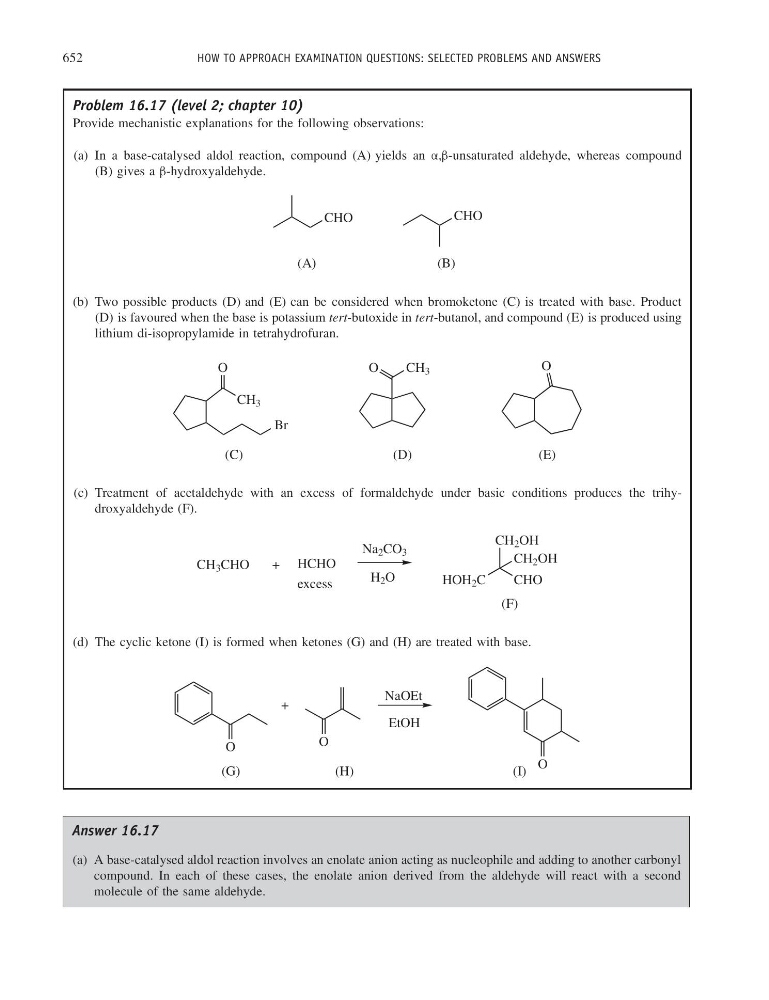
Provide mechanistic explanations for the following observations:
(a) In a base-catalysed aldol reaction, compound (A) yields an α,β-unsaturated aldehyde, whereas compound
(B) gives a β-hydroxyaldehyde.
CHO
CHO
(A)
(B)
(b) Two possible products (D) and (E) can be considered when bromoketone (C) is treated with base. Product
(D) is favoured when the base is potassium tert-butoxide in tert-butanol, and compound (E) is produced using
lithium di-isopropylamide in tetrahydrofuran.
CH 3
O
Br
O
CH 3
O
(E)
(C)
(D)
(c) Treatment of acetaldehyde with an excess of formaldehyde under basic conditions produces the trihydroxyaldehyde (F).
CH 3 CHO
+ HCHO
excess
Na 2 CO 3
H 2 O
CH 2 OH
HOH 2 C
CHO
CH 2 OH
(F)
(d) The cyclic ketone (I) is formed when ketones (G) and (H) are treated with base.
O
O
+
NaOEt
EtOH
O
(G)
(H)
(I)
Answer 16.17
(a) A base-catalysed aldol reaction involves an enolate anion acting as nucleophile and adding to another carbonyl
compound. In each of these cases, the enolate anion derived from the aldehyde will react with a second
molecule of the same aldehyde.