

WORKED PROBLEMS
623
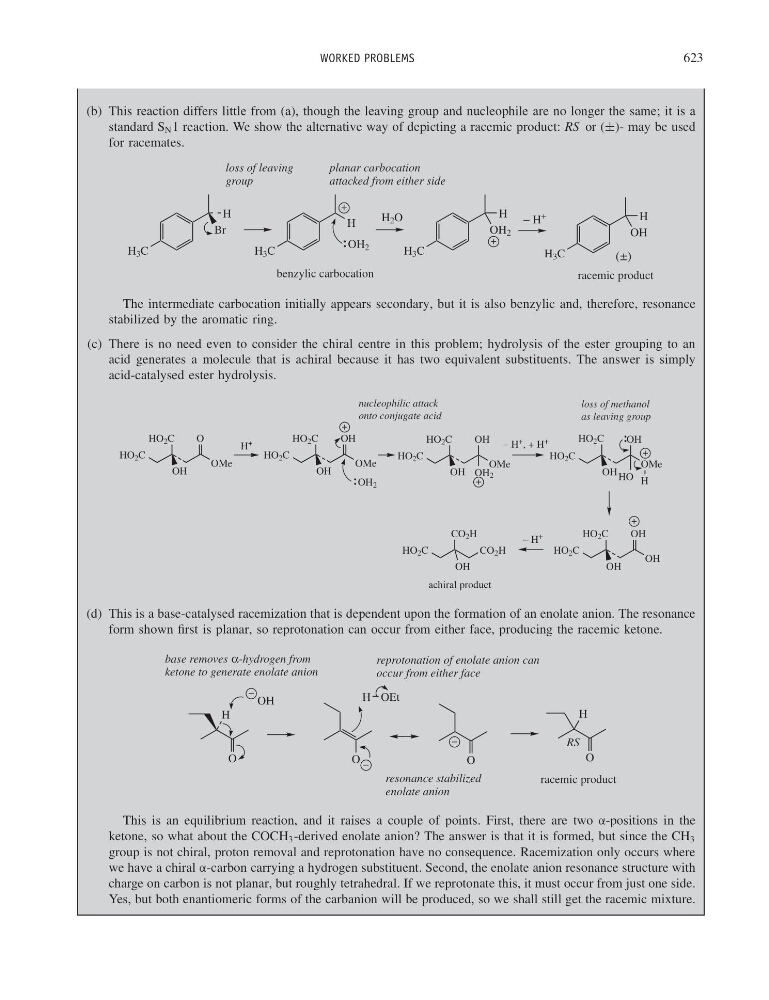
(b) This reaction differs little from (a), though the leaving group and nucleophile are no longer the same; it is a
standard S N 1 reaction. We show the alternative way of depicting a racemic product: RS or (±)- may be used
for racemates.
(±)
Br
H
H
OH 2
OH 2
H − H
+
OH
H
benzylic carbocation
racemic product
loss of leaving
group
planar carbocation
attacked from either side
H 3 C
H 3 C
H 3 C
H 3 C
H 2 O
The intermediate carbocation initially appears secondary, but it is also benzylic and, therefore, resonance
stabilized by the aromatic ring.
(c) There is no need even to consider the chiral centre in this problem; hydrolysis of the ester grouping to an
acid generates a molecule that is achiral because it has two equivalent substituents. The answer is simply
acid-catalysed ester hydrolysis.
HO 2 C
HO 2 C
OH
OMe
O
HO 2 C
HO 2 C
OH
OMe
OH
OH 2
HO 2 C
HO 2 C
OH
OMe
OH
OH 2
HO 2 C
HO 2 C
OH
OMe
OH
HO H
HO 2 C
HO 2 C
OH
OH
OH
HO 2 C
CO 2 H
CO 2 H
OH
H +
nucleophilic attack
onto conjugate acid
loss of methanol
as leaving group
− H
+
achiral product
− H + , + H +
(d) This is a base-catalysed racemization that is dependent upon the formation of an enolate anion. The resonance
form shown first is planar, so reprotonation can occur from either face, producing the racemic ketone.
O
H
OH
O
O
H OEt
O
H
RS
base removes α-hydrogen from
ketone to generate enolate anion
resonance stabilized
enolate anion
reprotonation of enolate anion can
occur from either face
racemic product
This is an equilibrium reaction, and it raises a couple of points. First, there are two α-positions in the
ketone, so what about the COCH 3 -derived enolate anion? The answer is that it is formed, but since the CH 3
group is not chiral, proton removal and reprotonation have no consequence. Racemization only occurs where
we have a chiral α-carbon carrying a hydrogen substituent. Second, the enolate anion resonance structure with
charge on carbon is not planar, but roughly tetrahedral. If we reprotonate this, it must occur from just one side.
Yes, but both enantiomeric forms of the carbanion will be produced, so we shall still get the racemic mixture.