

622
HOW TO APPROACH EXAMINATION QUESTIONS: SELECTED PROBLEMS AND ANSWERS
Problem 16.05 (level 1; chapters 3, 6, 7 and 10)
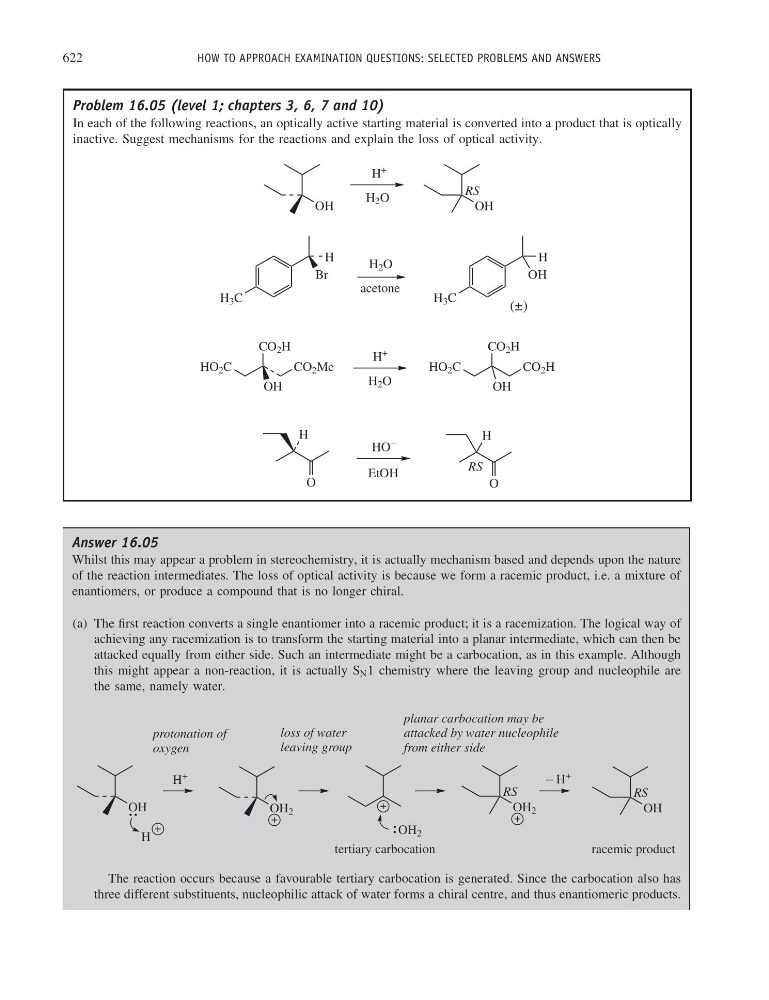
In each of the following reactions, an optically active starting material is converted into a product that is optically
inactive. Suggest mechanisms for the reactions and explain the loss of optical activity.
OH
OH
H
+
H 2 O
Br
H
OH
H
acetone
O
H
O
H
HO
−
EtOH
HO 2 C
CO 2 Me
CO 2 H
OH
HO 2 C
CO 2 H
CO 2 H
OH
H
+
H 2 O
RS
RS
(±)
H 3 C
H 3 C
H 2 O
Answer 16.05
Whilst this may appear a problem in stereochemistry, it is actually mechanism based and depends upon the nature
of the reaction intermediates. The loss of optical activity is because we form a racemic product, i.e. a mixture of
enantiomers, or produce a compound that is no longer chiral.
(a) The first reaction converts a single enantiomer into a racemic product; it is a racemization. The logical way of
achieving any racemization is to transform the starting material into a planar intermediate, which can then be
attacked equally from either side. Such an intermediate might be a carbocation, as in this example. Although
this might appear a non-reaction, it is actually S N 1 chemistry where the leaving group and nucleophile are
the same, namely water.
OH
H
OH 2
OH 2
OH 2
RS
OH
RS
H +
− H +
protonation of
oxygen
loss of water
leaving group
planar carbocation may be
attacked by water nucleophile
from either side
racemic product
tertiary carbocation
The reaction occurs because a favourable tertiary carbocation is generated. Since the carbocation also has
three different substituents, nucleophilic attack of water forms a chiral centre, and thus enantiomeric products.