

WORKED PROBLEMS
619
Only three of the compounds shown have chiral centres; these are indicated. These three compounds could,
therefore, exist in optically active form. None of the compounds shown is a meso compound. Note that we
have to consider part of the ring system as a ‘group’ attached to the centre in question. Follow this around
until a decision can be made. The last two are not exactly trick questions, but require care. One has a plane
of symmetry, and the carbon carrying the hydroxyl has two of its attached groups the same; the benzene ring
is planar, so none of its carbons has the potential to be chiral.
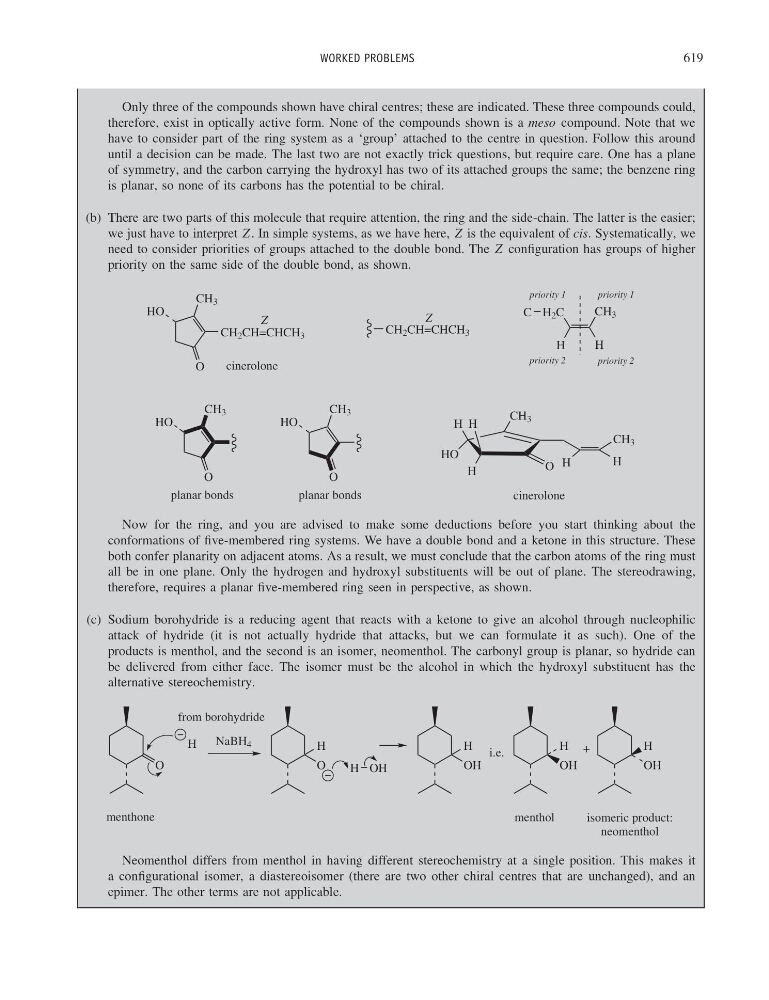
(b) There are two parts of this molecule that require attention, the ring and the side-chain. The latter is the easier;
we just have to interpret Z. In simple systems, as we have here, Z is the equivalent of cis. Systematically, we
need to consider priorities of groups attached to the double bond. The Z configuration has groups of higher
priority on the same side of the double bond, as shown.
CH 3
O
CH 2 CH=CHCH 3
HO
Z
cinerolone
CH 2 CH=CHCH 3
Z
C H 2 C
CH 3
H
H
priority 1
priority 2
priority 1
priority 2
CH 3
O
HO
CH 3
O
HO
planar bonds
planar bonds
CH 3
O
H
H
HO
H
CH 3
H
H
cinerolone
Now for the ring, and you are advised to make some deductions before you start thinking about the
conformations of five-membered ring systems. We have a double bond and a ketone in this structure. These
both confer planarity on adjacent atoms. As a result, we must conclude that the carbon atoms of the ring must
all be in one plane. Only the hydrogen and hydroxyl substituents will be out of plane. The stereodrawing,
therefore, requires a planar five-membered ring seen in perspective, as shown.
(c) Sodium borohydride is a reducing agent that reacts with a ketone to give an alcohol through nucleophilic
attack of hydride (it is not actually hydride that attacks, but we can formulate it as such). One of the
products is menthol, and the second is an isomer, neomenthol. The carbonyl group is planar, so hydride can
be delivered from either face. The isomer must be the alcohol in which the hydroxyl substituent has the
alternative stereochemistry.
O
menthone
H
from borohydride
O
NaBH 4
H
H OH
OH
H
OH
H
OH
H
i.e.
menthol
isomeric product:
neomenthol
+
Neomenthol differs from menthol in having different stereochemistry at a single position. This makes it
a configurational isomer, a diastereoisomer (there are two other chiral centres that are unchanged), and an
epimer. The other terms are not applicable.