

618
HOW TO APPROACH EXAMINATION QUESTIONS: SELECTED PROBLEMS AND ANSWERS
Problem 16.03 (level 1; chapters 3 and 7)
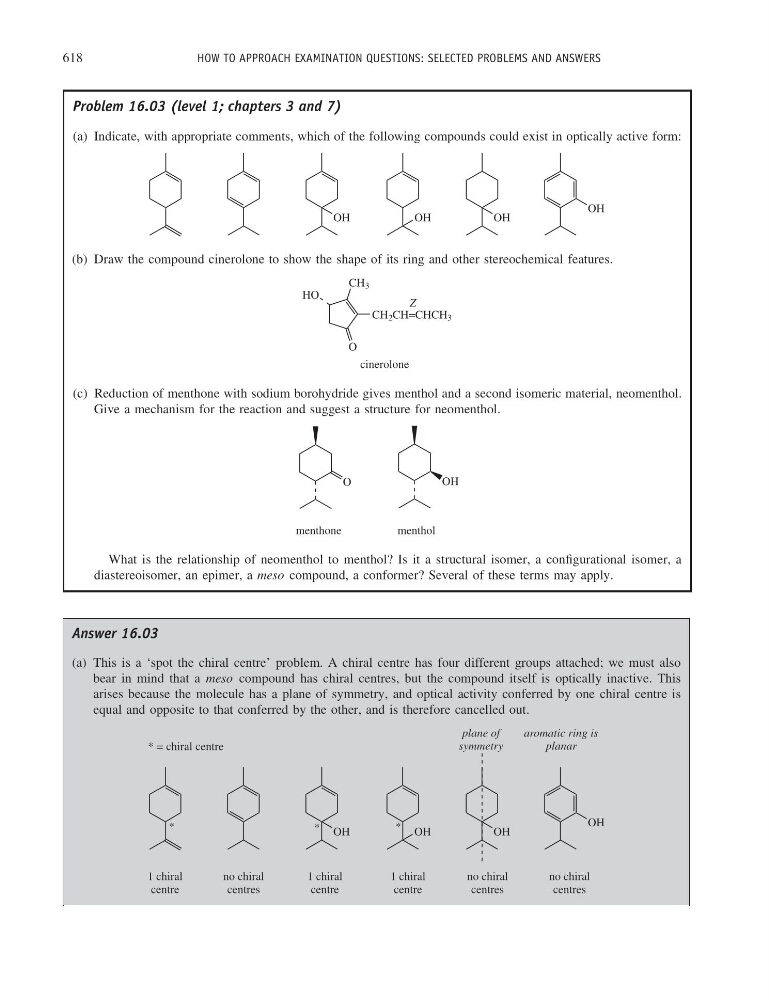
(a) Indicate, with appropriate comments, which of the following compounds could exist in optically active form:
OH
OH
OH
OH
(b) Draw the compound cinerolone to show the shape of its ring and other stereochemical features.
CH 3
O
CH 2 CH=CHCH 3
HO
Z
cinerolone
(c) Reduction of menthone with sodium borohydride gives menthol and a second isomeric material, neomenthol.
Give a mechanism for the reaction and suggest a structure for neomenthol.
OH
O
menthol
menthone
What is the relationship of neomenthol to menthol? Is it a structural isomer, a configurational isomer, a
diastereoisomer, an epimer, a meso compound, a conformer? Several of these terms may apply.
Answer 16.03
(a) This is a ‘spot the chiral centre’ problem. A chiral centre has four different groups attached; we must also
bear in mind that a meso compound has chiral centres, but the compound itself is optically inactive. This
arises because the molecule has a plane of symmetry, and optical activity conferred by one chiral centre is
equal and opposite to that conferred by the other, and is therefore cancelled out.
OH
OH
OH
OH
*
*
*
1 chiral
centre
no chiral
centres
1 chiral
centre
1 chiral
centre
no chiral
centres
no chiral
centres
plane of
symmetry
aromatic ring is
planar
* = chiral centre