

44
ATOMIC STRUCTURE AND BONDING
structure like benzene, but has two nonbonding electrons; it does not have the special stability we see in
benzene. As we have seen in Section 2.9.2, cyclooctatetraene also adopts a non-planar shape, lacks the
stabilization associated with conjugation, and behaves
like four separate normal alkenes.
2.9.4 Kekul´ e structures
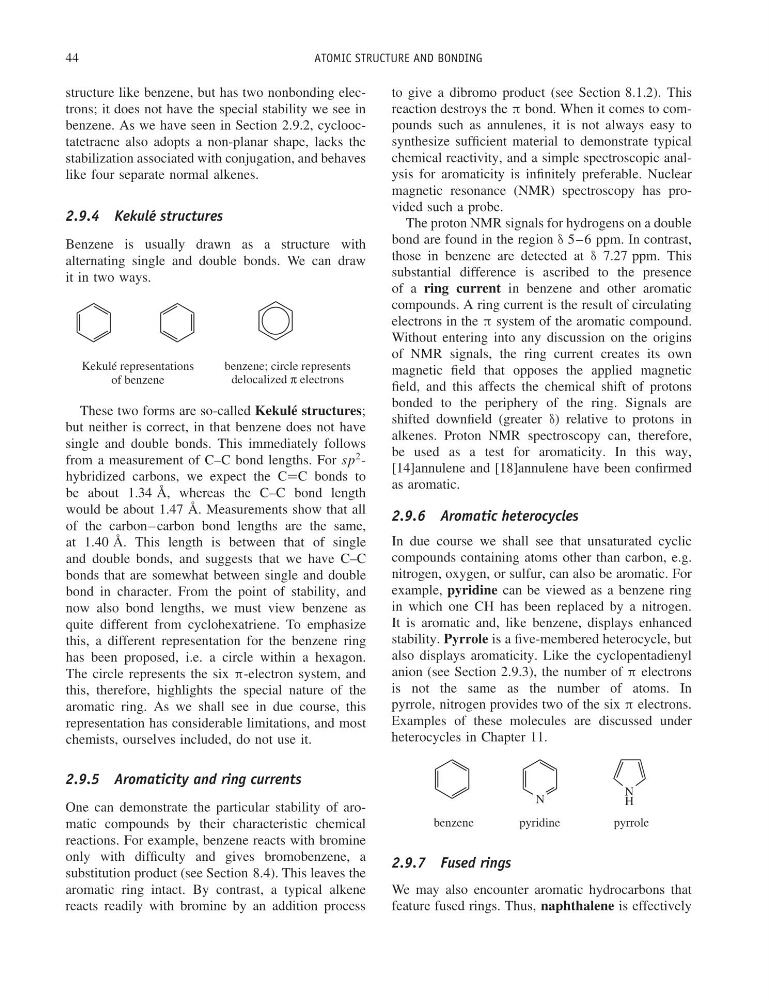
Benzene is usually drawn as a structure with
alternating single and double bonds. We can draw
it in two ways.
Kekulé representations
of benzene
benzene; circle represents
delocalized π electrons
These two forms are so-called Kekul´ e structures;
but neither is correct, in that benzene does not have
single and double bonds. This immediately follows
from a measurement of C–C bond lengths. For sp
2 -
hybridized carbons, we expect the C=C bonds to
be about 1.34 ˚
A, whereas the C–C bond length
would be about 1.47 ˚
A. Measurements show that all
of the carbon–carbon bond lengths are the same,
at 1.40 ˚
A. This length is between that of single
and double bonds, and suggests that we have C–C
bonds that are somewhat between single and double
bond in character. From the point of stability, and
now also bond lengths, we must view benzene as
quite different from cyclohexatriene. To emphasize
this, a different representation for the benzene ring
has been proposed, i.e. a circle within a hexagon.
The circle represents the six π-electron system, and
this, therefore, highlights the special nature of the
aromatic ring. As we shall see in due course, this
representation has considerable limitations, and most
chemists, ourselves included, do not use it.
2.9.5 Aromaticity and ring currents
One can demonstrate the particular stability of aromatic compounds by their characteristic chemical
reactions. For example, benzene reacts with bromine
only with difficulty and gives bromobenzene, a
substitution product (see Section 8.4). This leaves the
aromatic ring intact. By contrast, a typical alkene
reacts readily with bromine by an addition process
to give a dibromo product (see Section 8.1.2). This
reaction destroys the π bond. When it comes to compounds such as annulenes, it is not always easy to
synthesize sufficient material to demonstrate typical
chemical reactivity, and a simple spectroscopic analysis for aromaticity is infinitely preferable. Nuclear
magnetic resonance (NMR) spectroscopy has provided such a probe.
The proton NMR signals for hydrogens on a double
bond are found in the region δ 5–6 ppm. In contrast,
those in benzene are detected at δ 7.27 ppm. This
substantial difference is ascribed to the presence
of a ring current in benzene and other aromatic
compounds. A ring current is the result of circulating
electrons in the π system of the aromatic compound.
Without entering into any discussion on the origins
of NMR signals, the ring current creates its own
magnetic field that opposes the applied magnetic
field, and this affects the chemical shift of protons
bonded to the periphery of the ring. Signals are
shifted downfield (greater δ) relative to protons in
alkenes. Proton NMR spectroscopy can, therefore,
be used as a test for aromaticity. In this way,
[14]annulene and [18]annulene have been confirmed
as aromatic.
2.9.6 Aromatic heterocycles
In due course we shall see that unsaturated cyclic
compounds containing atoms other than carbon, e.g.
nitrogen, oxygen, or sulfur, can also be aromatic. For
example, pyridine can be viewed as a benzene ring
in which one CH has been replaced by a nitrogen.
It is aromatic and, like benzene, displays enhanced
stability. Pyrrole is a five-membered heterocycle, but
also displays aromaticity. Like the cyclopentadienyl
anion (see Section 2.9.3), the number of π electrons
is not the same as the number of atoms. In
pyrrole, nitrogen provides two of the six π electrons.
Examples of these molecules are discussed under
heterocycles in Chapter 11.
N
pyridine
benzene
N
H
pyrrole
2.9.7 Fused rings
We may also encounter aromatic hydrocarbons that
feature fused rings. Thus, naphthalene is effectively
ATOMIC STRUCTURE AND BONDING
structure like benzene, but has two nonbonding electrons; it does not have the special stability we see in
benzene. As we have seen in Section 2.9.2, cyclooctatetraene also adopts a non-planar shape, lacks the
stabilization associated with conjugation, and behaves
like four separate normal alkenes.
2.9.4 Kekul´ e structures
Benzene is usually drawn as a structure with
alternating single and double bonds. We can draw
it in two ways.
Kekulé representations
of benzene
benzene; circle represents
delocalized π electrons
These two forms are so-called Kekul´ e structures;
but neither is correct, in that benzene does not have
single and double bonds. This immediately follows
from a measurement of C–C bond lengths. For sp
2 -
hybridized carbons, we expect the C=C bonds to
be about 1.34 ˚
A, whereas the C–C bond length
would be about 1.47 ˚
A. Measurements show that all
of the carbon–carbon bond lengths are the same,
at 1.40 ˚
A. This length is between that of single
and double bonds, and suggests that we have C–C
bonds that are somewhat between single and double
bond in character. From the point of stability, and
now also bond lengths, we must view benzene as
quite different from cyclohexatriene. To emphasize
this, a different representation for the benzene ring
has been proposed, i.e. a circle within a hexagon.
The circle represents the six π-electron system, and
this, therefore, highlights the special nature of the
aromatic ring. As we shall see in due course, this
representation has considerable limitations, and most
chemists, ourselves included, do not use it.
2.9.5 Aromaticity and ring currents
One can demonstrate the particular stability of aromatic compounds by their characteristic chemical
reactions. For example, benzene reacts with bromine
only with difficulty and gives bromobenzene, a
substitution product (see Section 8.4). This leaves the
aromatic ring intact. By contrast, a typical alkene
reacts readily with bromine by an addition process
to give a dibromo product (see Section 8.1.2). This
reaction destroys the π bond. When it comes to compounds such as annulenes, it is not always easy to
synthesize sufficient material to demonstrate typical
chemical reactivity, and a simple spectroscopic analysis for aromaticity is infinitely preferable. Nuclear
magnetic resonance (NMR) spectroscopy has provided such a probe.
The proton NMR signals for hydrogens on a double
bond are found in the region δ 5–6 ppm. In contrast,
those in benzene are detected at δ 7.27 ppm. This
substantial difference is ascribed to the presence
of a ring current in benzene and other aromatic
compounds. A ring current is the result of circulating
electrons in the π system of the aromatic compound.
Without entering into any discussion on the origins
of NMR signals, the ring current creates its own
magnetic field that opposes the applied magnetic
field, and this affects the chemical shift of protons
bonded to the periphery of the ring. Signals are
shifted downfield (greater δ) relative to protons in
alkenes. Proton NMR spectroscopy can, therefore,
be used as a test for aromaticity. In this way,
[14]annulene and [18]annulene have been confirmed
as aromatic.
2.9.6 Aromatic heterocycles
In due course we shall see that unsaturated cyclic
compounds containing atoms other than carbon, e.g.
nitrogen, oxygen, or sulfur, can also be aromatic. For
example, pyridine can be viewed as a benzene ring
in which one CH has been replaced by a nitrogen.
It is aromatic and, like benzene, displays enhanced
stability. Pyrrole is a five-membered heterocycle, but
also displays aromaticity. Like the cyclopentadienyl
anion (see Section 2.9.3), the number of π electrons
is not the same as the number of atoms. In
pyrrole, nitrogen provides two of the six π electrons.
Examples of these molecules are discussed under
heterocycles in Chapter 11.
N
pyridine
benzene
N
H
pyrrole
2.9.7 Fused rings
We may also encounter aromatic hydrocarbons that
feature fused rings. Thus, naphthalene is effectively