

AROMATICITY
43
120
◦ , but we must realize that this attempts to place
two hydrogens in the same space. This is clearly
not feasible; as the hydrogens are pushed away from
each other, therefore, this must lead to a non-planar
molecule.
[10]annulene
[14]annulene
[18]annulene
looks OK, but
cannot be planar
because of
locating hydrogen
atoms
[10]annulene
10 π electrons (n = 2)
14 π electrons (n = 3)
18 π electrons (n = 4)
Structures that are also aromatic are the
cyclopropenyl cation (2 π electrons; n = 0) and
the cyclopentadienyl anion (6 π electrons; n = 1).
Although we do not wish to pursue these examples
further, they are representative of systems where the
number of π electrons is not the same as the number
of carbon atoms in the ring.
The stabilization conferred by aromaticity results
primarily from the much lower energy associated with
a set of electrons in molecular orbitals compared
cyclopropenyl cation
cyclopentadienyl anion
two π electrons (n = 0)
six π electrons (n = 1)
with them being in atomic orbitals. We have seen
how this originates in benzene by allocating electrons
to the bonding orbitals. We can apply the same
procedure to other annulene compounds, and there
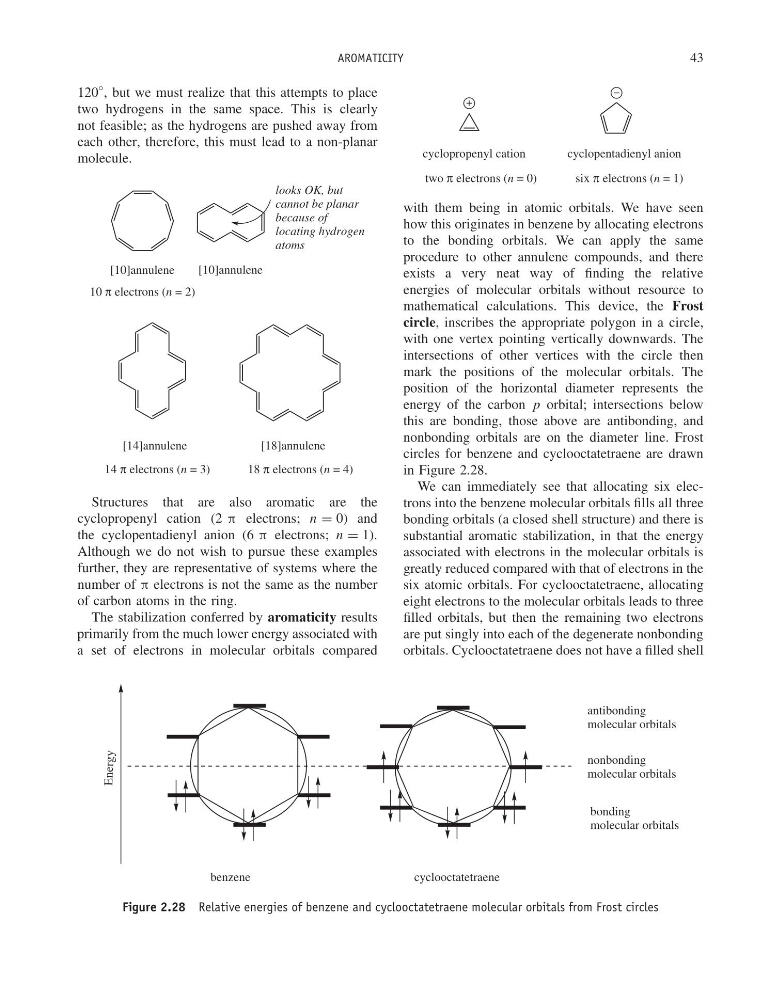
exists a very neat way of finding the relative
energies of molecular orbitals without resource to
mathematical calculations. This device, the Frost
circle, inscribes the appropriate polygon in a circle,
with one vertex pointing vertically downwards. The
intersections of other vertices with the circle then
mark the positions of the molecular orbitals. The
position of the horizontal diameter represents the
energy of the carbon p orbital; intersections below
this are bonding, those above are antibonding, and
nonbonding orbitals are on the diameter line. Frost
circles for benzene and cyclooctatetraene are drawn
in Figure 2.28.
We can immediately see that allocating six electrons into the benzene molecular orbitals fills all three
bonding orbitals (a closed shell structure) and there is
substantial aromatic stabilization, in that the energy
associated with electrons in the molecular orbitals is
greatly reduced compared with that of electrons in the
six atomic orbitals. For cyclooctatetraene, allocating
eight electrons to the molecular orbitals leads to three
filled orbitals, but then the remaining two electrons
are put singly into each of the degenerate nonbonding
orbitals. Cyclooctatetraene does not have a filled shell
benzene
cyclooctatetraene
nonbonding
molecular orbitals
antibonding
molecular orbitals
bonding
molecular orbitals
Energy
Figure 2.28 Relative energies of benzene and cyclooctatetraene molecular orbitals from Frost circles
43
120
◦ , but we must realize that this attempts to place
two hydrogens in the same space. This is clearly
not feasible; as the hydrogens are pushed away from
each other, therefore, this must lead to a non-planar
molecule.
[10]annulene
[14]annulene
[18]annulene
looks OK, but
cannot be planar
because of
locating hydrogen
atoms
[10]annulene
10 π electrons (n = 2)
14 π electrons (n = 3)
18 π electrons (n = 4)
Structures that are also aromatic are the
cyclopropenyl cation (2 π electrons; n = 0) and
the cyclopentadienyl anion (6 π electrons; n = 1).
Although we do not wish to pursue these examples
further, they are representative of systems where the
number of π electrons is not the same as the number
of carbon atoms in the ring.
The stabilization conferred by aromaticity results
primarily from the much lower energy associated with
a set of electrons in molecular orbitals compared
cyclopropenyl cation
cyclopentadienyl anion
two π electrons (n = 0)
six π electrons (n = 1)
with them being in atomic orbitals. We have seen
how this originates in benzene by allocating electrons
to the bonding orbitals. We can apply the same
procedure to other annulene compounds, and there
exists a very neat way of finding the relative
energies of molecular orbitals without resource to
mathematical calculations. This device, the Frost
circle, inscribes the appropriate polygon in a circle,
with one vertex pointing vertically downwards. The
intersections of other vertices with the circle then
mark the positions of the molecular orbitals. The
position of the horizontal diameter represents the
energy of the carbon p orbital; intersections below
this are bonding, those above are antibonding, and
nonbonding orbitals are on the diameter line. Frost
circles for benzene and cyclooctatetraene are drawn
in Figure 2.28.
We can immediately see that allocating six electrons into the benzene molecular orbitals fills all three
bonding orbitals (a closed shell structure) and there is
substantial aromatic stabilization, in that the energy
associated with electrons in the molecular orbitals is
greatly reduced compared with that of electrons in the
six atomic orbitals. For cyclooctatetraene, allocating
eight electrons to the molecular orbitals leads to three
filled orbitals, but then the remaining two electrons
are put singly into each of the degenerate nonbonding
orbitals. Cyclooctatetraene does not have a filled shell
benzene
cyclooctatetraene
nonbonding
molecular orbitals
antibonding
molecular orbitals
bonding
molecular orbitals
Energy
Figure 2.28 Relative energies of benzene and cyclooctatetraene molecular orbitals from Frost circles