

OLIGONUCLEOTIDE SYNTHESIS: THE PHOSPHORAMIDITE METHOD
567
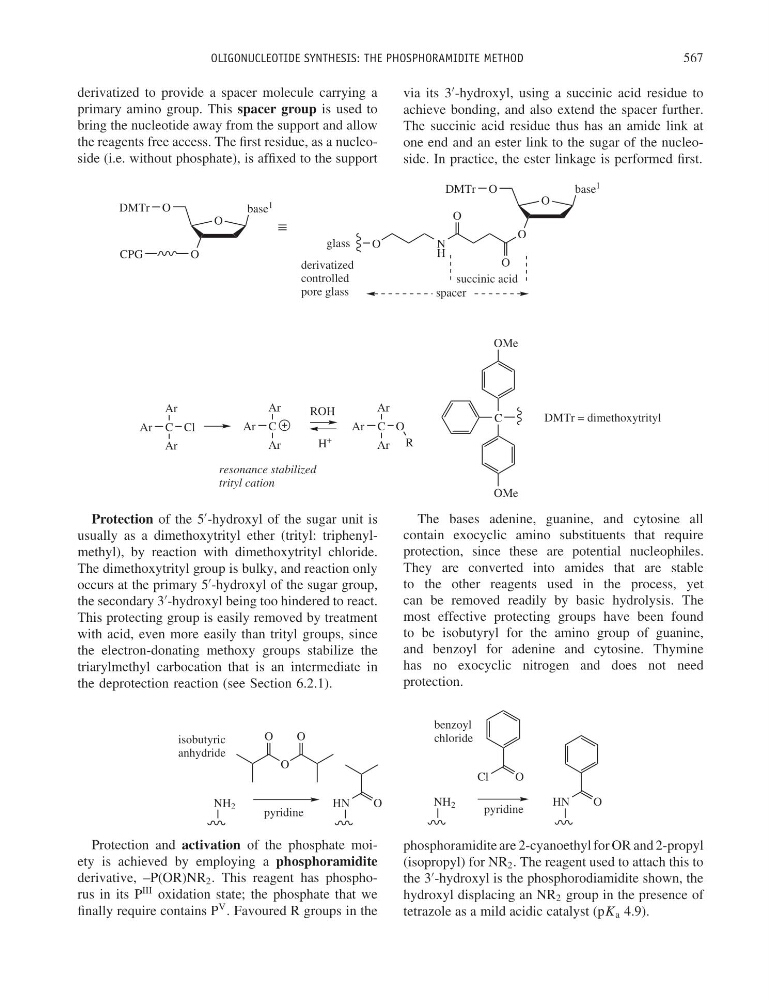
derivatized to provide a spacer molecule carrying a
primary amino group. This spacer group is used to
bring the nucleotide away from the support and allow
the reagents free access. The first residue, as a nucleoside (i.e. without phosphate), is affixed to the support
via its 3
-hydroxyl, using a succinic acid residue to
achieve bonding, and also extend the spacer further.
The succinic acid residue thus has an amide link at
one end and an ester link to the sugar of the nucleoside. In practice, the ester linkage is performed first.
C
OMe
OMe
DMTr = dimethoxytrityl
O
base 1
O
CPG
O
≡
O
N
H
O
O
O
base 1
O
O
DMTr
glass
derivatized
controlled
pore glass
succinic acid
spacer
C O
Ar
Ar
Ar R
C Cl
Ar
Ar
Ar
C
Ar
Ar
Ar
ROH
H +
resonance stabilized
trityl cation
DMTr
Protection of the 5
-hydroxyl of the sugar unit is
usually as a dimethoxytrityl ether (trityl: triphenylmethyl), by reaction with dimethoxytrityl chloride.
The dimethoxytrityl group is bulky, and reaction only
occurs at the primary 5
-hydroxyl of the sugar group,
the secondary 3
-hydroxyl being too hindered to react.
This protecting group is easily removed by treatment
with acid, even more easily than trityl groups, since
the electron-donating methoxy groups stabilize the
triarylmethyl carbocation that is an intermediate in
the deprotection reaction (see Section 6.2.1).
The bases adenine, guanine, and cytosine all
contain exocyclic amino substituents that require
protection, since these are potential nucleophiles.
They are converted into amides that are stable
to the other reagents used in the process, yet
can be removed readily by basic hydrolysis. The
most effective protecting groups have been found
to be isobutyryl for the amino group of guanine,
and benzoyl for adenine and cytosine. Thymine
has no exocyclic nitrogen and does not need
protection.
O
O
O
NH 2
HN
O
pyridine
NH 2
HN
O
Cl
O
pyridine
isobutyric
anhydride
benzoyl
chloride
Protection and activation of the phosphate moiety is achieved by employing a phosphoramidite
derivative, –P(OR)NR 2 . This reagent has phosphorus in its P
III oxidation state; the phosphate that we
finally require contains P
V . Favoured R groups in the
phosphoramidite are 2-cyanoethyl for OR and 2-propyl
(isopropyl) for NR 2 . The reagent used to attach this to
the 3
-hydroxyl is the phosphorodiamidite shown, the
hydroxyl displacing an NR 2 group in the presence of
tetrazole as a mild acidic catalyst (pK a 4.9).
567
derivatized to provide a spacer molecule carrying a
primary amino group. This spacer group is used to
bring the nucleotide away from the support and allow
the reagents free access. The first residue, as a nucleoside (i.e. without phosphate), is affixed to the support
via its 3
-hydroxyl, using a succinic acid residue to
achieve bonding, and also extend the spacer further.
The succinic acid residue thus has an amide link at
one end and an ester link to the sugar of the nucleoside. In practice, the ester linkage is performed first.
C
OMe
OMe
DMTr = dimethoxytrityl
O
base 1
O
CPG
O
≡
O
N
H
O
O
O
base 1
O
O
DMTr
glass
derivatized
controlled
pore glass
succinic acid
spacer
C O
Ar
Ar
Ar R
C Cl
Ar
Ar
Ar
C
Ar
Ar
Ar
ROH
H +
resonance stabilized
trityl cation
DMTr
Protection of the 5
-hydroxyl of the sugar unit is
usually as a dimethoxytrityl ether (trityl: triphenylmethyl), by reaction with dimethoxytrityl chloride.
The dimethoxytrityl group is bulky, and reaction only
occurs at the primary 5
-hydroxyl of the sugar group,
the secondary 3
-hydroxyl being too hindered to react.
This protecting group is easily removed by treatment
with acid, even more easily than trityl groups, since
the electron-donating methoxy groups stabilize the
triarylmethyl carbocation that is an intermediate in
the deprotection reaction (see Section 6.2.1).
The bases adenine, guanine, and cytosine all
contain exocyclic amino substituents that require
protection, since these are potential nucleophiles.
They are converted into amides that are stable
to the other reagents used in the process, yet
can be removed readily by basic hydrolysis. The
most effective protecting groups have been found
to be isobutyryl for the amino group of guanine,
and benzoyl for adenine and cytosine. Thymine
has no exocyclic nitrogen and does not need
protection.
O
O
O
NH 2
HN
O
pyridine
NH 2
HN
O
Cl
O
pyridine
isobutyric
anhydride
benzoyl
chloride
Protection and activation of the phosphate moiety is achieved by employing a phosphoramidite
derivative, –P(OR)NR 2 . This reagent has phosphorus in its P
III oxidation state; the phosphate that we
finally require contains P
V . Favoured R groups in the
phosphoramidite are 2-cyanoethyl for OR and 2-propyl
(isopropyl) for NR 2 . The reagent used to attach this to
the 3
-hydroxyl is the phosphorodiamidite shown, the
hydroxyl displacing an NR 2 group in the presence of
tetrazole as a mild acidic catalyst (pK a 4.9).