

560
NUCLEOSIDES, NUCLEOTIDES AND NUCLEIC ACIDS
S
CO 2 H
H 2 N
H 3 C
N
N
N
NH 2
O
HO
OH
N
CH 2
S-adenosylmethionine
(SAM)
Ad
Ad = adenosine
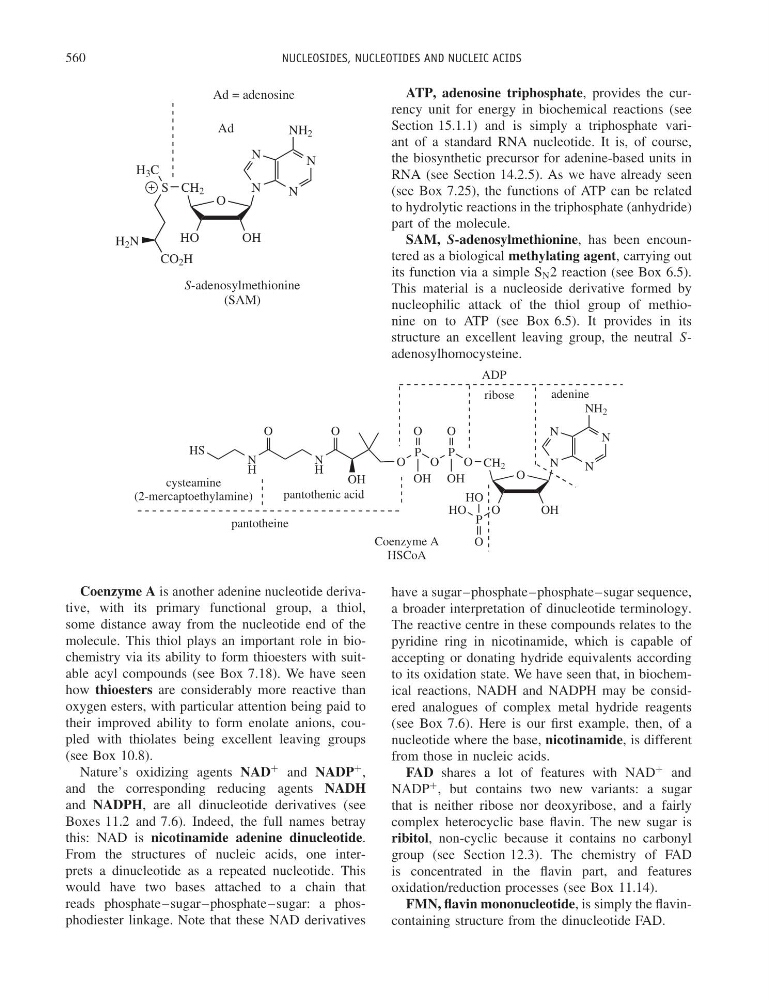
ATP, adenosine triphosphate, provides the currency unit for energy in biochemical reactions (see
Section 15.1.1) and is simply a triphosphate variant of a standard RNA nucleotide. It is, of course,
the biosynthetic precursor for adenine-based units in
RNA (see Section 14.2.5). As we have already seen
(see Box 7.25), the functions of ATP can be related
to hydrolytic reactions in the triphosphate (anhydride)
part of the molecule.
SAM, S-adenosylmethionine, has been encountered as a biological methylating agent, carrying out
its function via a simple S N 2 reaction (see Box 6.5).
This material is a nucleoside derivative formed by
nucleophilic attack of the thiol group of methionine on to ATP (see Box 6.5). It provides in its
structure an excellent leaving group, the neutral Sadenosylhomocysteine.
N
N
N
NH 2
O
OH
N
CH 2
N
H
N
H
OH
O
O
HS
Coenzyme A
HSCoA
O
P
O
O
OH
P
O
O
OH
O
P
HO
O
HO
adenine
ribose
ADP
pantothenic acid
pantotheine
cysteamine
(2-mercaptoethylamine)
Coenzyme A is another adenine nucleotide derivative, with its primary functional group, a thiol,
some distance away from the nucleotide end of the
molecule. This thiol plays an important role in biochemistry via its ability to form thioesters with suitable acyl compounds (see Box 7.18). We have seen
how thioesters are considerably more reactive than
oxygen esters, with particular attention being paid to
their improved ability to form enolate anions, coupled with thiolates being excellent leaving groups
(see Box 10.8).
Nature’s oxidizing agents NAD
+ and NADP
+ ,
and the corresponding reducing agents NADH
and NADPH, are all dinucleotide derivatives (see
Boxes 11.2 and 7.6). Indeed, the full names betray
this: NAD is nicotinamide adenine dinucleotide.
From the structures of nucleic acids, one interprets a dinucleotide as a repeated nucleotide. This
would have two bases attached to a chain that
reads phosphate–sugar–phosphate–sugar: a phosphodiester linkage. Note that these NAD derivatives
have a sugar–phosphate–phosphate–sugar sequence,
a broader interpretation of dinucleotide terminology.
The reactive centre in these compounds relates to the
pyridine ring in nicotinamide, which is capable of
accepting or donating hydride equivalents according
to its oxidation state. We have seen that, in biochemical reactions, NADH and NADPH may be considered analogues of complex metal hydride reagents
(see Box 7.6). Here is our first example, then, of a
nucleotide where the base, nicotinamide, is different
from those in nucleic acids.
FAD shares a lot of features with NAD
+ and
NADP
+ , but contains two new variants: a sugar
that is neither ribose nor deoxyribose, and a fairly
complex heterocyclic base flavin. The new sugar is
ribitol, non-cyclic because it contains no carbonyl
group (see Section 12.3). The chemistry of FAD
is concentrated in the flavin part, and features
oxidation/reduction processes (see Box 11.14).
FMN, flavin mononucleotide, is simply the flavincontaining structure from the dinucleotide FAD.
NUCLEOSIDES, NUCLEOTIDES AND NUCLEIC ACIDS
S
CO 2 H
H 2 N
H 3 C
N
N
N
NH 2
O
HO
OH
N
CH 2
S-adenosylmethionine
(SAM)
Ad
Ad = adenosine
ATP, adenosine triphosphate, provides the currency unit for energy in biochemical reactions (see
Section 15.1.1) and is simply a triphosphate variant of a standard RNA nucleotide. It is, of course,
the biosynthetic precursor for adenine-based units in
RNA (see Section 14.2.5). As we have already seen
(see Box 7.25), the functions of ATP can be related
to hydrolytic reactions in the triphosphate (anhydride)
part of the molecule.
SAM, S-adenosylmethionine, has been encountered as a biological methylating agent, carrying out
its function via a simple S N 2 reaction (see Box 6.5).
This material is a nucleoside derivative formed by
nucleophilic attack of the thiol group of methionine on to ATP (see Box 6.5). It provides in its
structure an excellent leaving group, the neutral Sadenosylhomocysteine.
N
N
N
NH 2
O
OH
N
CH 2
N
H
N
H
OH
O
O
HS
Coenzyme A
HSCoA
O
P
O
O
OH
P
O
O
OH
O
P
HO
O
HO
adenine
ribose
ADP
pantothenic acid
pantotheine
cysteamine
(2-mercaptoethylamine)
Coenzyme A is another adenine nucleotide derivative, with its primary functional group, a thiol,
some distance away from the nucleotide end of the
molecule. This thiol plays an important role in biochemistry via its ability to form thioesters with suitable acyl compounds (see Box 7.18). We have seen
how thioesters are considerably more reactive than
oxygen esters, with particular attention being paid to
their improved ability to form enolate anions, coupled with thiolates being excellent leaving groups
(see Box 10.8).
Nature’s oxidizing agents NAD
+ and NADP
+ ,
and the corresponding reducing agents NADH
and NADPH, are all dinucleotide derivatives (see
Boxes 11.2 and 7.6). Indeed, the full names betray
this: NAD is nicotinamide adenine dinucleotide.
From the structures of nucleic acids, one interprets a dinucleotide as a repeated nucleotide. This
would have two bases attached to a chain that
reads phosphate–sugar–phosphate–sugar: a phosphodiester linkage. Note that these NAD derivatives
have a sugar–phosphate–phosphate–sugar sequence,
a broader interpretation of dinucleotide terminology.
The reactive centre in these compounds relates to the
pyridine ring in nicotinamide, which is capable of
accepting or donating hydride equivalents according
to its oxidation state. We have seen that, in biochemical reactions, NADH and NADPH may be considered analogues of complex metal hydride reagents
(see Box 7.6). Here is our first example, then, of a
nucleotide where the base, nicotinamide, is different
from those in nucleic acids.
FAD shares a lot of features with NAD
+ and
NADP
+ , but contains two new variants: a sugar
that is neither ribose nor deoxyribose, and a fairly
complex heterocyclic base flavin. The new sugar is
ribitol, non-cyclic because it contains no carbonyl
group (see Section 12.3). The chemistry of FAD
is concentrated in the flavin part, and features
oxidation/reduction processes (see Box 11.14).
FMN, flavin mononucleotide, is simply the flavincontaining structure from the dinucleotide FAD.