

SOME OTHER IMPORTANT NUCLEOSIDES AND NUCLEOTIDES: ATP, SAM, COENZYME A, NAD, FAD
559
O
HOH 2 C
N
NH
N
O
N
NH 2
aciclovir
O
HO
HOH 2 C
N
NH
N
O
N
NH 2
2´-deoxyguanosine
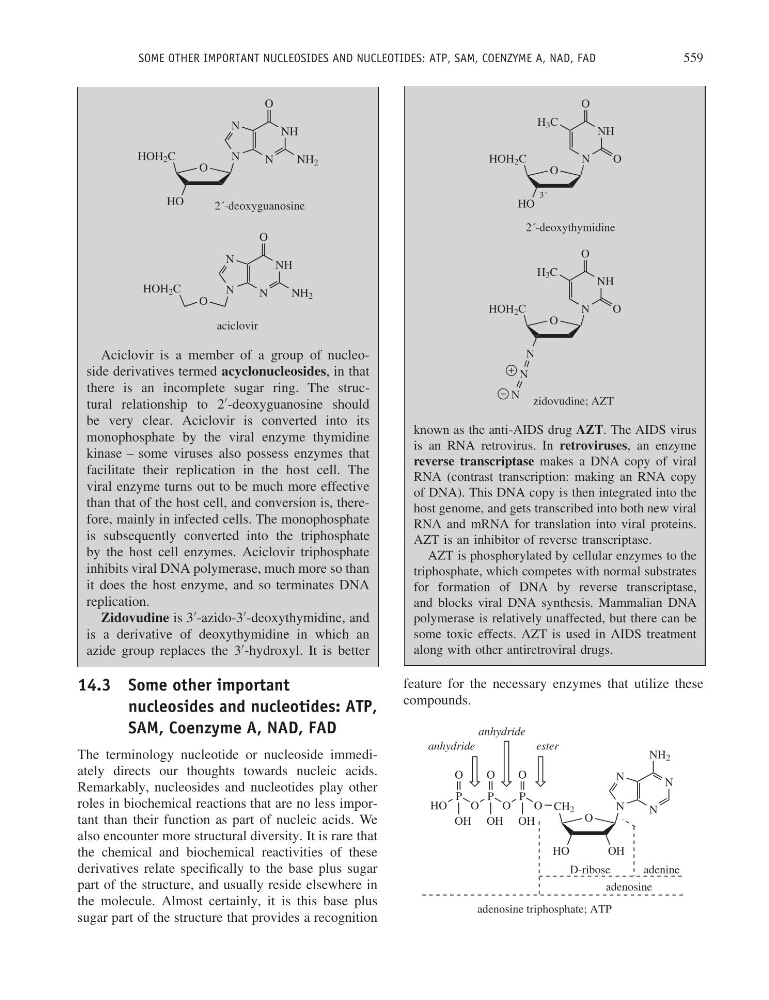
Aciclovir is a member of a group of nucleoside derivatives termed acyclonucleosides, in that
there is an incomplete sugar ring. The structural relationship to 2
-deoxyguanosine should
be very clear. Aciclovir is converted into its
monophosphate by the viral enzyme thymidine
kinase – some viruses also possess enzymes that
facilitate their replication in the host cell. The
viral enzyme turns out to be much more effective
than that of the host cell, and conversion is, therefore, mainly in infected cells. The monophosphate
is subsequently converted into the triphosphate
by the host cell enzymes. Aciclovir triphosphate
inhibits viral DNA polymerase, much more so than
it does the host enzyme, and so terminates DNA
replication.
Zidovudine is 3
-azido-3
-deoxythymidine, and
is a derivative of deoxythymidine in which an
azide group replaces the 3
-hydroxyl. It is better
zidovudine; AZT
O
N
HOH 2 C
N
NH
O
O
H 3 C
O
HO
HOH 2 C
N
NH
O
O
H 3 C
2´-deoxythymidine
3´
N
N
known as the anti-AIDS drug AZT. The AIDS virus
is an RNA retrovirus. In retroviruses, an enzyme
reverse transcriptase makes a DNA copy of viral
RNA (contrast transcription: making an RNA copy
of DNA). This DNA copy is then integrated into the
host genome, and gets transcribed into both new viral
RNA and mRNA for translation into viral proteins.
AZT is an inhibitor of reverse transcriptase.
AZT is phosphorylated by cellular enzymes to the
triphosphate, which competes with normal substrates
for formation of DNA by reverse transcriptase,
and blocks viral DNA synthesis. Mammalian DNA
polymerase is relatively unaffected, but there can be
some toxic effects. AZT is used in AIDS treatment
along with other antiretroviral drugs.
14.3 Some other important
nucleosides and nucleotides: ATP,
SAM, Coenzyme A, NAD, FAD
The terminology nucleotide or nucleoside immediately directs our thoughts towards nucleic acids.
Remarkably, nucleosides and nucleotides play other
roles in biochemical reactions that are no less important than their function as part of nucleic acids. We
also encounter more structural diversity. It is rare that
the chemical and biochemical reactivities of these
derivatives relate specifically to the base plus sugar
part of the structure, and usually reside elsewhere in
the molecule. Almost certainly, it is this base plus
sugar part of the structure that provides a recognition
feature for the necessary enzymes that utilize these
compounds.
N
N
N
NH 2
O
HO
OH
N
CH 2
anhydride
adenosine triphosphate; ATP
adenosine
adenine
D-ribose
anhydride
ester
O
P
HO
O
P
O
O
OH OH
P
O
O
OH
559
O
HOH 2 C
N
NH
N
O
N
NH 2
aciclovir
O
HO
HOH 2 C
N
NH
N
O
N
NH 2
2´-deoxyguanosine
Aciclovir is a member of a group of nucleoside derivatives termed acyclonucleosides, in that
there is an incomplete sugar ring. The structural relationship to 2
-deoxyguanosine should
be very clear. Aciclovir is converted into its
monophosphate by the viral enzyme thymidine
kinase – some viruses also possess enzymes that
facilitate their replication in the host cell. The
viral enzyme turns out to be much more effective
than that of the host cell, and conversion is, therefore, mainly in infected cells. The monophosphate
is subsequently converted into the triphosphate
by the host cell enzymes. Aciclovir triphosphate
inhibits viral DNA polymerase, much more so than
it does the host enzyme, and so terminates DNA
replication.
Zidovudine is 3
-azido-3
-deoxythymidine, and
is a derivative of deoxythymidine in which an
azide group replaces the 3
-hydroxyl. It is better
zidovudine; AZT
O
N
HOH 2 C
N
NH
O
O
H 3 C
O
HO
HOH 2 C
N
NH
O
O
H 3 C
2´-deoxythymidine
3´
N
N
known as the anti-AIDS drug AZT. The AIDS virus
is an RNA retrovirus. In retroviruses, an enzyme
reverse transcriptase makes a DNA copy of viral
RNA (contrast transcription: making an RNA copy
of DNA). This DNA copy is then integrated into the
host genome, and gets transcribed into both new viral
RNA and mRNA for translation into viral proteins.
AZT is an inhibitor of reverse transcriptase.
AZT is phosphorylated by cellular enzymes to the
triphosphate, which competes with normal substrates
for formation of DNA by reverse transcriptase,
and blocks viral DNA synthesis. Mammalian DNA
polymerase is relatively unaffected, but there can be
some toxic effects. AZT is used in AIDS treatment
along with other antiretroviral drugs.
14.3 Some other important
nucleosides and nucleotides: ATP,
SAM, Coenzyme A, NAD, FAD
The terminology nucleotide or nucleoside immediately directs our thoughts towards nucleic acids.
Remarkably, nucleosides and nucleotides play other
roles in biochemical reactions that are no less important than their function as part of nucleic acids. We
also encounter more structural diversity. It is rare that
the chemical and biochemical reactivities of these
derivatives relate specifically to the base plus sugar
part of the structure, and usually reside elsewhere in
the molecule. Almost certainly, it is this base plus
sugar part of the structure that provides a recognition
feature for the necessary enzymes that utilize these
compounds.
N
N
N
NH 2
O
HO
OH
N
CH 2
anhydride
adenosine triphosphate; ATP
adenosine
adenine
D-ribose
anhydride
ester
O
P
HO
O
P
O
O
OH OH
P
O
O
OH