

NUCLEIC ACIDS
557
R
CO 2 H
NH 2
R
NH 2
O
AMP
R
NH 2
O
tRNA
aminoacyl-tRNA
aminoacyl-AMP
ATP
AMP
PP
tRNA
activation of amino acid by
formation of mixed anhydride
aminoacyl group transferred to ribose
hydroxyl in 3′-terminal adenosine of
tRNA; formation of ester linkage
AMP
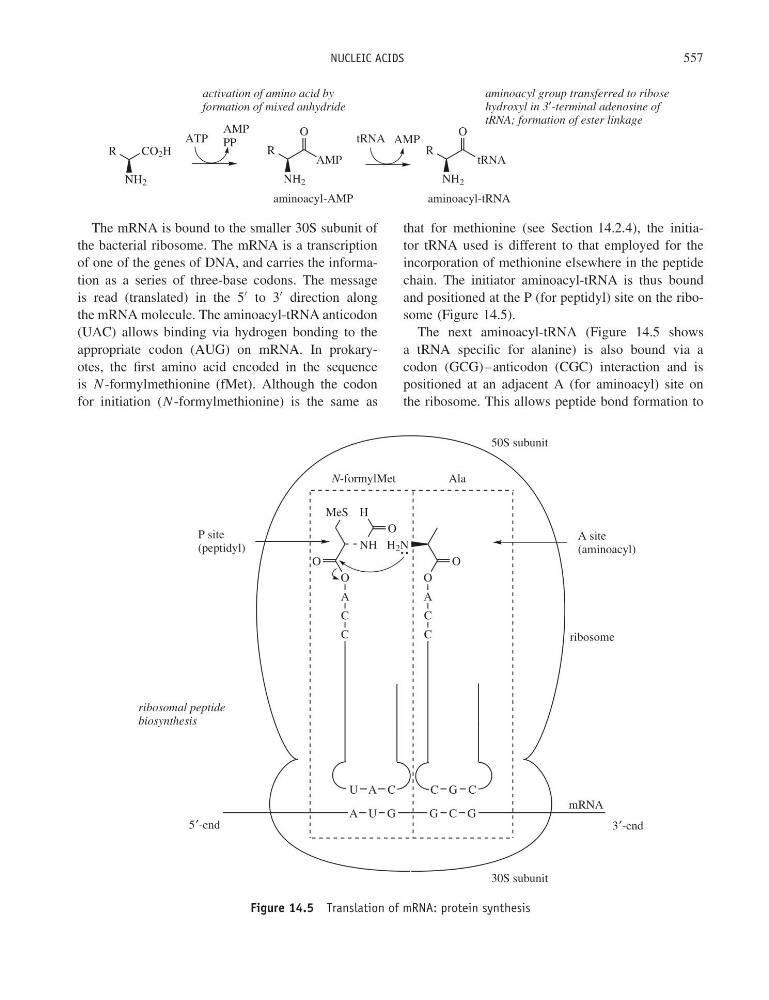
The mRNA is bound to the smaller 30S subunit of
the bacterial ribosome. The mRNA is a transcription
of one of the genes of DNA, and carries the information as a series of three-base codons. The message
is read (translated) in the 5
to 3
direction along
the mRNA molecule. The aminoacyl-tRNA anticodon
(UAC) allows binding via hydrogen bonding to the
appropriate codon (AUG) on mRNA. In prokaryotes, the first amino acid encoded in the sequence
is N -formylmethionine (fMet). Although the codon
for initiation (N -formylmethionine) is the same as
that for methionine (see Section 14.2.4), the initiator tRNA used is different to that employed for the
incorporation of methionine elsewhere in the peptide
chain. The initiator aminoacyl-tRNA is thus bound
and positioned at the P (for peptidyl) site on the ribosome (Figure 14.5).
The next aminoacyl-tRNA (Figure 14.5 shows
a tRNA specific for alanine) is also bound via a
codon (GCG)–anticodon (CGC) interaction and is
positioned at an adjacent A (for aminoacyl) site on
the ribosome. This allows peptide bond formation to
MeS
O
NH
H
O
O
A
O
O
H 2 N
A
C
C
C
C
5′-end
3′-end
A U G
G C G
mRNA
30S subunit
50S subunit
U A C
C G C
ribosome
A site
(aminoacyl)
P site
(peptidyl)
N-formylMet
Ala
ribosomal peptide
biosynthesis
Figure 14.5 Translation of mRNA: protein synthesis
557
R
CO 2 H
NH 2
R
NH 2
O
AMP
R
NH 2
O
tRNA
aminoacyl-tRNA
aminoacyl-AMP
ATP
AMP
PP
tRNA
activation of amino acid by
formation of mixed anhydride
aminoacyl group transferred to ribose
hydroxyl in 3′-terminal adenosine of
tRNA; formation of ester linkage
AMP
The mRNA is bound to the smaller 30S subunit of
the bacterial ribosome. The mRNA is a transcription
of one of the genes of DNA, and carries the information as a series of three-base codons. The message
is read (translated) in the 5
to 3
direction along
the mRNA molecule. The aminoacyl-tRNA anticodon
(UAC) allows binding via hydrogen bonding to the
appropriate codon (AUG) on mRNA. In prokaryotes, the first amino acid encoded in the sequence
is N -formylmethionine (fMet). Although the codon
for initiation (N -formylmethionine) is the same as
that for methionine (see Section 14.2.4), the initiator tRNA used is different to that employed for the
incorporation of methionine elsewhere in the peptide
chain. The initiator aminoacyl-tRNA is thus bound
and positioned at the P (for peptidyl) site on the ribosome (Figure 14.5).
The next aminoacyl-tRNA (Figure 14.5 shows
a tRNA specific for alanine) is also bound via a
codon (GCG)–anticodon (CGC) interaction and is
positioned at an adjacent A (for aminoacyl) site on
the ribosome. This allows peptide bond formation to
MeS
O
NH
H
O
O
A
O
O
H 2 N
A
C
C
C
C
5′-end
3′-end
A U G
G C G
mRNA
30S subunit
50S subunit
U A C
C G C
ribosome
A site
(aminoacyl)
P site
(peptidyl)
N-formylMet
Ala
ribosomal peptide
biosynthesis
Figure 14.5 Translation of mRNA: protein synthesis