

MOLECULAR SHAPE OF PROTEINS: PRIMARY, SECONDARY AND TERTIARY STRUCTURES
509
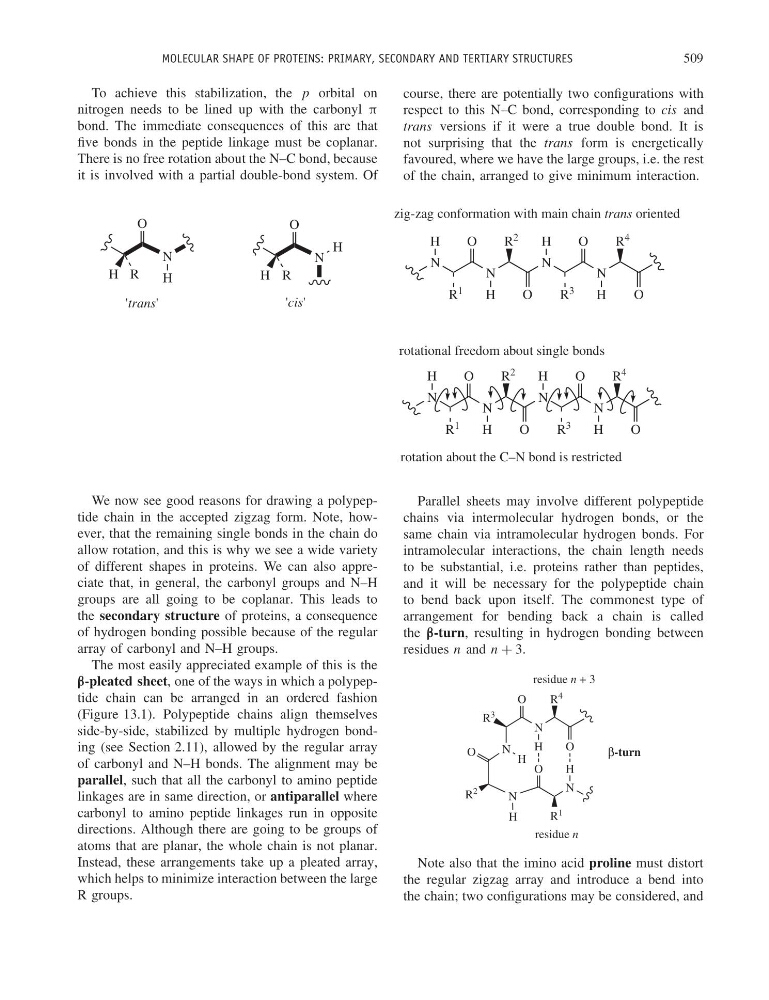
To achieve this stabilization, the p orbital on
nitrogen needs to be lined up with the carbonyl π
bond. The immediate consequences of this are that
five bonds in the peptide linkage must be coplanar.
There is no free rotation about the N–C bond, because
it is involved with a partial double-bond system. Of
course, there are potentially two configurations with
respect to this N–C bond, corresponding to cis and
trans versions if it were a true double bond. It is
not surprising that the trans form is energetically
favoured, where we have the large groups, i.e. the rest
of the chain, arranged to give minimum interaction.
N
N
N
N
O
O
O
O
R 1
R 2
R 3
R 4
H
H
H
H
N
N
N
N
O
O
O
O
R
1
R 2
R
3
R 4
H
H
H
H
zig-zag conformation with main chain trans oriented
rotational freedom about single bonds
rotation about the C–N bond is restricted
N
O
H
R
H
N
O
H
R
H
'cis'
'trans'
We now see good reasons for drawing a polypeptide chain in the accepted zigzag form. Note, however, that the remaining single bonds in the chain do
allow rotation, and this is why we see a wide variety
of different shapes in proteins. We can also appreciate that, in general, the carbonyl groups and N–H
groups are all going to be coplanar. This leads to
the secondary structure of proteins, a consequence
of hydrogen bonding possible because of the regular
array of carbonyl and N–H groups.
The most easily appreciated example of this is the
β-pleated sheet, one of the ways in which a polypeptide chain can be arranged in an ordered fashion
(Figure 13.1). Polypeptide chains align themselves
side-by-side, stabilized by multiple hydrogen bonding (see Section 2.11), allowed by the regular array
of carbonyl and N–H bonds. The alignment may be
parallel, such that all the carbonyl to amino peptide
linkages are in same direction, or antiparallel where
carbonyl to amino peptide linkages run in opposite
directions. Although there are going to be groups of
atoms that are planar, the whole chain is not planar.
Instead, these arrangements take up a pleated array,
which helps to minimize interaction between the large
R groups.
Parallel sheets may involve different polypeptide
chains via intermolecular hydrogen bonds, or the
same chain via intramolecular hydrogen bonds. For
intramolecular interactions, the chain length needs
to be substantial, i.e. proteins rather than peptides,
and it will be necessary for the polypeptide chain
to bend back upon itself. The commonest type of
arrangement for bending back a chain is called
the β-turn, resulting in hydrogen bonding between
residues n and n + 3.
N
O
O
N
R 4
H
R 3
H
R 2
N
O
O
H
N
H
R 1
β-turn
residue n
residue n + 3
Note also that the imino acid proline must distort
the regular zigzag array and introduce a bend into
the chain; two configurations may be considered, and
509
To achieve this stabilization, the p orbital on
nitrogen needs to be lined up with the carbonyl π
bond. The immediate consequences of this are that
five bonds in the peptide linkage must be coplanar.
There is no free rotation about the N–C bond, because
it is involved with a partial double-bond system. Of
course, there are potentially two configurations with
respect to this N–C bond, corresponding to cis and
trans versions if it were a true double bond. It is
not surprising that the trans form is energetically
favoured, where we have the large groups, i.e. the rest
of the chain, arranged to give minimum interaction.
N
N
N
N
O
O
O
O
R 1
R 2
R 3
R 4
H
H
H
H
N
N
N
N
O
O
O
O
R
1
R 2
R
3
R 4
H
H
H
H
zig-zag conformation with main chain trans oriented
rotational freedom about single bonds
rotation about the C–N bond is restricted
N
O
H
R
H
N
O
H
R
H
'cis'
'trans'
We now see good reasons for drawing a polypeptide chain in the accepted zigzag form. Note, however, that the remaining single bonds in the chain do
allow rotation, and this is why we see a wide variety
of different shapes in proteins. We can also appreciate that, in general, the carbonyl groups and N–H
groups are all going to be coplanar. This leads to
the secondary structure of proteins, a consequence
of hydrogen bonding possible because of the regular
array of carbonyl and N–H groups.
The most easily appreciated example of this is the
β-pleated sheet, one of the ways in which a polypeptide chain can be arranged in an ordered fashion
(Figure 13.1). Polypeptide chains align themselves
side-by-side, stabilized by multiple hydrogen bonding (see Section 2.11), allowed by the regular array
of carbonyl and N–H bonds. The alignment may be
parallel, such that all the carbonyl to amino peptide
linkages are in same direction, or antiparallel where
carbonyl to amino peptide linkages run in opposite
directions. Although there are going to be groups of
atoms that are planar, the whole chain is not planar.
Instead, these arrangements take up a pleated array,
which helps to minimize interaction between the large
R groups.
Parallel sheets may involve different polypeptide
chains via intermolecular hydrogen bonds, or the
same chain via intramolecular hydrogen bonds. For
intramolecular interactions, the chain length needs
to be substantial, i.e. proteins rather than peptides,
and it will be necessary for the polypeptide chain
to bend back upon itself. The commonest type of
arrangement for bending back a chain is called
the β-turn, resulting in hydrogen bonding between
residues n and n + 3.
N
O
O
N
R 4
H
R 3
H
R 2
N
O
O
H
N
H
R 1
β-turn
residue n
residue n + 3
Note also that the imino acid proline must distort
the regular zigzag array and introduce a bend into
the chain; two configurations may be considered, and