

508
AMINO ACIDS, PEPTIDES AND PROTEINS
Box 13.2
Disulfide bridges: glutathione protects cells against damage by peroxides
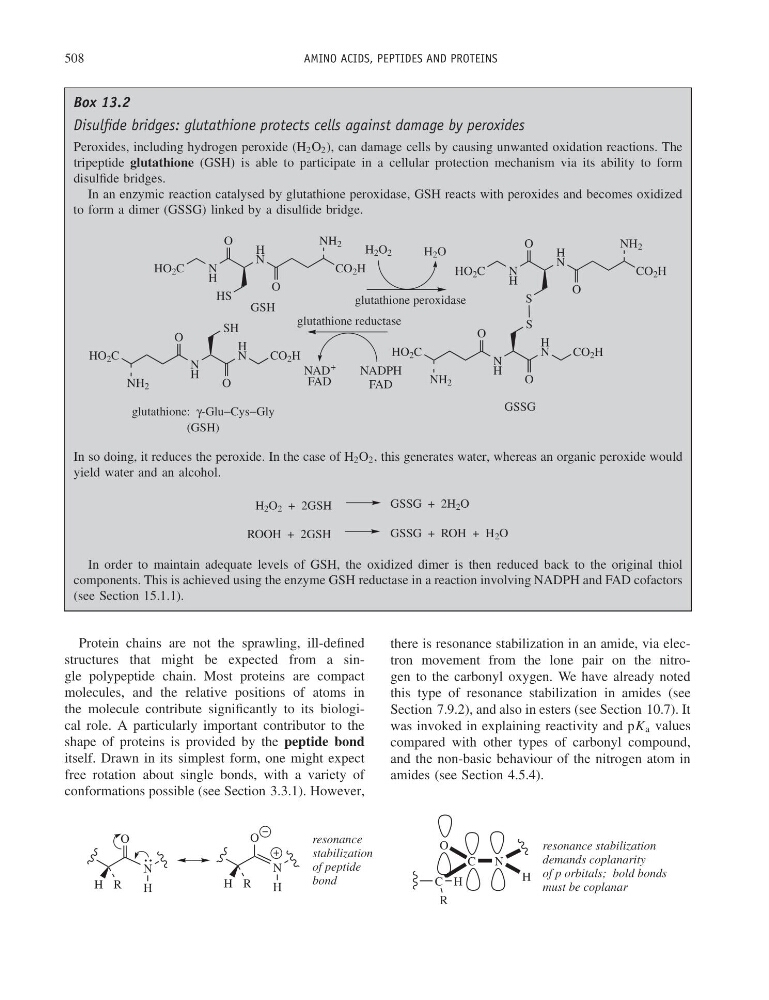
Peroxides, including hydrogen peroxide (H 2 O 2 ), can damage cells by causing unwanted oxidation reactions. The
tripeptide glutathione (GSH) is able to participate in a cellular protection mechanism via its ability to form
disulfide bridges.
In an enzymic reaction catalysed by glutathione peroxidase, GSH reacts with peroxides and becomes oxidized
to form a dimer (GSSG) linked by a disulfide bridge.
glutathione: γ-Glu−Cys−Gly
(GSH)
HO 2 C
N
H
H
N
CO 2 H
NH 2
O
S
O
HO 2 C
N
H
H
N
CO 2 H
NH 2
O
SH
O
CO 2 H
H
N
N
H
HO 2 C
NH 2
O
S
O
CO 2 H
H
N
N
H
HO 2 C
NH 2
O
HS
O
H 2 O 2
H 2 O
glutathione peroxidase
glutathione reductase
NADPH
FAD
NAD
+
FAD
GSSG
GSH
In so doing, it reduces the peroxide. In the case of H 2 O 2 , this generates water, whereas an organic peroxide would
yield water and an alcohol.
H 2 O 2 + 2GSH
ROOH + 2GSH
GSSG + 2H 2 O
GSSG + ROH + H 2 O
In order to maintain adequate levels of GSH, the oxidized dimer is then reduced back to the original thiol
components. This is achieved using the enzyme GSH reductase in a reaction involving NADPH and FAD cofactors
(see Section 15.1.1).
Protein chains are not the sprawling, ill-defined
structures that might be expected from a single polypeptide chain. Most proteins are compact
molecules, and the relative positions of atoms in
the molecule contribute significantly to its biological role. A particularly important contributor to the
shape of proteins is provided by the peptide bond
itself. Drawn in its simplest form, one might expect
free rotation about single bonds, with a variety of
conformations possible (see Section 3.3.1). However,
there is resonance stabilization in an amide, via electron movement from the lone pair on the nitrogen to the carbonyl oxygen. We have already noted
this type of resonance stabilization in amides (see
Section 7.9.2), and also in esters (see Section 10.7). It
was invoked in explaining reactivity and pK a values
compared with other types of carbonyl compound,
and the non-basic behaviour of the nitrogen atom in
amides (see Section 4.5.4).
N
O
H
R
H
N
O
H
R
H
resonance
stabilization
of peptide
bond
C
N
H
C
O
R
H
resonance stabilization
demands coplanarity
of p orbitals; bold bonds
must be coplanar
AMINO ACIDS, PEPTIDES AND PROTEINS
Box 13.2
Disulfide bridges: glutathione protects cells against damage by peroxides
Peroxides, including hydrogen peroxide (H 2 O 2 ), can damage cells by causing unwanted oxidation reactions. The
tripeptide glutathione (GSH) is able to participate in a cellular protection mechanism via its ability to form
disulfide bridges.
In an enzymic reaction catalysed by glutathione peroxidase, GSH reacts with peroxides and becomes oxidized
to form a dimer (GSSG) linked by a disulfide bridge.
glutathione: γ-Glu−Cys−Gly
(GSH)
HO 2 C
N
H
H
N
CO 2 H
NH 2
O
S
O
HO 2 C
N
H
H
N
CO 2 H
NH 2
O
SH
O
CO 2 H
H
N
N
H
HO 2 C
NH 2
O
S
O
CO 2 H
H
N
N
H
HO 2 C
NH 2
O
HS
O
H 2 O 2
H 2 O
glutathione peroxidase
glutathione reductase
NADPH
FAD
NAD
+
FAD
GSSG
GSH
In so doing, it reduces the peroxide. In the case of H 2 O 2 , this generates water, whereas an organic peroxide would
yield water and an alcohol.
H 2 O 2 + 2GSH
ROOH + 2GSH
GSSG + 2H 2 O
GSSG + ROH + H 2 O
In order to maintain adequate levels of GSH, the oxidized dimer is then reduced back to the original thiol
components. This is achieved using the enzyme GSH reductase in a reaction involving NADPH and FAD cofactors
(see Section 15.1.1).
Protein chains are not the sprawling, ill-defined
structures that might be expected from a single polypeptide chain. Most proteins are compact
molecules, and the relative positions of atoms in
the molecule contribute significantly to its biological role. A particularly important contributor to the
shape of proteins is provided by the peptide bond
itself. Drawn in its simplest form, one might expect
free rotation about single bonds, with a variety of
conformations possible (see Section 3.3.1). However,
there is resonance stabilization in an amide, via electron movement from the lone pair on the nitrogen to the carbonyl oxygen. We have already noted
this type of resonance stabilization in amides (see
Section 7.9.2), and also in esters (see Section 10.7). It
was invoked in explaining reactivity and pK a values
compared with other types of carbonyl compound,
and the non-basic behaviour of the nitrogen atom in
amides (see Section 4.5.4).
N
O
H
R
H
N
O
H
R
H
resonance
stabilization
of peptide
bond
C
N
H
C
O
R
H
resonance stabilization
demands coplanarity
of p orbitals; bold bonds
must be coplanar