

446
HETEROCYCLES
We noted above (see Section 11.5.1) that pyrrole,
though a very weak base, is potentially acidic (pK a
17.5). This was because the anion formed by losing
the proton from nitrogen has a negative charge on the
relatively electronegative nitrogen, but maintains its
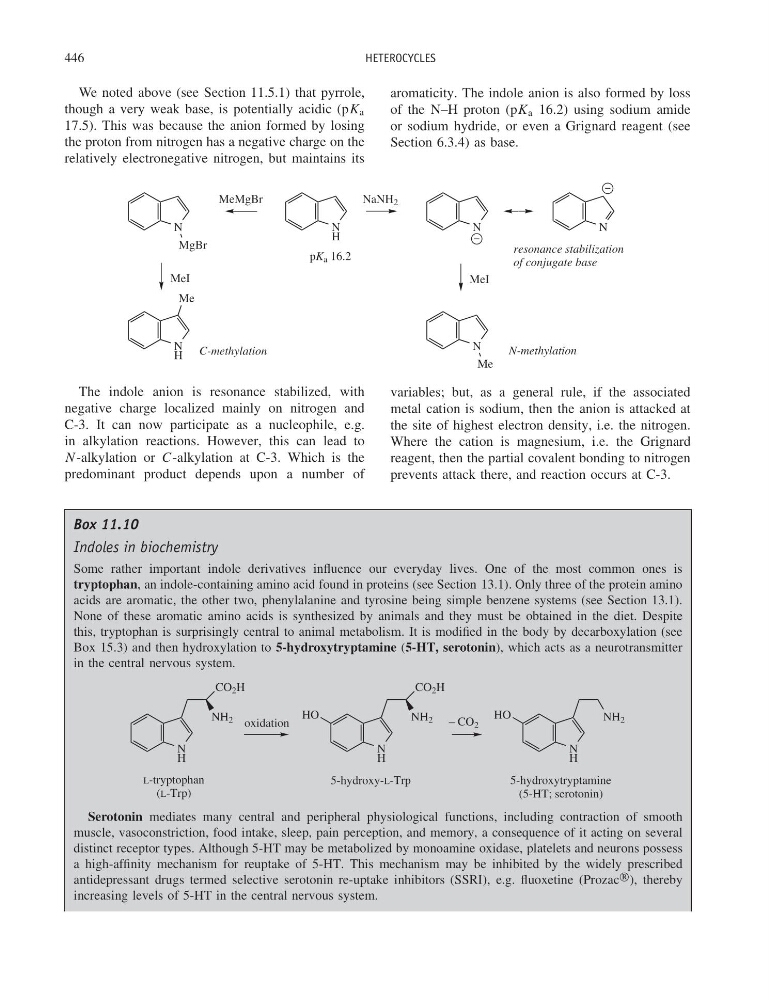
aromaticity. The indole anion is also formed by loss
of the N–H proton (pK a 16.2) using sodium amide
or sodium hydride, or even a Grignard reagent (see
Section 6.3.4) as base.
N
H
NaNH 2
N
N
MeMgBr
N
MgBr
MeI
N
H
Me
MeI
N
Me
pK a 16.2
resonance stabilization
of conjugate base
C-methylation
N-methylation
The indole anion is resonance stabilized, with
negative charge localized mainly on nitrogen and
C-3. It can now participate as a nucleophile, e.g.
in alkylation reactions. However, this can lead to
N -alkylation or C-alkylation at C-3. Which is the
predominant product depends upon a number of
variables; but, as a general rule, if the associated
metal cation is sodium, then the anion is attacked at
the site of highest electron density, i.e. the nitrogen.
Where the cation is magnesium, i.e. the Grignard
reagent, then the partial covalent bonding to nitrogen
prevents attack there, and reaction occurs at C-3.
Box 11.10
Indoles in biochemistry
Some rather important indole derivatives influence our everyday lives. One of the most common ones is
tryptophan, an indole-containing amino acid found in proteins (see Section 13.1). Only three of the protein amino
acids are aromatic, the other two, phenylalanine and tyrosine being simple benzene systems (see Section 13.1).
None of these aromatic amino acids is synthesized by animals and they must be obtained in the diet. Despite
this, tryptophan is surprisingly central to animal metabolism. It is modified in the body by decarboxylation (see
Box 15.3) and then hydroxylation to 5-hydroxytryptamine (5-HT, serotonin), which acts as a neurotransmitter
in the central nervous system.
N
H
CO 2 H
NH 2
N
H
CO 2 H
NH 2
HO
N
H
NH 2
HO
L-tryptophan
(L-Trp)
oxidation
5-hydroxy-L-Trp
5-hydroxytryptamine
(5-HT; serotonin)
– CO 2
Serotonin mediates many central and peripheral physiological functions, including contraction of smooth
muscle, vasoconstriction, food intake, sleep, pain perception, and memory, a consequence of it acting on several
distinct receptor types. Although 5-HT may be metabolized by monoamine oxidase, platelets and neurons possess
a high-affinity mechanism for reuptake of 5-HT. This mechanism may be inhibited by the widely prescribed
antidepressant drugs termed selective serotonin re-uptake inhibitors (SSRI), e.g. fluoxetine (Prozac ), thereby
increasing levels of 5-HT in the central nervous system.
HETEROCYCLES
We noted above (see Section 11.5.1) that pyrrole,
though a very weak base, is potentially acidic (pK a
17.5). This was because the anion formed by losing
the proton from nitrogen has a negative charge on the
relatively electronegative nitrogen, but maintains its
aromaticity. The indole anion is also formed by loss
of the N–H proton (pK a 16.2) using sodium amide
or sodium hydride, or even a Grignard reagent (see
Section 6.3.4) as base.
N
H
NaNH 2
N
N
MeMgBr
N
MgBr
MeI
N
H
Me
MeI
N
Me
pK a 16.2
resonance stabilization
of conjugate base
C-methylation
N-methylation
The indole anion is resonance stabilized, with
negative charge localized mainly on nitrogen and
C-3. It can now participate as a nucleophile, e.g.
in alkylation reactions. However, this can lead to
N -alkylation or C-alkylation at C-3. Which is the
predominant product depends upon a number of
variables; but, as a general rule, if the associated
metal cation is sodium, then the anion is attacked at
the site of highest electron density, i.e. the nitrogen.
Where the cation is magnesium, i.e. the Grignard
reagent, then the partial covalent bonding to nitrogen
prevents attack there, and reaction occurs at C-3.
Box 11.10
Indoles in biochemistry
Some rather important indole derivatives influence our everyday lives. One of the most common ones is
tryptophan, an indole-containing amino acid found in proteins (see Section 13.1). Only three of the protein amino
acids are aromatic, the other two, phenylalanine and tyrosine being simple benzene systems (see Section 13.1).
None of these aromatic amino acids is synthesized by animals and they must be obtained in the diet. Despite
this, tryptophan is surprisingly central to animal metabolism. It is modified in the body by decarboxylation (see
Box 15.3) and then hydroxylation to 5-hydroxytryptamine (5-HT, serotonin), which acts as a neurotransmitter
in the central nervous system.
N
H
CO 2 H
NH 2
N
H
CO 2 H
NH 2
HO
N
H
NH 2
HO
L-tryptophan
(L-Trp)
oxidation
5-hydroxy-L-Trp
5-hydroxytryptamine
(5-HT; serotonin)
– CO 2
Serotonin mediates many central and peripheral physiological functions, including contraction of smooth
muscle, vasoconstriction, food intake, sleep, pain perception, and memory, a consequence of it acting on several
distinct receptor types. Although 5-HT may be metabolized by monoamine oxidase, platelets and neurons possess
a high-affinity mechanism for reuptake of 5-HT. This mechanism may be inhibited by the widely prescribed
antidepressant drugs termed selective serotonin re-uptake inhibitors (SSRI), e.g. fluoxetine (Prozac ), thereby
increasing levels of 5-HT in the central nervous system.