

HETEROCYCLES FUSED TO A BENZENE RING
445
N
H
O
H 3 C
O
CH 3
O
HOAc
N
H
H 3 C
O
N
H 3 C
O
H 3 C
O
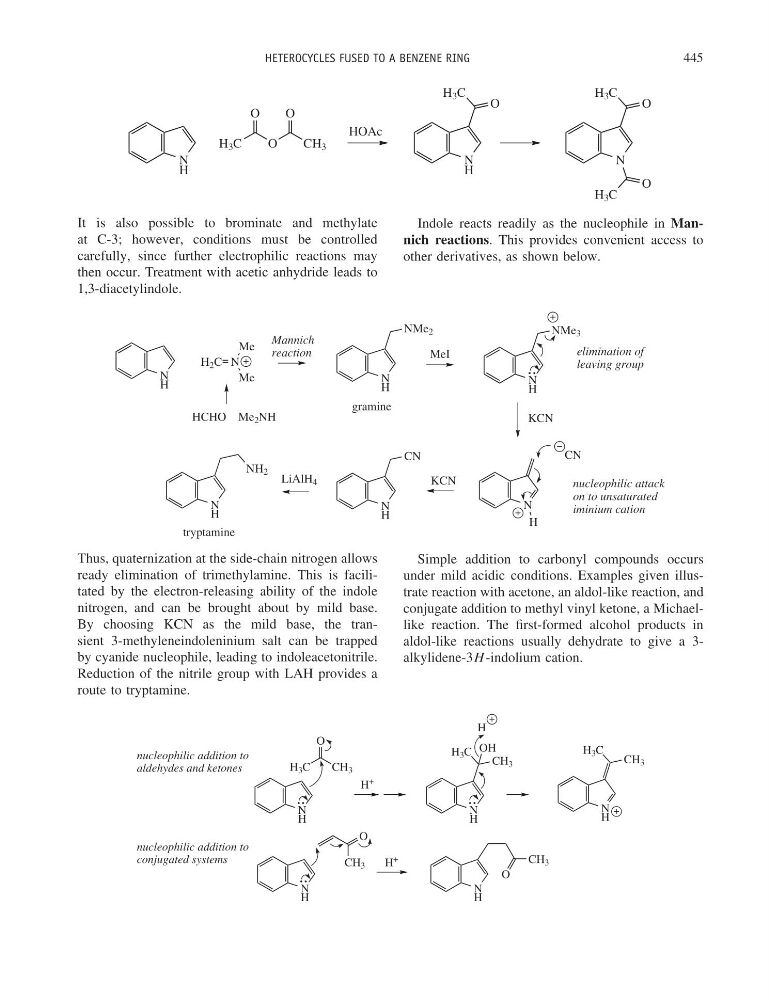
It is also possible to brominate and methylate
at C-3; however, conditions must be controlled
carefully, since further electrophilic reactions may
then occur. Treatment with acetic anhydride leads to
1,3-diacetylindole.
Indole reacts readily as the nucleophile in Mannich reactions. This provides convenient access to
other derivatives, as shown below.
Me 2 NH
HCHO
Mannich
reaction
H 2 C N
Me
Me
N
H
N
H
NMe 2
MeI
N
H
NMe 3
gramine
N
H
CN
N
H
CN
N
H
NH 2
tryptamine
KCN
KCN
LiAlH 4
elimination of
leaving group
nucleophilic attack
on to unsaturated
iminium cation
Thus, quaternization at the side-chain nitrogen allows
ready elimination of trimethylamine. This is facilitated by the electron-releasing ability of the indole
nitrogen, and can be brought about by mild base.
By choosing KCN as the mild base, the transient 3-methyleneindoleninium salt can be trapped
by cyanide nucleophile, leading to indoleacetonitrile.
Reduction of the nitrile group with LAH provides a
route to tryptamine.
Simple addition to carbonyl compounds occurs
under mild acidic conditions. Examples given illustrate reaction with acetone, an aldol-like reaction, and
conjugate addition to methyl vinyl ketone, a Michaellike reaction. The first-formed alcohol products in
aldol-like reactions usually dehydrate to give a 3alkylidene-3H -indolium cation.
N
H
O
CH 3
N
H
O
CH 3
N
H
O
CH 3
H 3 C
N
H
H 3 C
CH 3
OH
H
N
H
H 3 C
CH 3
H +
H +
nucleophilic addition to
aldehydes and ketones
nucleophilic addition to
conjugated systems
445
N
H
O
H 3 C
O
CH 3
O
HOAc
N
H
H 3 C
O
N
H 3 C
O
H 3 C
O
It is also possible to brominate and methylate
at C-3; however, conditions must be controlled
carefully, since further electrophilic reactions may
then occur. Treatment with acetic anhydride leads to
1,3-diacetylindole.
Indole reacts readily as the nucleophile in Mannich reactions. This provides convenient access to
other derivatives, as shown below.
Me 2 NH
HCHO
Mannich
reaction
H 2 C N
Me
Me
N
H
N
H
NMe 2
MeI
N
H
NMe 3
gramine
N
H
CN
N
H
CN
N
H
NH 2
tryptamine
KCN
KCN
LiAlH 4
elimination of
leaving group
nucleophilic attack
on to unsaturated
iminium cation
Thus, quaternization at the side-chain nitrogen allows
ready elimination of trimethylamine. This is facilitated by the electron-releasing ability of the indole
nitrogen, and can be brought about by mild base.
By choosing KCN as the mild base, the transient 3-methyleneindoleninium salt can be trapped
by cyanide nucleophile, leading to indoleacetonitrile.
Reduction of the nitrile group with LAH provides a
route to tryptamine.
Simple addition to carbonyl compounds occurs
under mild acidic conditions. Examples given illustrate reaction with acetone, an aldol-like reaction, and
conjugate addition to methyl vinyl ketone, a Michaellike reaction. The first-formed alcohol products in
aldol-like reactions usually dehydrate to give a 3alkylidene-3H -indolium cation.
N
H
O
CH 3
N
H
O
CH 3
N
H
O
CH 3
H 3 C
N
H
H 3 C
CH 3
OH
H
N
H
H 3 C
CH 3
H +
H +
nucleophilic addition to
aldehydes and ketones
nucleophilic addition to
conjugated systems