

400
NUCLEOPHILIC REACTIONS INVOLVING ENOLATE ANIONS
Box 10.20 (continued)
It is the thiol group in glutathione that reacts with a carcinogenic α,β-unsaturated carbonyl compound in exactly
the same way as did the thiol group of DNA polymerase. As a result, the carcinogen becomes irreversibly bound
to glutathione, and can no longer interact with other biochemicals. Furthermore, as a result of the amino acid
functionalities, the inactivated carcinogen now has increased polarity compared with the original compound. This
compound is likely to be water soluble, and can thus be excreted from the body. We have also seen glutathione
inactivating other electrophiles, e.g. toxic epoxides (see Box 6.8).
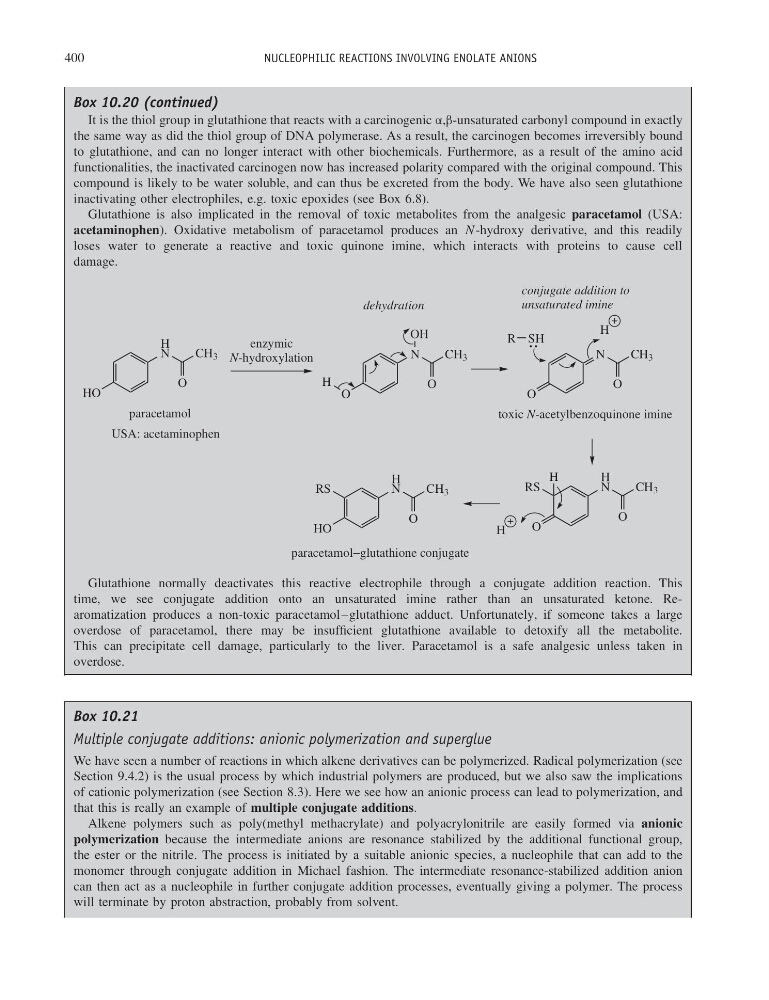
Glutathione is also implicated in the removal of toxic metabolites from the analgesic paracetamol (USA:
acetaminophen). Oxidative metabolism of paracetamol produces an N-hydroxy derivative, and this readily
loses water to generate a reactive and toxic quinone imine, which interacts with proteins to cause cell
damage.
H
N
HO
CH 3
O
paracetamol
USA: acetaminophen
enzymic
N-hydroxylation
N
O
CH 3
O
OH
H
N
O
CH 3
O
toxic N-acetylbenzoquinone imine
R SH
H
H
N
O
CH 3
O
RS
H
H
H
N
HO
CH 3
O
RS
paracetamol−glutathione conjugate
conjugate addition to
unsaturated imine
dehydration
Glutathione normally deactivates this reactive electrophile through a conjugate addition reaction. This
time, we see conjugate addition onto an unsaturated imine rather than an unsaturated ketone. Rearomatization produces a non-toxic paracetamol–glutathione adduct. Unfortunately, if someone takes a large
overdose of paracetamol, there may be insufficient glutathione available to detoxify all the metabolite.
This can precipitate cell damage, particularly to the liver. Paracetamol is a safe analgesic unless taken in
overdose.
Box 10.21
Multiple conjugate additions: anionic polymerization and superglue
We have seen a number of reactions in which alkene derivatives can be polymerized. Radical polymerization (see
Section 9.4.2) is the usual process by which industrial polymers are produced, but we also saw the implications
of cationic polymerization (see Section 8.3). Here we see how an anionic process can lead to polymerization, and
that this is really an example of multiple conjugate additions.
Alkene polymers such as poly(methyl methacrylate) and polyacrylonitrile are easily formed via anionic
polymerization because the intermediate anions are resonance stabilized by the additional functional group,
the ester or the nitrile. The process is initiated by a suitable anionic species, a nucleophile that can add to the
monomer through conjugate addition in Michael fashion. The intermediate resonance-stabilized addition anion
can then act as a nucleophile in further conjugate addition processes, eventually giving a polymer. The process
will terminate by proton abstraction, probably from solvent.
NUCLEOPHILIC REACTIONS INVOLVING ENOLATE ANIONS
Box 10.20 (continued)
It is the thiol group in glutathione that reacts with a carcinogenic α,β-unsaturated carbonyl compound in exactly
the same way as did the thiol group of DNA polymerase. As a result, the carcinogen becomes irreversibly bound
to glutathione, and can no longer interact with other biochemicals. Furthermore, as a result of the amino acid
functionalities, the inactivated carcinogen now has increased polarity compared with the original compound. This
compound is likely to be water soluble, and can thus be excreted from the body. We have also seen glutathione
inactivating other electrophiles, e.g. toxic epoxides (see Box 6.8).
Glutathione is also implicated in the removal of toxic metabolites from the analgesic paracetamol (USA:
acetaminophen). Oxidative metabolism of paracetamol produces an N-hydroxy derivative, and this readily
loses water to generate a reactive and toxic quinone imine, which interacts with proteins to cause cell
damage.
H
N
HO
CH 3
O
paracetamol
USA: acetaminophen
enzymic
N-hydroxylation
N
O
CH 3
O
OH
H
N
O
CH 3
O
toxic N-acetylbenzoquinone imine
R SH
H
H
N
O
CH 3
O
RS
H
H
H
N
HO
CH 3
O
RS
paracetamol−glutathione conjugate
conjugate addition to
unsaturated imine
dehydration
Glutathione normally deactivates this reactive electrophile through a conjugate addition reaction. This
time, we see conjugate addition onto an unsaturated imine rather than an unsaturated ketone. Rearomatization produces a non-toxic paracetamol–glutathione adduct. Unfortunately, if someone takes a large
overdose of paracetamol, there may be insufficient glutathione available to detoxify all the metabolite.
This can precipitate cell damage, particularly to the liver. Paracetamol is a safe analgesic unless taken in
overdose.
Box 10.21
Multiple conjugate additions: anionic polymerization and superglue
We have seen a number of reactions in which alkene derivatives can be polymerized. Radical polymerization (see
Section 9.4.2) is the usual process by which industrial polymers are produced, but we also saw the implications
of cationic polymerization (see Section 8.3). Here we see how an anionic process can lead to polymerization, and
that this is really an example of multiple conjugate additions.
Alkene polymers such as poly(methyl methacrylate) and polyacrylonitrile are easily formed via anionic
polymerization because the intermediate anions are resonance stabilized by the additional functional group,
the ester or the nitrile. The process is initiated by a suitable anionic species, a nucleophile that can add to the
monomer through conjugate addition in Michael fashion. The intermediate resonance-stabilized addition anion
can then act as a nucleophile in further conjugate addition processes, eventually giving a polymer. The process
will terminate by proton abstraction, probably from solvent.