

NUCLEOPHILIC ADDITION TO CONJUGATED SYSTEMS: CONJUGATE ADDITION AND MICHAEL REACTIONS
399
These are reacted together in basic solution. It can be deduced that the 1,3-diketone is more acidic than the
monoketone substrate, so will be ionized by removal of a proton from the carbon between the two carbonyls
to give the enolate anion as a nucleophile. This attacks the α,β-unsaturated ketone in a Michael reaction. It
is understandable that this large nucleophile prefers to attack the unhindered β-position rather than the more
congested ketone carbonyl.
The product from the Michael reaction will be a triketone. Now this substrate has four potential sites
for proton removal, all flanked by a single ketone group, and thus all hydrogens are of similar acidity.
The reaction that occurs is the intramolecular reaction that generates a strain-free six-membered ring system.
This involves generating an enolate anion through loss of a proton from the terminal methyl of the sidechain, followed by an aldol reaction involving the appropriate ring carbonyl as electrophile. Dehydration
follows to generate the conjugated system, and it is this dehydration that disturbs the equilibrium (see
Section 10.3).
This annulation process was of considerable value in early approaches to steroid synthesis. The structural
relationship of the bicyclic product obtained here to the male sex hormone testosterone is immediately apparent.
Further, the non-conjugated carbonyl is now activating the adjacent carbon that subsequently features in building
up the third ring system.
Box 10.20
Michael acceptors can be carcinogens
The Michael reaction involves conjugate addition of a nucleophile onto an α,β-unsaturated carbonyl compound,
or similar system. Such reactions take place in nature as well, and some can be potentially dangerous to us.
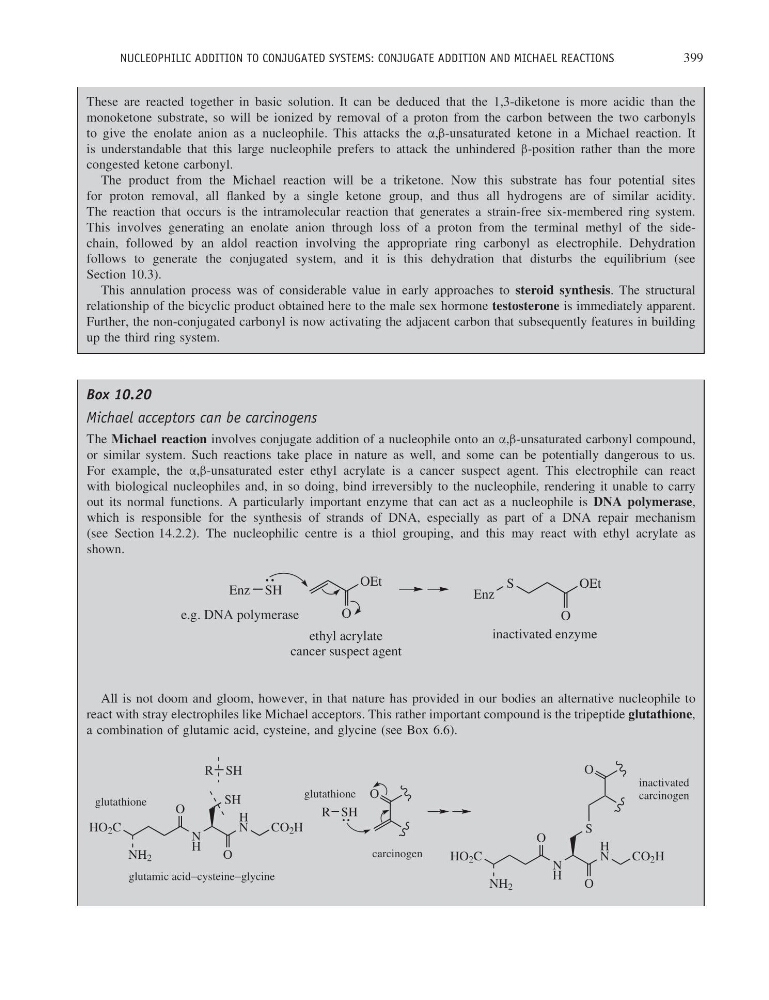
For example, the α,β-unsaturated ester ethyl acrylate is a cancer suspect agent. This electrophile can react
with biological nucleophiles and, in so doing, bind irreversibly to the nucleophile, rendering it unable to carry
out its normal functions. A particularly important enzyme that can act as a nucleophile is DNA polymerase,
which is responsible for the synthesis of strands of DNA, especially as part of a DNA repair mechanism
(see Section 14.2.2). The nucleophilic centre is a thiol grouping, and this may react with ethyl acrylate as
shown.
Enz SH
e.g. DNA polymerase
OEt
O
ethyl acrylate
cancer suspect agent
OEt
O
S
Enz
inactivated enzyme
All is not doom and gloom, however, in that nature has provided in our bodies an alternative nucleophile to
react with stray electrophiles like Michael acceptors. This rather important compound is the tripeptide glutathione,
a combination of glutamic acid, cysteine, and glycine (see Box 6.6).
HO 2 C
N
H
H
N
CO 2 H
NH 2
O
SH
O
glutamic acid−cysteine−glycine
glutathione
R SH
O
carcinogen
inactivated
carcinogen
HO 2 C
N
H
H
N
CO 2 H
NH 2
O
S
O
O
R SH
glutathione
399
These are reacted together in basic solution. It can be deduced that the 1,3-diketone is more acidic than the
monoketone substrate, so will be ionized by removal of a proton from the carbon between the two carbonyls
to give the enolate anion as a nucleophile. This attacks the α,β-unsaturated ketone in a Michael reaction. It
is understandable that this large nucleophile prefers to attack the unhindered β-position rather than the more
congested ketone carbonyl.
The product from the Michael reaction will be a triketone. Now this substrate has four potential sites
for proton removal, all flanked by a single ketone group, and thus all hydrogens are of similar acidity.
The reaction that occurs is the intramolecular reaction that generates a strain-free six-membered ring system.
This involves generating an enolate anion through loss of a proton from the terminal methyl of the sidechain, followed by an aldol reaction involving the appropriate ring carbonyl as electrophile. Dehydration
follows to generate the conjugated system, and it is this dehydration that disturbs the equilibrium (see
Section 10.3).
This annulation process was of considerable value in early approaches to steroid synthesis. The structural
relationship of the bicyclic product obtained here to the male sex hormone testosterone is immediately apparent.
Further, the non-conjugated carbonyl is now activating the adjacent carbon that subsequently features in building
up the third ring system.
Box 10.20
Michael acceptors can be carcinogens
The Michael reaction involves conjugate addition of a nucleophile onto an α,β-unsaturated carbonyl compound,
or similar system. Such reactions take place in nature as well, and some can be potentially dangerous to us.
For example, the α,β-unsaturated ester ethyl acrylate is a cancer suspect agent. This electrophile can react
with biological nucleophiles and, in so doing, bind irreversibly to the nucleophile, rendering it unable to carry
out its normal functions. A particularly important enzyme that can act as a nucleophile is DNA polymerase,
which is responsible for the synthesis of strands of DNA, especially as part of a DNA repair mechanism
(see Section 14.2.2). The nucleophilic centre is a thiol grouping, and this may react with ethyl acrylate as
shown.
Enz SH
e.g. DNA polymerase
OEt
O
ethyl acrylate
cancer suspect agent
OEt
O
S
Enz
inactivated enzyme
All is not doom and gloom, however, in that nature has provided in our bodies an alternative nucleophile to
react with stray electrophiles like Michael acceptors. This rather important compound is the tripeptide glutathione,
a combination of glutamic acid, cysteine, and glycine (see Box 6.6).
HO 2 C
N
H
H
N
CO 2 H
NH 2
O
SH
O
glutamic acid−cysteine−glycine
glutathione
R SH
O
carcinogen
inactivated
carcinogen
HO 2 C
N
H
H
N
CO 2 H
NH 2
O
S
O
O
R SH
glutathione