

24
ATOMIC STRUCTURE AND BONDING
chloride anion Cl
− . Sodium loses one electron to
become the cation Na
+ .
Cl
Na
Cl
Na
The simplest of the cations we encounter is H
+ .
This is the result of a hydrogen atom losing an
electron, and simple arithmetic tells us that this
entity now has no electrons, being composed of just
a proton. We thus refer to H
+ as a proton, and
combination with H
+ as protonation.
In favourable circumstances, we may see more
than one electron being donated/acquired, e.g. Mg
2+
O
2− , though the more electrons involved the more
difficult it is to achieve the necessary ionizations.
Molecules such as methane, CH 4 , are not obtained
through ionic bonding, but through the covalent
electron-sharing mechanism.
2.6 Covalent bonding
2.6.1 Molecular orbitals: σ and π bonds
We have used the electronic energy levels for atomic
hydrogen to serve as a model for other atoms. In
a similar way, we can use the interaction of two
hydrogen atoms giving the hydrogen molecule as
a model for bonding between other atoms. In its
simplest form, we can consider the bond between
two hydrogen atoms originates by bringing the two
atoms together so that the atomic orbitals overlap,
allowing the electrons from each atom to mingle and
become associated with both atoms. This sharing of
electrons effectively brings each atom up to the noble
gas electronic configuration (He, two electrons).
Furthermore, it creates a new orbital spanning both
atoms in which the two electrons are located; this is
called a molecular orbital.
1s atomic orbitals of
two hydrogen atoms
overlap of
orbitals
molecular orbital
of H 2 molecule
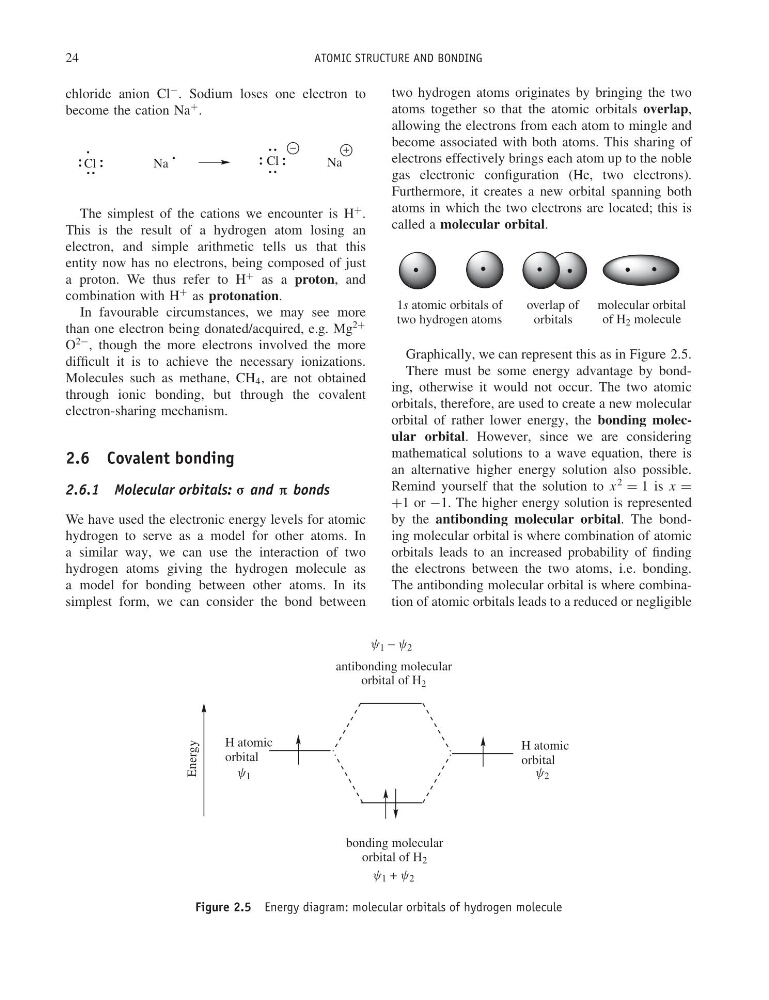
Graphically, we can represent this as in Figure 2.5.
There must be some energy advantage by bonding, otherwise it would not occur. The two atomic
orbitals, therefore, are used to create a new molecular
orbital of rather lower energy, the bonding molecular orbital. However, since we are considering
mathematical solutions to a wave equation, there is
an alternative higher energy solution also possible.
Remind yourself that the solution to x
2
= 1 is x =
+1 or −1. The higher energy solution is represented
by the antibonding molecular orbital. The bonding molecular orbital is where combination of atomic
orbitals leads to an increased probability of finding
the electrons between the two atoms, i.e. bonding.
The antibonding molecular orbital is where combination of atomic orbitals leads to a reduced or negligible
H atomic
orbital
H atomic
orbital
antibonding molecular
orbital of H 2
bonding molecular
orbital of H 2
Energy
y 1 + y 2
y 1 − y 2
y 1
y 2
Figure 2.5 Energy diagram: molecular orbitals of hydrogen molecule
ATOMIC STRUCTURE AND BONDING
chloride anion Cl
− . Sodium loses one electron to
become the cation Na
+ .
Cl
Na
Cl
Na
The simplest of the cations we encounter is H
+ .
This is the result of a hydrogen atom losing an
electron, and simple arithmetic tells us that this
entity now has no electrons, being composed of just
a proton. We thus refer to H
+ as a proton, and
combination with H
+ as protonation.
In favourable circumstances, we may see more
than one electron being donated/acquired, e.g. Mg
2+
O
2− , though the more electrons involved the more
difficult it is to achieve the necessary ionizations.
Molecules such as methane, CH 4 , are not obtained
through ionic bonding, but through the covalent
electron-sharing mechanism.
2.6 Covalent bonding
2.6.1 Molecular orbitals: σ and π bonds
We have used the electronic energy levels for atomic
hydrogen to serve as a model for other atoms. In
a similar way, we can use the interaction of two
hydrogen atoms giving the hydrogen molecule as
a model for bonding between other atoms. In its
simplest form, we can consider the bond between
two hydrogen atoms originates by bringing the two
atoms together so that the atomic orbitals overlap,
allowing the electrons from each atom to mingle and
become associated with both atoms. This sharing of
electrons effectively brings each atom up to the noble
gas electronic configuration (He, two electrons).
Furthermore, it creates a new orbital spanning both
atoms in which the two electrons are located; this is
called a molecular orbital.
1s atomic orbitals of
two hydrogen atoms
overlap of
orbitals
molecular orbital
of H 2 molecule
Graphically, we can represent this as in Figure 2.5.
There must be some energy advantage by bonding, otherwise it would not occur. The two atomic
orbitals, therefore, are used to create a new molecular
orbital of rather lower energy, the bonding molecular orbital. However, since we are considering
mathematical solutions to a wave equation, there is
an alternative higher energy solution also possible.
Remind yourself that the solution to x
2
= 1 is x =
+1 or −1. The higher energy solution is represented
by the antibonding molecular orbital. The bonding molecular orbital is where combination of atomic
orbitals leads to an increased probability of finding
the electrons between the two atoms, i.e. bonding.
The antibonding molecular orbital is where combination of atomic orbitals leads to a reduced or negligible
H atomic
orbital
H atomic
orbital
antibonding molecular
orbital of H 2
bonding molecular
orbital of H 2
Energy
y 1 + y 2
y 1 − y 2
y 1
y 2
Figure 2.5 Energy diagram: molecular orbitals of hydrogen molecule