

RADICAL ADDITION OF OXYGEN: AUTOXIDATION REACTIONS
337
HO
O
O
O
O
O
O
O
OOR
resonance-stabilized
radical
O
O
O
O
OH
α-tocopherol
O
O
OH
hydrolysis of
hemiketal
initiation of radical
reaction by peroxyl radical
quenching of second
peroxyl radical
α-tocopherolquinone
loss of peroxide
leaving group
nucleophilic addition of water
generates a hemiketal
OH 2
ROO
ROO
H 2 O
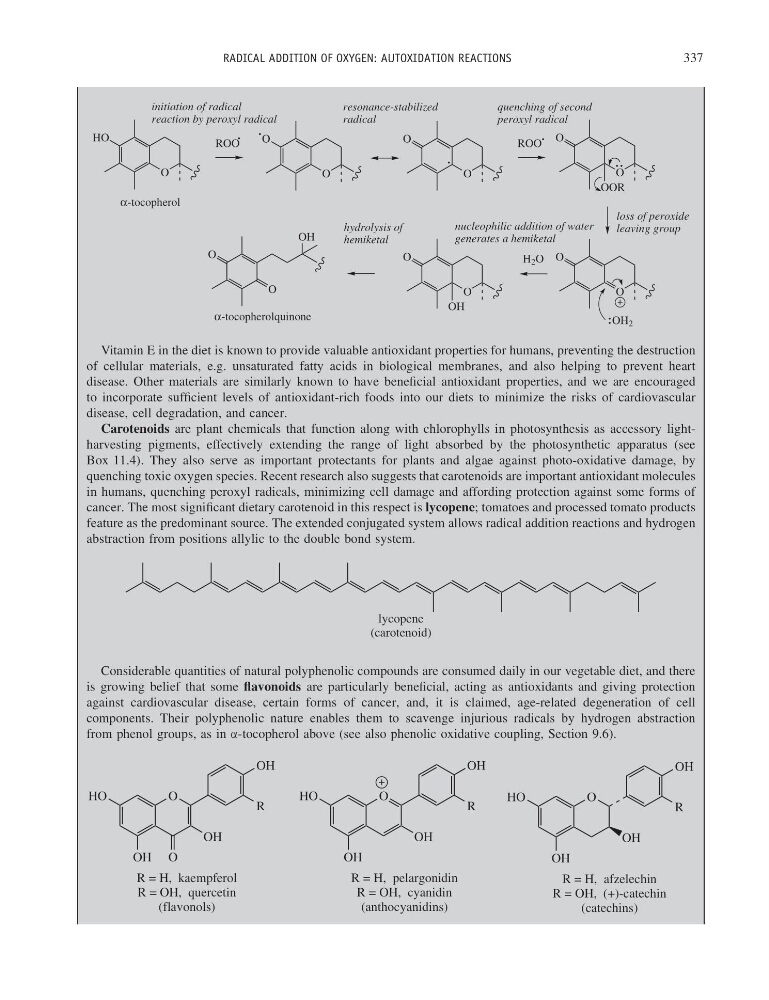
Vitamin E in the diet is known to provide valuable antioxidant properties for humans, preventing the destruction
of cellular materials, e.g. unsaturated fatty acids in biological membranes, and also helping to prevent heart
disease. Other materials are similarly known to have beneficial antioxidant properties, and we are encouraged
to incorporate sufficient levels of antioxidant-rich foods into our diets to minimize the risks of cardiovascular
disease, cell degradation, and cancer.
Carotenoids are plant chemicals that function along with chlorophylls in photosynthesis as accessory lightharvesting pigments, effectively extending the range of light absorbed by the photosynthetic apparatus (see
Box 11.4). They also serve as important protectants for plants and algae against photo-oxidative damage, by
quenching toxic oxygen species. Recent research also suggests that carotenoids are important antioxidant molecules
in humans, quenching peroxyl radicals, minimizing cell damage and affording protection against some forms of
cancer. The most significant dietary carotenoid in this respect is lycopene; tomatoes and processed tomato products
feature as the predominant source. The extended conjugated system allows radical addition reactions and hydrogen
abstraction from positions allylic to the double bond system.
lycopene
(carotenoid)
Considerable quantities of natural polyphenolic compounds are consumed daily in our vegetable diet, and there
is growing belief that some flavonoids are particularly beneficial, acting as antioxidants and giving protection
against cardiovascular disease, certain forms of cancer, and, it is claimed, age-related degeneration of cell
components. Their polyphenolic nature enables them to scavenge injurious radicals by hydrogen abstraction
from phenol groups, as in α-tocopherol above (see also phenolic oxidative coupling, Section 9.6).
O
O
OH
HO
OH
R
OH
O
OH
HO
OH
R
OH
O
OH
HO
OH
R
OH
R = H, kaempferol
R = OH, quercetin
(flavonols)
R = H, afzelechin
R = OH, (+)-catechin
(catechins)
R = H, pelargonidin
R = OH, cyanidin
(anthocyanidins)
337
HO
O
O
O
O
O
O
O
OOR
resonance-stabilized
radical
O
O
O
O
OH
α-tocopherol
O
O
OH
hydrolysis of
hemiketal
initiation of radical
reaction by peroxyl radical
quenching of second
peroxyl radical
α-tocopherolquinone
loss of peroxide
leaving group
nucleophilic addition of water
generates a hemiketal
OH 2
ROO
ROO
H 2 O
Vitamin E in the diet is known to provide valuable antioxidant properties for humans, preventing the destruction
of cellular materials, e.g. unsaturated fatty acids in biological membranes, and also helping to prevent heart
disease. Other materials are similarly known to have beneficial antioxidant properties, and we are encouraged
to incorporate sufficient levels of antioxidant-rich foods into our diets to minimize the risks of cardiovascular
disease, cell degradation, and cancer.
Carotenoids are plant chemicals that function along with chlorophylls in photosynthesis as accessory lightharvesting pigments, effectively extending the range of light absorbed by the photosynthetic apparatus (see
Box 11.4). They also serve as important protectants for plants and algae against photo-oxidative damage, by
quenching toxic oxygen species. Recent research also suggests that carotenoids are important antioxidant molecules
in humans, quenching peroxyl radicals, minimizing cell damage and affording protection against some forms of
cancer. The most significant dietary carotenoid in this respect is lycopene; tomatoes and processed tomato products
feature as the predominant source. The extended conjugated system allows radical addition reactions and hydrogen
abstraction from positions allylic to the double bond system.
lycopene
(carotenoid)
Considerable quantities of natural polyphenolic compounds are consumed daily in our vegetable diet, and there
is growing belief that some flavonoids are particularly beneficial, acting as antioxidants and giving protection
against cardiovascular disease, certain forms of cancer, and, it is claimed, age-related degeneration of cell
components. Their polyphenolic nature enables them to scavenge injurious radicals by hydrogen abstraction
from phenol groups, as in α-tocopherol above (see also phenolic oxidative coupling, Section 9.6).
O
O
OH
HO
OH
R
OH
O
OH
HO
OH
R
OH
O
OH
HO
OH
R
OH
R = H, kaempferol
R = OH, quercetin
(flavonols)
R = H, afzelechin
R = OH, (+)-catechin
(catechins)
R = H, pelargonidin
R = OH, cyanidin
(anthocyanidins)