

336
RADICAL REACTIONS
Box 9.1 (continued)
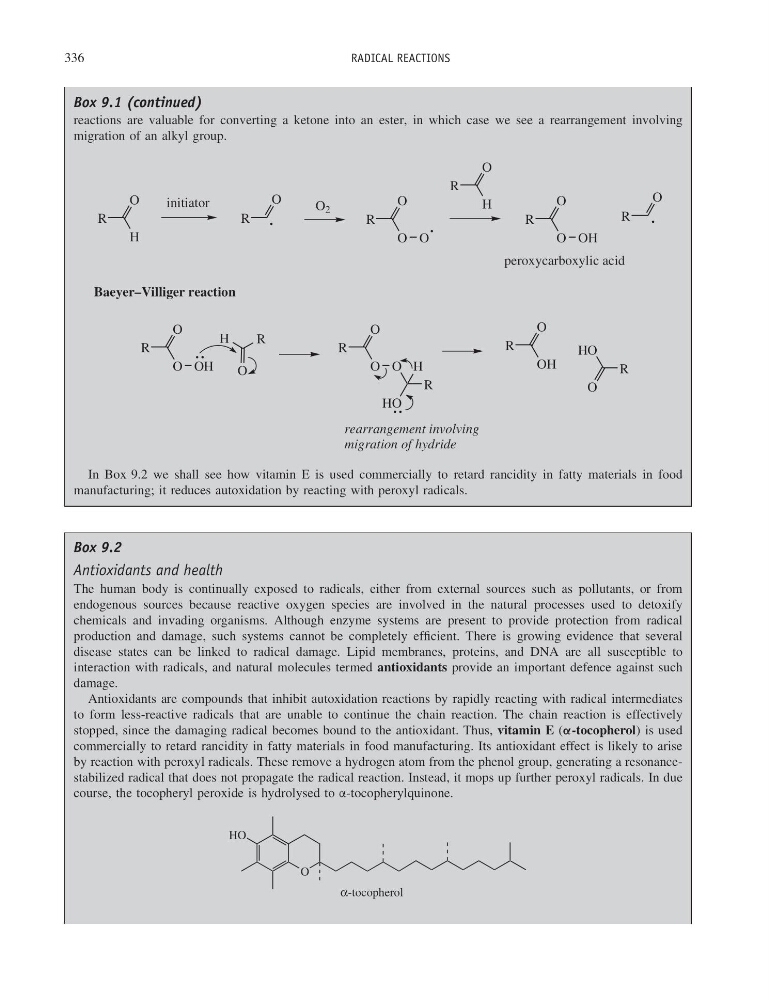
reactions are valuable for converting a ketone into an ester, in which case we see a rearrangement involving
migration of an alkyl group.
R
H
O
initiator
R
O
O 2
R
O
O
O
R
H
O
R
O
O
OH
R
O
peroxycarboxylic acid
R
O
O
OH
R
H
O
R
O
O
O
R
HO
H
R
OH
O
R
O
HO
Baeyer–Villiger reaction
rearrangement involving
migration of hydride
In Box 9.2 we shall see how vitamin E is used commercially to retard rancidity in fatty materials in food
manufacturing; it reduces autoxidation by reacting with peroxyl radicals.
Box 9.2
Antioxidants and health
The human body is continually exposed to radicals, either from external sources such as pollutants, or from
endogenous sources because reactive oxygen species are involved in the natural processes used to detoxify
chemicals and invading organisms. Although enzyme systems are present to provide protection from radical
production and damage, such systems cannot be completely efficient. There is growing evidence that several
disease states can be linked to radical damage. Lipid membranes, proteins, and DNA are all susceptible to
interaction with radicals, and natural molecules termed antioxidants provide an important defence against such
damage.
Antioxidants are compounds that inhibit autoxidation reactions by rapidly reacting with radical intermediates
to form less-reactive radicals that are unable to continue the chain reaction. The chain reaction is effectively
stopped, since the damaging radical becomes bound to the antioxidant. Thus, vitamin E (α-tocopherol) is used
commercially to retard rancidity in fatty materials in food manufacturing. Its antioxidant effect is likely to arise
by reaction with peroxyl radicals. These remove a hydrogen atom from the phenol group, generating a resonancestabilized radical that does not propagate the radical reaction. Instead, it mops up further peroxyl radicals. In due
course, the tocopheryl peroxide is hydrolysed to α-tocopherylquinone.
HO
O
α-tocopherol
RADICAL REACTIONS
Box 9.1 (continued)
reactions are valuable for converting a ketone into an ester, in which case we see a rearrangement involving
migration of an alkyl group.
R
H
O
initiator
R
O
O 2
R
O
O
O
R
H
O
R
O
O
OH
R
O
peroxycarboxylic acid
R
O
O
OH
R
H
O
R
O
O
O
R
HO
H
R
OH
O
R
O
HO
Baeyer–Villiger reaction
rearrangement involving
migration of hydride
In Box 9.2 we shall see how vitamin E is used commercially to retard rancidity in fatty materials in food
manufacturing; it reduces autoxidation by reacting with peroxyl radicals.
Box 9.2
Antioxidants and health
The human body is continually exposed to radicals, either from external sources such as pollutants, or from
endogenous sources because reactive oxygen species are involved in the natural processes used to detoxify
chemicals and invading organisms. Although enzyme systems are present to provide protection from radical
production and damage, such systems cannot be completely efficient. There is growing evidence that several
disease states can be linked to radical damage. Lipid membranes, proteins, and DNA are all susceptible to
interaction with radicals, and natural molecules termed antioxidants provide an important defence against such
damage.
Antioxidants are compounds that inhibit autoxidation reactions by rapidly reacting with radical intermediates
to form less-reactive radicals that are unable to continue the chain reaction. The chain reaction is effectively
stopped, since the damaging radical becomes bound to the antioxidant. Thus, vitamin E (α-tocopherol) is used
commercially to retard rancidity in fatty materials in food manufacturing. Its antioxidant effect is likely to arise
by reaction with peroxyl radicals. These remove a hydrogen atom from the phenol group, generating a resonancestabilized radical that does not propagate the radical reaction. Instead, it mops up further peroxyl radicals. In due
course, the tocopheryl peroxide is hydrolysed to α-tocopherylquinone.
HO
O
α-tocopherol