

NITROGEN AS A NUCLEOPHILE: AMIDES
265
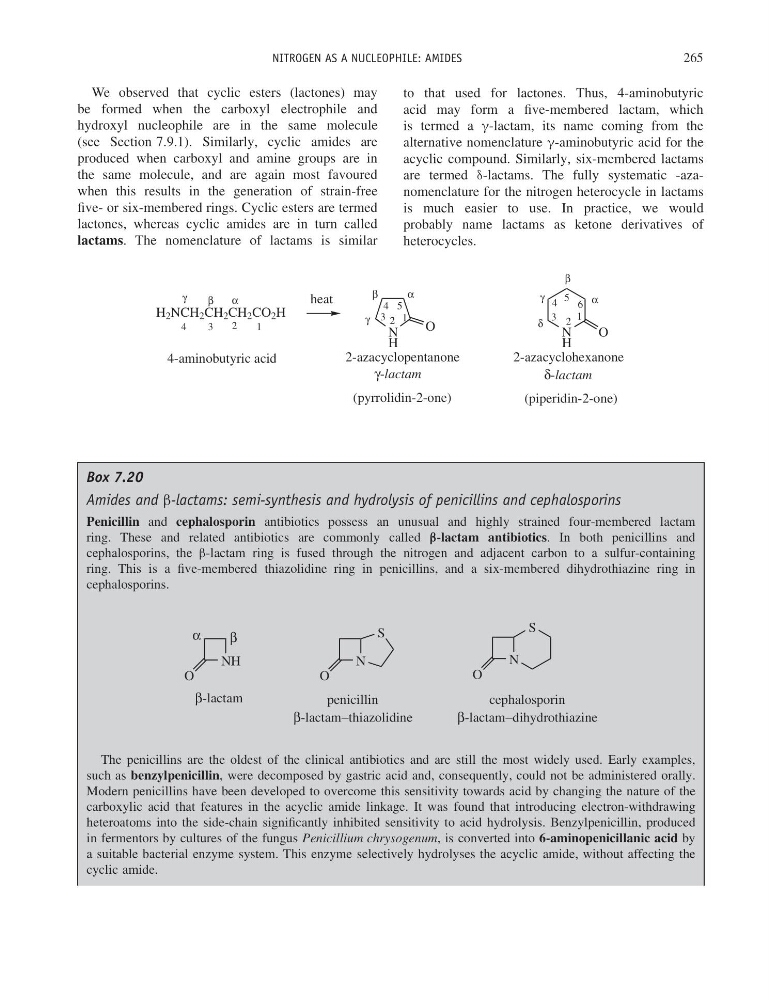
We observed that cyclic esters (lactones) may
be formed when the carboxyl electrophile and
hydroxyl nucleophile are in the same molecule
(see Section 7.9.1). Similarly, cyclic amides are
produced when carboxyl and amine groups are in
the same molecule, and are again most favoured
when this results in the generation of strain-free
five- or six-membered rings. Cyclic esters are termed
lactones, whereas cyclic amides are in turn called
lactams. The nomenclature of lactams is similar
to that used for lactones. Thus, 4-aminobutyric
acid may form a five-membered lactam, which
is termed a γ-lactam, its name coming from the
alternative nomenclature γ-aminobutyric acid for the
acyclic compound. Similarly, six-membered lactams
are termed δ-lactams. The fully systematic -azanomenclature for the nitrogen heterocycle in lactams
is much easier to use. In practice, we would
probably name lactams as ketone derivatives of
heterocycles.
N
H
O
N
H
O
α
γ
β
β
heat
γ
α
1
2
3
4
2-azacyclopentanone
4-aminobutyric acid
1
2
3
4 5
2-azacyclohexanone
α
β
γ
1
4
2
δ
3
5 6
δ-lactam
γ-lactam
(pyrrolidin-2-one)
(piperidin-2-one)
H 2 NCH 2 CH 2 CH 2 CO 2 H
Box 7.20
Amides and β-lactams: semi-synthesis and hydrolysis of penicillins and cephalosporins
Penicillin and cephalosporin antibiotics possess an unusual and highly strained four-membered lactam
ring. These and related antibiotics are commonly called β-lactam antibiotics. In both penicillins and
cephalosporins, the β-lactam ring is fused through the nitrogen and adjacent carbon to a sulfur-containing
ring. This is a five-membered thiazolidine ring in penicillins, and a six-membered dihydrothiazine ring in
cephalosporins.
N
S
O
N
O
S
NH
O
α
penicillin
β-lactam−thiazolidine
β
β-lactam
cephalosporin
β-lactam−dihydrothiazine
The penicillins are the oldest of the clinical antibiotics and are still the most widely used. Early examples,
such as benzylpenicillin, were decomposed by gastric acid and, consequently, could not be administered orally.
Modern penicillins have been developed to overcome this sensitivity towards acid by changing the nature of the
carboxylic acid that features in the acyclic amide linkage. It was found that introducing electron-withdrawing
heteroatoms into the side-chain significantly inhibited sensitivity to acid hydrolysis. Benzylpenicillin, produced
in fermentors by cultures of the fungus Penicillium chrysogenum, is converted into 6-aminopenicillanic acid by
a suitable bacterial enzyme system. This enzyme selectively hydrolyses the acyclic amide, without affecting the
cyclic amide.
265
We observed that cyclic esters (lactones) may
be formed when the carboxyl electrophile and
hydroxyl nucleophile are in the same molecule
(see Section 7.9.1). Similarly, cyclic amides are
produced when carboxyl and amine groups are in
the same molecule, and are again most favoured
when this results in the generation of strain-free
five- or six-membered rings. Cyclic esters are termed
lactones, whereas cyclic amides are in turn called
lactams. The nomenclature of lactams is similar
to that used for lactones. Thus, 4-aminobutyric
acid may form a five-membered lactam, which
is termed a γ-lactam, its name coming from the
alternative nomenclature γ-aminobutyric acid for the
acyclic compound. Similarly, six-membered lactams
are termed δ-lactams. The fully systematic -azanomenclature for the nitrogen heterocycle in lactams
is much easier to use. In practice, we would
probably name lactams as ketone derivatives of
heterocycles.
N
H
O
N
H
O
α
γ
β
β
heat
γ
α
1
2
3
4
2-azacyclopentanone
4-aminobutyric acid
1
2
3
4 5
2-azacyclohexanone
α
β
γ
1
4
2
δ
3
5 6
δ-lactam
γ-lactam
(pyrrolidin-2-one)
(piperidin-2-one)
H 2 NCH 2 CH 2 CH 2 CO 2 H
Box 7.20
Amides and β-lactams: semi-synthesis and hydrolysis of penicillins and cephalosporins
Penicillin and cephalosporin antibiotics possess an unusual and highly strained four-membered lactam
ring. These and related antibiotics are commonly called β-lactam antibiotics. In both penicillins and
cephalosporins, the β-lactam ring is fused through the nitrogen and adjacent carbon to a sulfur-containing
ring. This is a five-membered thiazolidine ring in penicillins, and a six-membered dihydrothiazine ring in
cephalosporins.
N
S
O
N
O
S
NH
O
α
penicillin
β-lactam−thiazolidine
β
β-lactam
cephalosporin
β-lactam−dihydrothiazine
The penicillins are the oldest of the clinical antibiotics and are still the most widely used. Early examples,
such as benzylpenicillin, were decomposed by gastric acid and, consequently, could not be administered orally.
Modern penicillins have been developed to overcome this sensitivity towards acid by changing the nature of the
carboxylic acid that features in the acyclic amide linkage. It was found that introducing electron-withdrawing
heteroatoms into the side-chain significantly inhibited sensitivity to acid hydrolysis. Benzylpenicillin, produced
in fermentors by cultures of the fungus Penicillium chrysogenum, is converted into 6-aminopenicillanic acid by
a suitable bacterial enzyme system. This enzyme selectively hydrolyses the acyclic amide, without affecting the
cyclic amide.