

264
NUCLEOPHILIC REACTIONS OF CARBONYL GROUPS
than alcohols (see Section 6.1.2), and that addition
of nitrogen to the carbonyl compound does not
usually require acid or base catalysis. Indeed, acid
conditions would protonate the amine and destroy its
nucleophilicity (see Section 7.7.1).
Note that, in all of these reaction mechanisms,
a proton needs to be removed from the nitrogen
nucleophile. Hence ammonia, primary amines, and
secondary amines, but not tertiary amines, can
function as nucleophiles. Where we appeared to
exploit the nucleophilicity of a tertiary amine (pyridine) towards carboxylic acid derivatives forming
an acylpyridinium ion, the amine was subsequently
lost as a leaving group (see Section 7.9.1). Pyridine
behaved as a nucleophilic catalyst, and a permanent
N–C bond was not produced.
Box 7.19
Synthesis of paracetamol: an example of selective reactivities
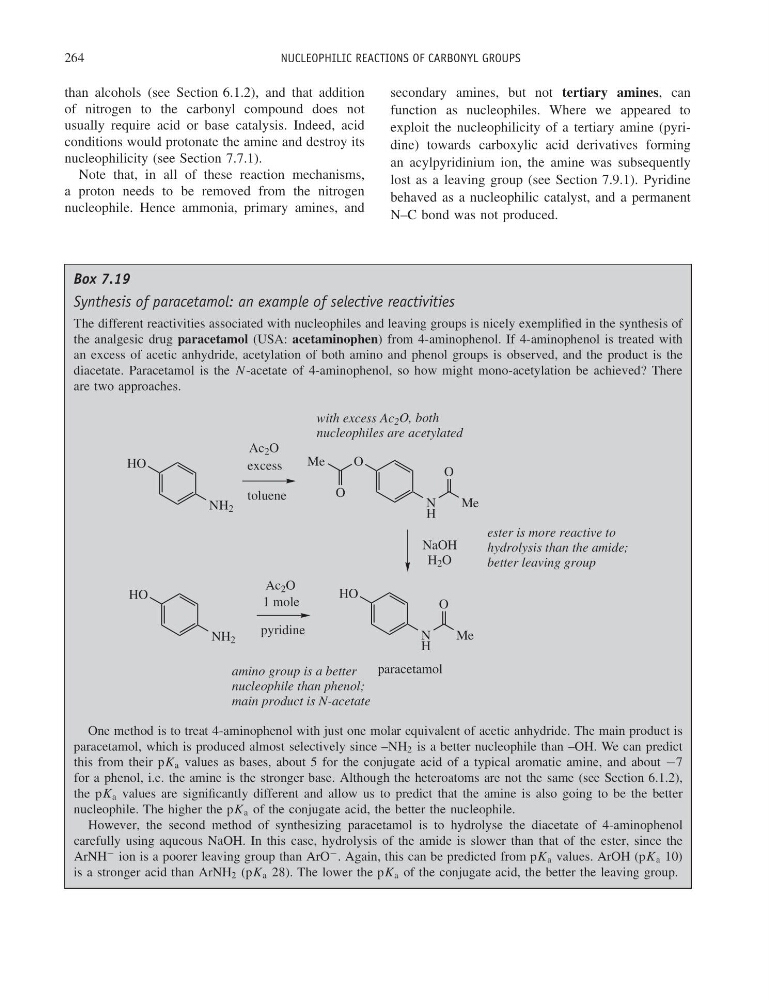
The different reactivities associated with nucleophiles and leaving groups is nicely exemplified in the synthesis of
the analgesic drug paracetamol (USA: acetaminophen) from 4-aminophenol. If 4-aminophenol is treated with
an excess of acetic anhydride, acetylation of both amino and phenol groups is observed, and the product is the
diacetate. Paracetamol is the N-acetate of 4-aminophenol, so how might mono-acetylation be achieved? There
are two approaches.
HO
NH 2
O
N
H
Me
O
Me
O
Ac 2 O
excess
HO
NH 2
Ac 2 O
pyridine
toluene
1 mole
HO
N
H
Me
O
paracetamol
NaOH
H 2 O
with excess Ac 2 O, both
nucleophiles are acetylated
amino group is a better
nucleophile than phenol;
main product is N-acetate
ester is more reactive to
hydrolysis than the amide;
better leaving group
One method is to treat 4-aminophenol with just one molar equivalent of acetic anhydride. The main product is
paracetamol, which is produced almost selectively since –NH 2 is a better nucleophile than –OH. We can predict
this from their pK a values as bases, about 5 for the conjugate acid of a typical aromatic amine, and about −7
for a phenol, i.e. the amine is the stronger base. Although the heteroatoms are not the same (see Section 6.1.2),
the pK a values are significantly different and allow us to predict that the amine is also going to be the better
nucleophile. The higher the pK a of the conjugate acid, the better the nucleophile.
However, the second method of synthesizing paracetamol is to hydrolyse the diacetate of 4-aminophenol
carefully using aqueous NaOH. In this case, hydrolysis of the amide is slower than that of the ester, since the
ArNH
− ion is a poorer leaving group than ArO
− . Again, this can be predicted from pK a values. ArOH (pK a 10)
is a stronger acid than ArNH 2 (pK a 28). The lower the pK a of the conjugate acid, the better the leaving group.
NUCLEOPHILIC REACTIONS OF CARBONYL GROUPS
than alcohols (see Section 6.1.2), and that addition
of nitrogen to the carbonyl compound does not
usually require acid or base catalysis. Indeed, acid
conditions would protonate the amine and destroy its
nucleophilicity (see Section 7.7.1).
Note that, in all of these reaction mechanisms,
a proton needs to be removed from the nitrogen
nucleophile. Hence ammonia, primary amines, and
secondary amines, but not tertiary amines, can
function as nucleophiles. Where we appeared to
exploit the nucleophilicity of a tertiary amine (pyridine) towards carboxylic acid derivatives forming
an acylpyridinium ion, the amine was subsequently
lost as a leaving group (see Section 7.9.1). Pyridine
behaved as a nucleophilic catalyst, and a permanent
N–C bond was not produced.
Box 7.19
Synthesis of paracetamol: an example of selective reactivities
The different reactivities associated with nucleophiles and leaving groups is nicely exemplified in the synthesis of
the analgesic drug paracetamol (USA: acetaminophen) from 4-aminophenol. If 4-aminophenol is treated with
an excess of acetic anhydride, acetylation of both amino and phenol groups is observed, and the product is the
diacetate. Paracetamol is the N-acetate of 4-aminophenol, so how might mono-acetylation be achieved? There
are two approaches.
HO
NH 2
O
N
H
Me
O
Me
O
Ac 2 O
excess
HO
NH 2
Ac 2 O
pyridine
toluene
1 mole
HO
N
H
Me
O
paracetamol
NaOH
H 2 O
with excess Ac 2 O, both
nucleophiles are acetylated
amino group is a better
nucleophile than phenol;
main product is N-acetate
ester is more reactive to
hydrolysis than the amide;
better leaving group
One method is to treat 4-aminophenol with just one molar equivalent of acetic anhydride. The main product is
paracetamol, which is produced almost selectively since –NH 2 is a better nucleophile than –OH. We can predict
this from their pK a values as bases, about 5 for the conjugate acid of a typical aromatic amine, and about −7
for a phenol, i.e. the amine is the stronger base. Although the heteroatoms are not the same (see Section 6.1.2),
the pK a values are significantly different and allow us to predict that the amine is also going to be the better
nucleophile. The higher the pK a of the conjugate acid, the better the nucleophile.
However, the second method of synthesizing paracetamol is to hydrolyse the diacetate of 4-aminophenol
carefully using aqueous NaOH. In this case, hydrolysis of the amide is slower than that of the ester, since the
ArNH
− ion is a poorer leaving group than ArO
− . Again, this can be predicted from pK a values. ArOH (pK a 10)
is a stronger acid than ArNH 2 (pK a 28). The lower the pK a of the conjugate acid, the better the leaving group.