

256
NUCLEOPHILIC REACTIONS OF CARBONYL GROUPS
good example. This antibiotic is prescribed for patients who are allergic towards penicillins, and is the antibiotic
of choice for infections of Legionella pneumophila, the cause of legionnaire’s disease.
OH
O
O
O
HO
OH
O
O
NMe 2
HO
O
O
OMe
OH
erythronolide
D-desosamine
L-cladinose
erythromycin A
1
2
3
4
5
6
11
7
8
12
10
9
13
lactone
acetal
acetal
O
Osugar
Osugar
O
HO
O OH
OH
4
1
2
3
5
6
7
8
9
10
11
12
13
shape of macrolide
ring in erythromycin
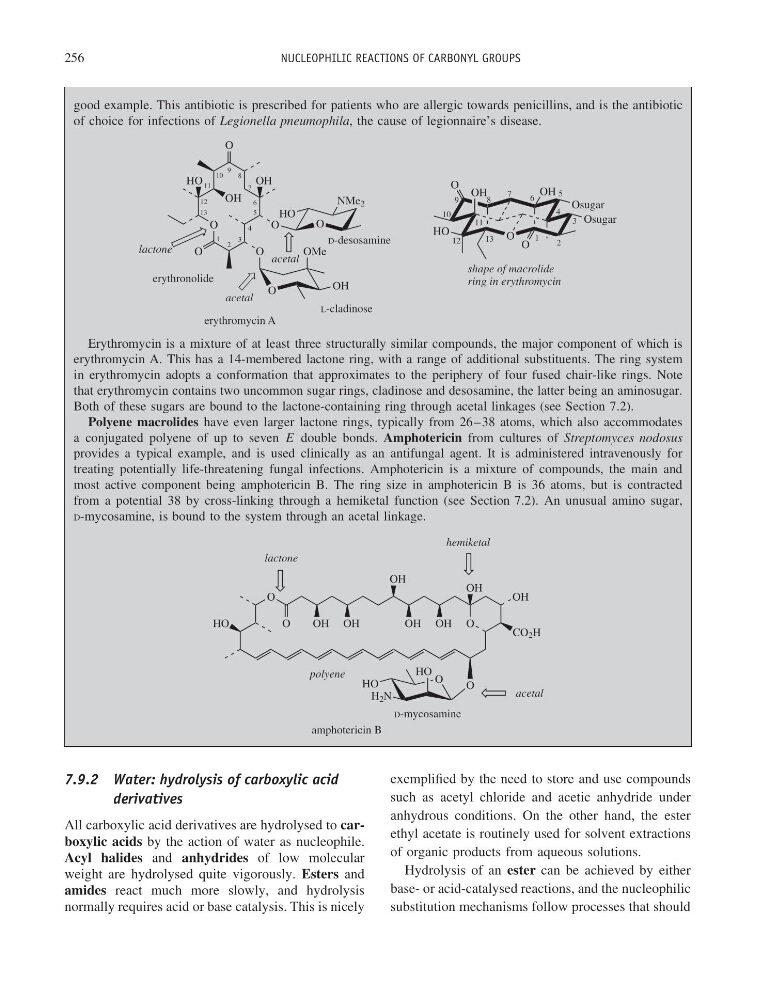
Erythromycin is a mixture of at least three structurally similar compounds, the major component of which is
erythromycin A. This has a 14-membered lactone ring, with a range of additional substituents. The ring system
in erythromycin adopts a conformation that approximates to the periphery of four fused chair-like rings. Note
that erythromycin contains two uncommon sugar rings, cladinose and desosamine, the latter being an aminosugar.
Both of these sugars are bound to the lactone-containing ring through acetal linkages (see Section 7.2).
Polyene macrolides have even larger lactone rings, typically from 26–38 atoms, which also accommodates
a conjugated polyene of up to seven E double bonds. Amphotericin from cultures of Streptomyces nodosus
provides a typical example, and is used clinically as an antifungal agent. It is administered intravenously for
treating potentially life-threatening fungal infections. Amphotericin is a mixture of compounds, the main and
most active component being amphotericin B. The ring size in amphotericin B is 36 atoms, but is contracted
from a potential 38 by cross-linking through a hemiketal function (see Section 7.2). An unusual amino sugar,
D-mycosamine, is bound to the system through an acetal linkage.
O
O
OH OH
OH
OH OH O
OH
CO 2 H
OH
O
HO
O
HO
H 2 N
HO
amphotericin B
D-mycosamine
hemiketal
polyene
acetal
lactone
7.9.2 Water: hydrolysis of carboxylic acid
derivatives
All carboxylic acid derivatives are hydrolysed to carboxylic acids by the action of water as nucleophile.
Acyl halides and anhydrides of low molecular
weight are hydrolysed quite vigorously. Esters and
amides react much more slowly, and hydrolysis
normally requires acid or base catalysis. This is nicely
exemplified by the need to store and use compounds
such as acetyl chloride and acetic anhydride under
anhydrous conditions. On the other hand, the ester
ethyl acetate is routinely used for solvent extractions
of organic products from aqueous solutions.
Hydrolysis of an ester can be achieved by either
base- or acid-catalysed reactions, and the nucleophilic
substitution mechanisms follow processes that should
NUCLEOPHILIC REACTIONS OF CARBONYL GROUPS
good example. This antibiotic is prescribed for patients who are allergic towards penicillins, and is the antibiotic
of choice for infections of Legionella pneumophila, the cause of legionnaire’s disease.
OH
O
O
O
HO
OH
O
O
NMe 2
HO
O
O
OMe
OH
erythronolide
D-desosamine
L-cladinose
erythromycin A
1
2
3
4
5
6
11
7
8
12
10
9
13
lactone
acetal
acetal
O
Osugar
Osugar
O
HO
O OH
OH
4
1
2
3
5
6
7
8
9
10
11
12
13
shape of macrolide
ring in erythromycin
Erythromycin is a mixture of at least three structurally similar compounds, the major component of which is
erythromycin A. This has a 14-membered lactone ring, with a range of additional substituents. The ring system
in erythromycin adopts a conformation that approximates to the periphery of four fused chair-like rings. Note
that erythromycin contains two uncommon sugar rings, cladinose and desosamine, the latter being an aminosugar.
Both of these sugars are bound to the lactone-containing ring through acetal linkages (see Section 7.2).
Polyene macrolides have even larger lactone rings, typically from 26–38 atoms, which also accommodates
a conjugated polyene of up to seven E double bonds. Amphotericin from cultures of Streptomyces nodosus
provides a typical example, and is used clinically as an antifungal agent. It is administered intravenously for
treating potentially life-threatening fungal infections. Amphotericin is a mixture of compounds, the main and
most active component being amphotericin B. The ring size in amphotericin B is 36 atoms, but is contracted
from a potential 38 by cross-linking through a hemiketal function (see Section 7.2). An unusual amino sugar,
D-mycosamine, is bound to the system through an acetal linkage.
O
O
OH OH
OH
OH OH O
OH
CO 2 H
OH
O
HO
O
HO
H 2 N
HO
amphotericin B
D-mycosamine
hemiketal
polyene
acetal
lactone
7.9.2 Water: hydrolysis of carboxylic acid
derivatives
All carboxylic acid derivatives are hydrolysed to carboxylic acids by the action of water as nucleophile.
Acyl halides and anhydrides of low molecular
weight are hydrolysed quite vigorously. Esters and
amides react much more slowly, and hydrolysis
normally requires acid or base catalysis. This is nicely
exemplified by the need to store and use compounds
such as acetyl chloride and acetic anhydride under
anhydrous conditions. On the other hand, the ester
ethyl acetate is routinely used for solvent extractions
of organic products from aqueous solutions.
Hydrolysis of an ester can be achieved by either
base- or acid-catalysed reactions, and the nucleophilic
substitution mechanisms follow processes that should