

OXYGEN AND SULFUR AS NUCLEOPHILES: ESTERS AND CARBOXYLIC ACIDS
255
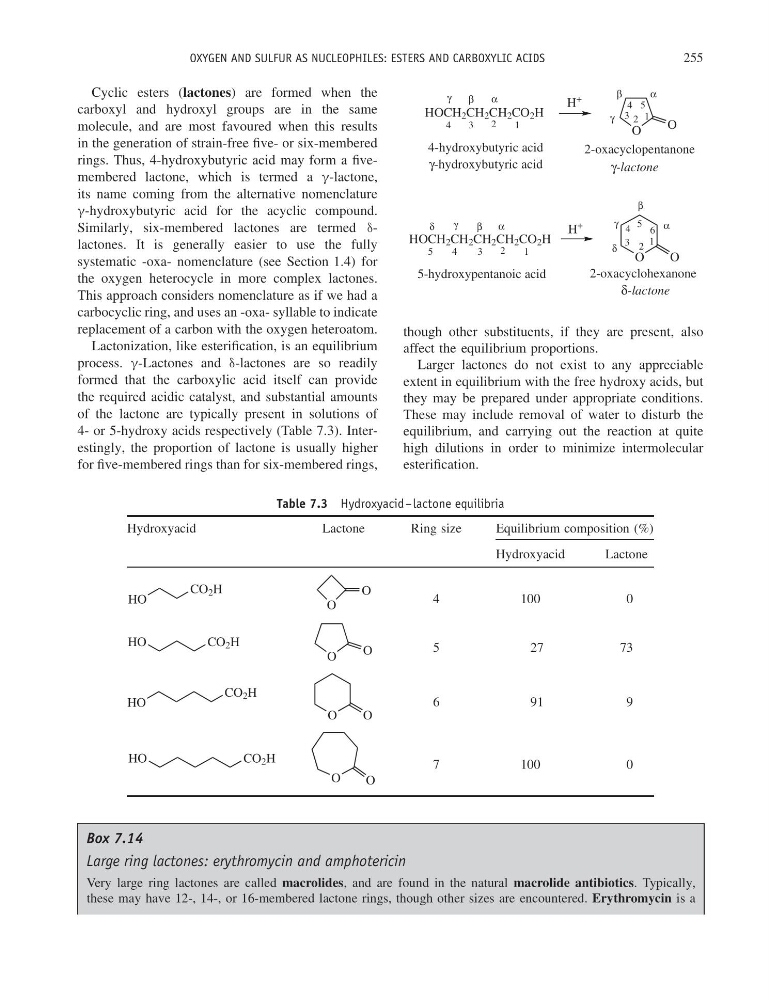
Cyclic esters (lactones) are formed when the
carboxyl and hydroxyl groups are in the same
molecule, and are most favoured when this results
in the generation of strain-free five- or six-membered
rings. Thus, 4-hydroxybutyric acid may form a fivemembered lactone, which is termed a γ-lactone,
its name coming from the alternative nomenclature
γ-hydroxybutyric acid for the acyclic compound.
Similarly, six-membered lactones are termed δlactones. It is generally easier to use the fully
systematic -oxa- nomenclature (see Section 1.4) for
the oxygen heterocycle in more complex lactones.
This approach considers nomenclature as if we had a
carbocyclic ring, and uses an -oxa- syllable to indicate
replacement of a carbon with the oxygen heteroatom.
Lactonization, like esterification, is an equilibrium
process. γ-Lactones and δ-lactones are so readily
formed that the carboxylic acid itself can provide
the required acidic catalyst, and substantial amounts
of the lactone are typically present in solutions of
4- or 5-hydroxy acids respectively (Table 7.3). Interestingly, the proportion of lactone is usually higher
for five-membered rings than for six-membered rings,
O
O
α
β
γ
β
γ
α
1
2
3
4
4-hydroxybutyric acid
γ-hydroxybutyric acid
2-oxacyclopentanone
1
2
3
5
4
O
O
2-oxacyclohexanone
γ-lactone
δ-lactone
α
β
γ
δ
1
2
3
5
4
6
α
β
γ
1
2
3
4
5-hydroxypentanoic acid
HOCH 2 CH 2 CH 2 CH 2 CO 2 H
5
δ
H
+
H
+
HOCH 2 CH 2 CH 2 CO 2 H
though other substituents, if they are present, also
affect the equilibrium proportions.
Larger lactones do not exist to any appreciable
extent in equilibrium with the free hydroxy acids, but
they may be prepared under appropriate conditions.
These may include removal of water to disturb the
equilibrium, and carrying out the reaction at quite
high dilutions in order to minimize intermolecular
esterification.
Table 7.3 Hydroxyacid–lactone equilibria
Hydroxyacid
Lactone
Ring size
Equilibrium composition (%)
Hydroxyacid
Lactone
HO
CO 2 H
O
O
4
100
0
HO
CO 2 H
O
O
5
2 7
7 3
HO
CO 2 H
O
O
6
9 1
9
HO
CO 2 H
O
O
7
100
0
Box 7.14
Large ring lactones: erythromycin and amphotericin
Very large ring lactones are called macrolides, and are found in the natural macrolide antibiotics. Typically,
these may have 12-, 14-, or 16-membered lactone rings, though other sizes are encountered. Erythromycin is a
255
Cyclic esters (lactones) are formed when the
carboxyl and hydroxyl groups are in the same
molecule, and are most favoured when this results
in the generation of strain-free five- or six-membered
rings. Thus, 4-hydroxybutyric acid may form a fivemembered lactone, which is termed a γ-lactone,
its name coming from the alternative nomenclature
γ-hydroxybutyric acid for the acyclic compound.
Similarly, six-membered lactones are termed δlactones. It is generally easier to use the fully
systematic -oxa- nomenclature (see Section 1.4) for
the oxygen heterocycle in more complex lactones.
This approach considers nomenclature as if we had a
carbocyclic ring, and uses an -oxa- syllable to indicate
replacement of a carbon with the oxygen heteroatom.
Lactonization, like esterification, is an equilibrium
process. γ-Lactones and δ-lactones are so readily
formed that the carboxylic acid itself can provide
the required acidic catalyst, and substantial amounts
of the lactone are typically present in solutions of
4- or 5-hydroxy acids respectively (Table 7.3). Interestingly, the proportion of lactone is usually higher
for five-membered rings than for six-membered rings,
O
O
α
β
γ
β
γ
α
1
2
3
4
4-hydroxybutyric acid
γ-hydroxybutyric acid
2-oxacyclopentanone
1
2
3
5
4
O
O
2-oxacyclohexanone
γ-lactone
δ-lactone
α
β
γ
δ
1
2
3
5
4
6
α
β
γ
1
2
3
4
5-hydroxypentanoic acid
HOCH 2 CH 2 CH 2 CH 2 CO 2 H
5
δ
H
+
H
+
HOCH 2 CH 2 CH 2 CO 2 H
though other substituents, if they are present, also
affect the equilibrium proportions.
Larger lactones do not exist to any appreciable
extent in equilibrium with the free hydroxy acids, but
they may be prepared under appropriate conditions.
These may include removal of water to disturb the
equilibrium, and carrying out the reaction at quite
high dilutions in order to minimize intermolecular
esterification.
Table 7.3 Hydroxyacid–lactone equilibria
Hydroxyacid
Lactone
Ring size
Equilibrium composition (%)
Hydroxyacid
Lactone
HO
CO 2 H
O
O
4
100
0
HO
CO 2 H
O
O
5
2 7
7 3
HO
CO 2 H
O
O
6
9 1
9
HO
CO 2 H
O
O
7
100
0
Box 7.14
Large ring lactones: erythromycin and amphotericin
Very large ring lactones are called macrolides, and are found in the natural macrolide antibiotics. Typically,
these may have 12-, 14-, or 16-membered lactone rings, though other sizes are encountered. Erythromycin is a