

248
NUCLEOPHILIC REACTIONS OF CARBONYL GROUPS
nucleophilic attack
on to carbonyl
O
N
H
N
H
N
enamine formation
– H 2 O
α β
no proton on N;
therefore, lose proton
from β-position
enamine
N
O
H
N
HO
N
H 2 O
− H +
H +
secondary amine
loss of leaving
group
7.8 Nucleophilic substitution on
carbonyl groups: carboxylic acid
derivatives
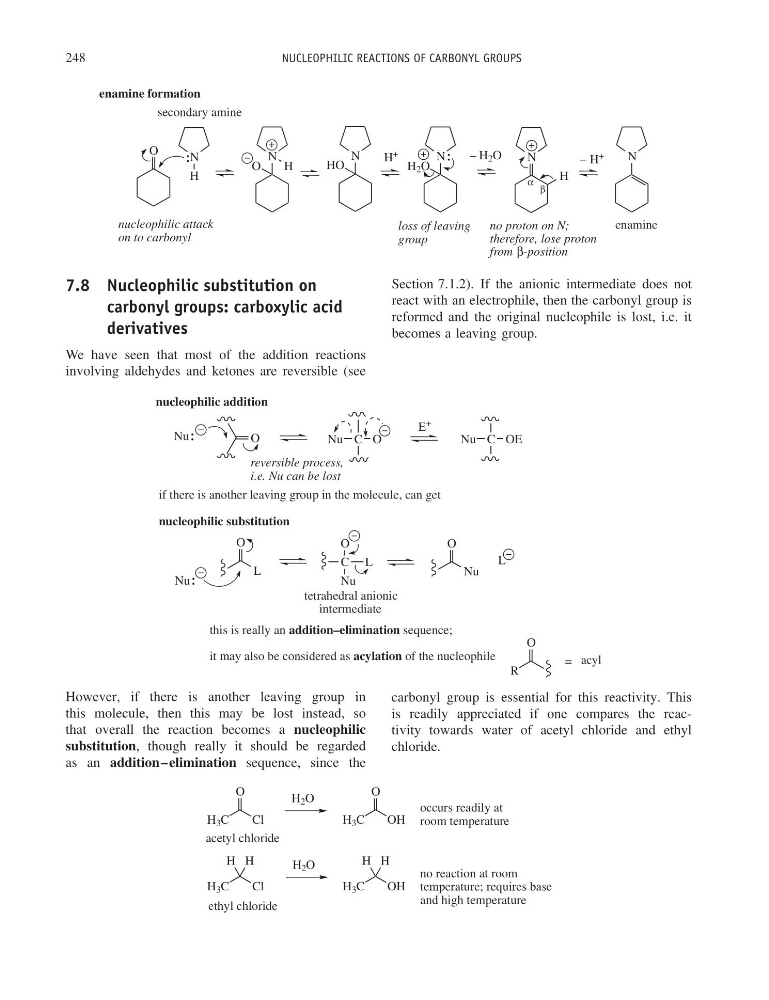
We have seen that most of the addition reactions
involving aldehydes and ketones are reversible (see
Section 7.1.2). If the anionic intermediate does not
react with an electrophile, then the carbonyl group is
reformed and the original nucleophile is lost, i.e. it
becomes a leaving group.
O
Nu C O
Nu C OE
O
L
O
C L
Nu
O
Nu
nucleophilic addition
Nu
if there is another leaving group in the molecule, can get
nucleophilic substitution
reversible process,
i.e. Nu can be lost
E +
Nu
L
this is really an addition–elimination sequence;
it may also be considered as acylation of the nucleophile
=
O
R
tetrahedral anionic
intermediate
acyl
However, if there is another leaving group in
this molecule, then this may be lost instead, so
that overall the reaction becomes a nucleophilic
substitution, though really it should be regarded
as an addition–elimination sequence, since the
carbonyl group is essential for this reactivity. This
is readily appreciated if one compares the reactivity towards water of acetyl chloride and ethyl
chloride.
O
H 3 C
Cl
O
H 3 C
OH
no reaction at room
temperature; requires base
and high temperature
occurs readily at
room temperature
acetyl chloride
ethyl chloride
H 3 C
OH
H H
H 3 C
Cl
H H
H 2 O
H 2 O
NUCLEOPHILIC REACTIONS OF CARBONYL GROUPS
nucleophilic attack
on to carbonyl
O
N
H
N
H
N
enamine formation
– H 2 O
α β
no proton on N;
therefore, lose proton
from β-position
enamine
N
O
H
N
HO
N
H 2 O
− H +
H +
secondary amine
loss of leaving
group
7.8 Nucleophilic substitution on
carbonyl groups: carboxylic acid
derivatives
We have seen that most of the addition reactions
involving aldehydes and ketones are reversible (see
Section 7.1.2). If the anionic intermediate does not
react with an electrophile, then the carbonyl group is
reformed and the original nucleophile is lost, i.e. it
becomes a leaving group.
O
Nu C O
Nu C OE
O
L
O
C L
Nu
O
Nu
nucleophilic addition
Nu
if there is another leaving group in the molecule, can get
nucleophilic substitution
reversible process,
i.e. Nu can be lost
E +
Nu
L
this is really an addition–elimination sequence;
it may also be considered as acylation of the nucleophile
=
O
R
tetrahedral anionic
intermediate
acyl
However, if there is another leaving group in
this molecule, then this may be lost instead, so
that overall the reaction becomes a nucleophilic
substitution, though really it should be regarded
as an addition–elimination sequence, since the
carbonyl group is essential for this reactivity. This
is readily appreciated if one compares the reactivity towards water of acetyl chloride and ethyl
chloride.
O
H 3 C
Cl
O
H 3 C
OH
no reaction at room
temperature; requires base
and high temperature
occurs readily at
room temperature
acetyl chloride
ethyl chloride
H 3 C
OH
H H
H 3 C
Cl
H H
H 2 O
H 2 O